Ontologization as a Fundamental Epistemic Operation
Functional Stabilization, Intersubjectivity, and Malfunction
Abstract
This paper reconstructs ontologization functionally as a fundamental epistemic operation. Ontologization is not understood as a metaphysical statement about what exists, but as a specific form of functional stabilization through which finite cognitive systems transform a dynamic field of experience into identifiable, available for take-up, and referentially available units of reference. In the sense of Epistemics, ontologization is therefore to be understood as a cross-domain operative achievement of cognition under finite conditions. Finitude here designates the structural lack of fully available order. Ontologization as an operation is not confined to a single domain; its concrete conditions of stability, validity, and revision, however, are determined in domain-specific ways. Ontologization therefore does not generate truth about an independent reality, but rather the stable forms of reference within which perception, memory, expectation, action, and later truth claims first become possible. The analysis traces this operation from individual enactment to intersubjective stabilization. The transition from individual to intersubjective ontologization is reconstructed through joint attention and shared reference and is clarified by means of declarative pointing as a paradigmatic marker of this threshold. Language then appears as a secondary but powerful layer of fixation: it does not generate minimal ontologization from nothing, but condenses and extends existing references, preserves them across situations, and changes their conditions of revision. Against this background, the paper defines the malfunction of ontologization as absolutization, in which functional posits are misunderstood as final descriptions of reality. Ontologization thus proves to be at once a cross-domain enabling condition of cognition, a constitutive operation of shared epistemic reality, and a structural source of epistemic entrenchment.
Keywords
Ontologization; Epistemics; epistemic stabilization; referential units; intersubjectivity; shared reference; declarative pointing; linguistic fixation; absolutization; malfunction; ontology; epistemology
1. The Gap of Ontologization
The philosophical engagement with ontology belongs to the oldest and at the same time most controversial traditions of thought. Since antiquity, thinkers have disputed what exists, in what sense it exists, and how being can be distinguished from mere appearance. In modernity, this debate increasingly shifts onto epistemological and philosophy-of-language levels. Ontological assumptions are either critically deconstructed or defended as indispensable presuppositions of rational cognition of the world. What is striking, however, is that these discussions often concern ontologies as results or contents, not the underlying process by which they arise.
The perspective pursued here stands close to classical questions concerning the conditions of experience, objecthood, language, and intersubjectivity, as they become visible, for example, in Kant, Husserl, Wittgenstein, Mead, and in more recent work on joint attention and shared intentionality (Kant 1998; Husserl 1970; Wittgenstein 1953; Mead 1934; Tomasello 1999, 2008). It does not, however, adopt these approaches as the starting point of a transcendental doctrine of categories, a phenomenological analysis of constitution, a theory of language games, or a developmental-psychological origin thesis. The independent contribution of this work lies instead in reconstructing ontologization as the functional stabilization of referentially available units of reference: as the operation through which finite cognitive systems stabilize dynamic experience in such a way that perception, memory, action, shared reference, and later truth claims become possible.
What is largely missing is a systematic investigation of ontologization itself, that is, of the epistemic operation through which a cognitive system generates stability in order to remain capable of acting and remaining connectable under finite conditions. Ontologization is understood here neither as an independent ontological access nor as an alternative theory of reality, but as a specific form of functional stabilization through which units of reference can be treated as identifiable, available for take-up, and capable of reference. The focus is therefore not on ontological contents or results, but on the operative achievement through which something becomes available as a stable point of reference. In this sense, ontologization is not a competitor to ontology, but an epistemic presupposition that allows ontological commitments to become effective at all.
In the sense of Epistemics, ontologization is therefore to be understood as a cross-domain operative achievement of cognition under finite conditions. Finitude here designates the structural lack of fully available order, because of which cognitive systems must distinguish, stabilize, and take up again. Ontologization as an operation is not confined to a single domain; its concrete conditions of stability, validity, and revision, however, are determined in domain-specific ways. Ontologization fulfills this function by transforming fleeting, context-dependent relations of experience into units of reference that can be treated as sufficiently stable. This stabilization is not a copy of an independent reality, but an operative presupposition of cognition itself. The analysis therefore presupposes no immediate access to a prior outside, but remains within a cognition-relative limit of positive determinability (Rapp 2026d).
The philosophical problem of ontology does not arise from this functionality, but from its misrecognition. Historically, ontological commitments have often been understood as knowledge claims about being, not as results of epistemic stabilization. As a result, both their achievements and their systematic risks fall out of view. In particular, it remains unclear why ontological commitments are indispensable on the one hand, yet on the other can lead to dogmatic blockages, excessive truth claims, and ideological hardenings.
A central aim of this work is therefore to reconstruct ontologization functionally, not metaphysically. This requires a shift in the guiding question: the central question is not “What is?” but “What stabilization must a cognitive system accomplish in order to be able to operate at all?” Ontology is not abolished by this move; it is returned to its epistemic role.
A special focus lies on the transition from individual to intersubjective ontologization. While individual ontologization is already required for perception, memory, and action, its structure changes fundamentally as soon as it is socially shared. Intersubjective stabilization increases the reach, duration, and social binding force of ontological posits. This condensation is highly effective in terms of epistemic economy, but it also carries an increased potential for malfunction.
To analyze this transition precisely, a paradigmatic case will be drawn on in what follows: social, more specifically declarative, pointing. Pointing is understood here not as the origin of intersubjective ontologization, but as an especially clear marker of an epistemic threshold at which ontologization becomes intersubjectively addressable. Through pointing, one actor can make something available to another as a shared point of reference even before language fixes this reference. This makes visible a level on which actors treat one another not merely as reaction systems, but as epistemic systems that themselves stabilize units of reference. “Meta-ontologization” here does not designate conceptual reflection on ontology, but the pre-linguistic operative addressing of the other as a system whose stabilization is relevant for shared orientation.
The guiding thesis of this work is therefore: Ontologization is a functionally necessary epistemic relief operation whose intersubjective stabilization enables cognition, while at the same time generating the structural possibility of its malfunction. Declarative pointing marks not the origin of this transition, but a point at which intersubjective meta-ontologization becomes especially clearly reconstructible. It thereby makes visible the epistemic structure from which both productive achievements of stabilization and later malfunctions can develop.
2. Ontologization as a Fundamental Epistemic Operation
In what follows, ontologization does not designate a metaphysical act of world-description, but a fundamental epistemic operation through which a cognitive system stabilizes its experiential world in such a way that something becomes available as an identifiable and available for take-up “something.” In the sense of Epistemics, this is a cross-domain form of functional stabilization under finite conditions (Rapp 2026b). Ontologization as an operation is not confined to a single domain; its concrete validity, form of stability, and revisability, however, are determined in domain-specific ways. Not every stabilization is already ontologization, but only that stabilization through which units of reference can be treated as identical, distinguishable, and capable of reference. Ontologization thereby enables perception, memory, expectation formation, and action, because it transforms dynamic experience into points of reference that a system can access again. It is therefore not the result of reflected theory, but part of the operative structure of cognition under finite conditions. It does not describe properties of the world in itself, but an epistemic achievement without which ongoing cognition would not be possible.
Cognitive systems face a basic problem: their experience is dynamic, context-dependent, and highly variable, while their processing resources are limited. Ontologization functions here as a relief mechanism by reducing change, enabling recognizability, and stabilizing relations of experience so that they can be taken up again. It does not necessarily transform a continuous field of experience into rigid things, but into units of reference treated as stable: objects, properties, relations, events, roles, or processual relations. These units of reference need not in fact be invariant. It is enough that they can functionally be treated as if they remained sufficiently identical to enable orientation, comparison, and action.
The term “finite cognitive systems” is meant neutrally here. It does not commit the analysis to a specific naturalistic theory, but first designates the structural circumstance that cognition does not proceed from fully available order. A finite cognitive system must select, distinguish, stabilize, and take up again because its experiential world is not already available as a completely ordered unity. Time, attention, perspective, and action are, in this sense, derivative forms in which this structural limitation becomes epistemically effective. Ontologization is therefore necessary not as a metaphysical law and not as a statement about the world in itself, but functionally: without minimal stabilization of units of reference available for take-up, a finite cognitive system could not compare experiences, form expectations, or coordinate actions.
It is therefore decisive that ontologization must not be confused with truth. It is not a statement about how the world is constituted independently of the knowing system. Rather, it is an operative simplification that allows the system to form expectations, plan actions, and relate experiences to one another. Ontologization is therefore not a goal of cognition, but an enabling condition of cognition. It does not generate truth, but the stable forms of reference within which truth claims can first be formulated, tested, or corrected.
This stabilization initially takes place implicitly. In its enactment, the cognitive system does not distinguish between “ontologically posited” and “epistemically constructed.” For the system itself, ontological units simply appear as given. Precisely this unobtrusiveness makes ontologization so effective. It continuously reduces the burden of comparison, integration, and decision without having to appear as a distinct operation.
Ontologization is not a singular act, but an ongoing process. It is constantly confirmed, corrected, or adjusted without requiring explicit reflection. Stability is always relative, context-bound, and provisional, even when it is experienced in enactment as self-evident. Ontological units are therefore not to be understood as fixed structures, but as stabilized patterns of expectation and reference that carry only as long as they enable orientation, comparison, and connectability.
It is important that ontologization is already unavoidable at the level of individual cognition. Even simple perceptual achievements presuppose that something is treated as “the same,” although sensory data are continuously changing. Memory requires the assumption of temporal identity; action requires the assumption of sufficient stability in situations, bodies, objects, or relations. Ontologization here is not an additional theoretical achievement, but the condition under which perception, memory, and action can be integrated at all.
Ontologization becomes philosophically problematic only when it is detached from its functional role. If ontological stabilization is no longer understood as an epistemic necessity under finite conditions, but is interpreted as a copy of an independent reality, a categorical shift occurs. An operative simplification becomes an ontological assertion. This shift forms one starting point of metaphysical ontology formation, but at the same time explains its susceptibility to dogmatization.
For the further argument, then, the following must be maintained: Ontologization is a structurally necessary epistemic operation, not a contingent cultural practice. Its necessity lies in its function for finite cognitive systems, which do not find order fully given, but must first stabilize it under conditions of structural lack; it does not lie in a metaphysical access to being itself. It is neither true nor false, but functional or malfunctioning. Its capacity is evident in the stabilization of cognition; its problem lies in the tendency toward absolutization. Both aspects, however, can be understood only if ontologization is grasped not as content, but as operation.
With this functional determination, the framework is also set for analyzing the transition from individual to intersubjective ontologization. For while ontological stabilization is already indispensable at the individual level, its epistemic dynamics change fundamentally as soon as stabilized units of reference are socially shared, mutually expected, and jointly correctable.
The following figure summarizes this basic structure and shows how ontologization, as a cross-domain operation, assumes different forms of stability and strain.
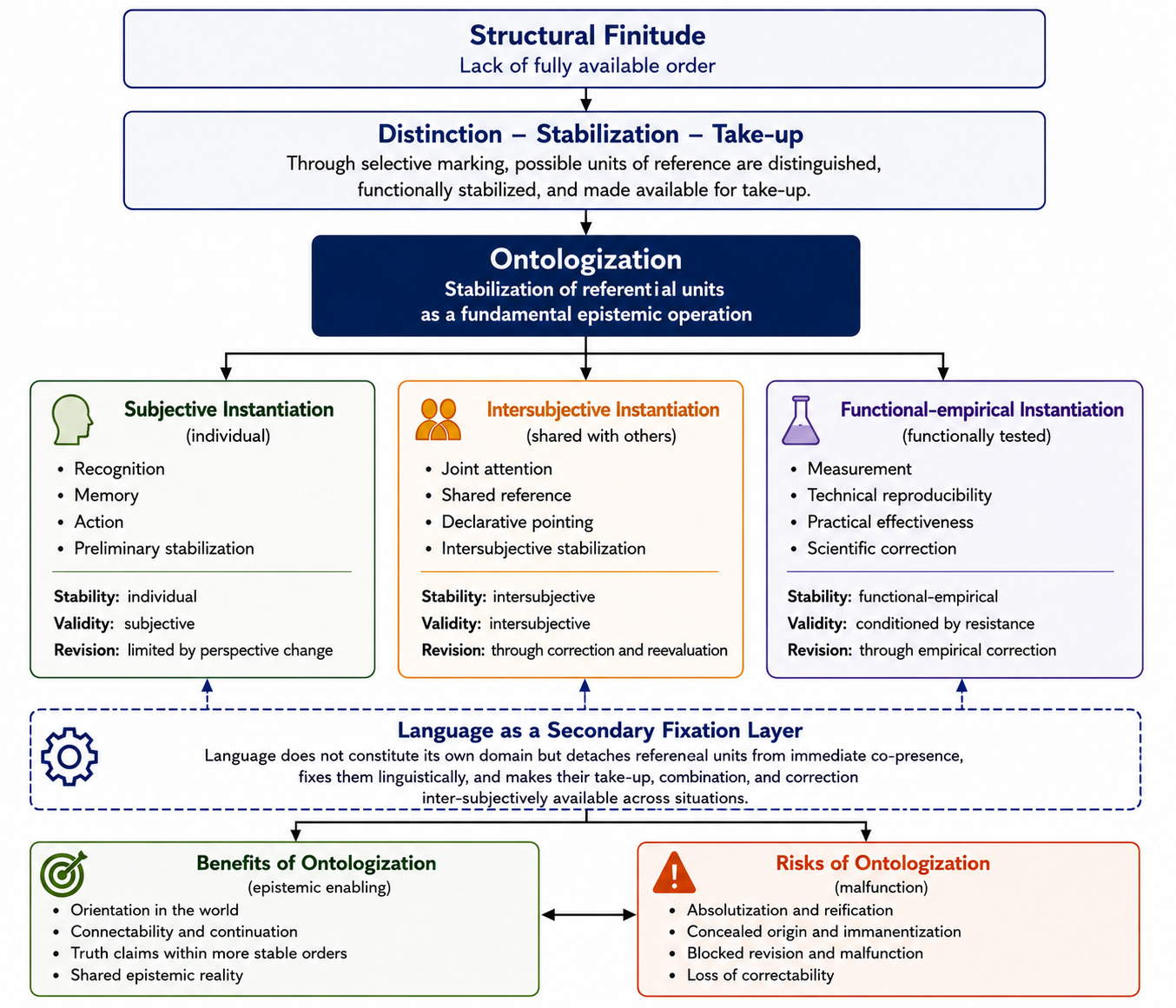
3. From the Individual to the Intersubjective
Ontologization is initially an individual epistemic operation. It enables a cognitive system to stabilize its own experiential world and remain capable of action. This individual stabilization, however, is only the first step. As soon as several actors interact with one another, ontologization enters an expanded functional space. The operation itself remains the same, but its conditions of stability change: stabilized units of reference now provide orientation not only for a single system, but become coordinable, expectable, and correctable between several systems.
The analysis thereby moves into the area that, in the broader project framework, is understood as shared epistemic reality (Rapp 2026c). Ontologization, however, is not understood here as a replacement for shared epistemic reality, but as one of its constitutive operations. It builds on a more general reconstruction of the intersubjective domain as a space of take-up, conditionedness, and shared connectability (Rapp 2026a). Shared epistemic reality does not arise merely because several actors presuppose the same world, but because units of reference, expectations, and possibilities of correction are stabilized between them. Within this context, ontologization designates the operation through which something can become available as a shared point of reference in the first place.
The transition to intersubjectivity does not change the fundamental operation of ontologization, but it does change the character of its stabilization. Individual ontologization primarily serves the internal coherence of a system. Intersubjective ontologization, by contrast, fulfills an additional coordinating function. It allows several systems to attune their expectations to one another without having to renegotiate the entire experiential world each time. Ontological stabilization thereby becomes a social relief mechanism.
In social contexts, it is no longer enough that something be stable for one individual subject. It must be stabilizable and available for take-up in sufficiently similar ways for several actors. This sameness is not a metaphysical identity, but a practical correspondence in enactment. Ontological referential units now function as shared points of reference by which expectations, actions, and reactions can be oriented.
This process is initially neither explicit nor reflective. Intersubjective ontologization does not necessarily arise through conscious agreement, but through repeated successful coordination. What proves itself in enactment is stabilized; what fails is adapted or discarded. In this way, what emerges is not a social ontology in the metaphysical sense, but an intersubjectively stabilized space of reference that is made durable through success, repetition, and correction.
With intersubjective stabilization, the cost structures of ontologization also change. On the one hand, coordination costs decrease considerably. Shared ontological points of reference allow rapid understanding, predictable behavior, and shared expectations. On the other hand, the costs of revision increase. The more strongly ontological posits are socially anchored, the more effort their correction requires. Deviations must be explained, justified, or socially processed.
This shift marks a decisive epistemic turning point. Ontological stabilization gains reach and duration, but at the same time loses flexibility, because deviations can now no longer be corrected merely individually, but require processes of social attunement. What could previously occur as functional adjustment becomes more demanding intersubjectively, since shared points of reference bundle and stabilize expectations. Ontologization thereby acquires no normative validity in an independent sense, but rather an increased binding force that results from the rising effort required for its revision. The epistemic dynamic therefore shifts not toward truth or obligation, but toward growing stabilization costs.
It is important that this transition is not bound to language. Intersubjective ontologization can already begin where actors systematically attune their behavior to one another and develop stable expectations concerning shared points of reference. Language reinforces, fixes, and extends this process, but it is not its minimal presupposition. Rather, language presupposes that something can already become available between actors as a unit of reference capable of take-up.
This raises the question of how this transition becomes epistemically graspable. If individual ontologization remains implicit and intersubjective stabilization is at first gradual, a point is needed at which the shared structure of this development becomes explicitly visible. What is at stake here is not an absolute origin of intersubjectivity, but the reconstruction of a threshold at which individual stabilization becomes graspable as shared reference. To determine this point precisely, it is first necessary to clarify the minimal conditions of intersubjective coupling. These lie in the area of joint attention and shared reference.
4. Joint Attention and Reference
Before ontologization becomes intersubjectively explicit, a minimal form of epistemic coupling must be established between actors. This coupling does not yet lie in shared beliefs or linguistic meanings, but first in the coordination of attention. Joint attention forms the basic structure in which individual ontologizations can first be related to one another without already being fully stabilized as shared reference.
Joint attention is not merely a psychological phenomenon, but an epistemic operation through which several actors relate their respective relevance structures to one another. It marks what is currently significant for a cognitive system and becomes intersubjectively effective as soon as another actor’s attention is treated as epistemically informative. In that case, a system no longer reacts merely to stimuli or events, but to the directed world-relation of another actor. Joint attention thereby forms a minimal coupling structure in which individual ontologizations can enter into relation with one another without already being expressly marked as shared reference.
The decisive point is the difference between mere co-orientation and shared reference. Co-orientation occurs when several actors happen to react, reactively or in parallel, to the same event. Shared reference, by contrast, presupposes that actors mutually treat their attentional behavior as an indication of a shared world-relation. In that case, it is not merely that the same thing is perceived; rather, something becomes available as the same possible point of reference.
This distinction is epistemically central. Joint attention alone does not yet guarantee intersubjective ontologization. Only when attention is not merely adopted, but understood as an indication of a possible shared point of reference, does a shared frame of reference emerge. The actor then orients not only to the behavior of the other, but to that to which this behavior refers. This implicitly acknowledges that the other’s perception is not accidental, but organized in relation to the world.
In this mode, ontologization begins to become intersubjectively effective. The relevant unit of reference is no longer stabilized merely individually, but treated as a potentially shared point of reference. This process, however, initially remains implicit. There is as yet no explicit marking of what is being shared and no express addressing of the other as an epistemic actor. Shared reference arises here in enactment, not through declarative positing.
Joint attention is therefore a necessary, but not sufficient, condition of intersubjective ontologization. It makes it possible for individual ontologizations to be attuned to one another without already making them explicit. The epistemic status of the participating actors initially remains underdetermined. They react to one another and to shared points of reference without expressly addressing one another as bearers of their own stabilizations of world.
Precisely this underdetermination makes joint attention epistemically efficient. It allows flexible adjustment and situational coordination without the costs of explicit understanding. At the same time, it marks the limit of this efficiency. As long as reference is only implicitly shared, it remains unclear whether the same ontological referential unit is actually meant or whether there is merely a temporary overlap of attention.
To overcome this ambiguity, language is not required, but an operation is needed at which shared reference becomes explicitly markable. Such an operation must be possible pre-linguistically and at the same time contain a clear epistemic addressing. It is precisely at this point that social, more specifically declarative, pointing can be drawn on as a paradigmatic case. It functions not as the origin of intersubjective ontologization, but as an explicit marker of an epistemic threshold at which ontologization is no longer merely coordinated, but intersubjectively addressed.
5. Pointing as a Paradigmatic Marker of Intersubjective Meta-Ontologization
Social pointing is not to be understood in this context as the exact point of origin of intersubjective meta-ontologization. Nor is every form of attention-directing or imperative pointing meant, such as can also be observed in non-human animals. Rather, the focus is on declarative pointing in the narrower sense: an act in which one actor makes something available to another as a shared point of reference. Pointing is therefore not asserted here as the empirical origin of intersubjectivity, but as a paradigmatic case in which the structure of intersubjective ontologization can be reconstructed with particular clarity. It is not ruled out that corresponding epistemic structures are already effective before explicit pointing or occur in subtler forms. Pointing instead functions as an explicative marker at which it becomes visible how individual stabilization can pass into shared reference. This analysis connects with research on joint attention, shared intentionality, and declarative pointing, but uses pointing here primarily in a conceptual-functional way: it does not serve as a complete empirical origin thesis of intersubjectivity, but as an especially clear case in which the structure of explicit shared reference can be reconstructed (Tomasello 1999, 2008).
Finger pointing may count as the simplest and most intuitive example of pointing, but it does not exhaust the meaning of pointing. Pointing here is neither a purely motor gesture nor a merely primitive precursor of linguistic communication. The term is understood functionally: it designates any pre-linguistic or pre-conceptual marking operation through which one actor makes something available to another as a possible shared point of reference. This marking may occur through finger pointing, gaze direction, bodily orientation, facial emphasis, bodily movement, or also through basic vocal sounds, provided these do not yet function as linguistically fixed concepts. What is decisive is not the concrete form of expression, but the declarative structure of shared reference contained in it: something is not merely indicated to another, but made accessible as a possible shared point of reference. Understood epistemically, pointing directs another toward a particular world-relation because this world-relation is to be treated as jointly relevant.
This structure presupposes several conditions at once. First, what is pointed to must be treated as an ontologically stabilized unit of reference. It is not enough that a stimulus be present; it must function as an identifiable and available for take-up point of reference. Second, the other actor must be addressed as a bearer of their own perception, expectation, and meaning formation. Pointing is not directed merely at a reaction system, but at an epistemic system. Third, pointing contains a meta-expectation: I expect not only that you perceive something, but that you understand what I am referring to and that this reference can become coordination-relevant for both of us.
In this interplay, a new level of ontologization becomes visible. Ontological stabilization is no longer enacted merely individually, but addressed intersubjectively. The other is treated as someone who themselves stabilizes units of reference and whose stabilization is relevant for one’s own epistemic orientation. It is precisely this operative addressing of the other as a co-stabilizing cognitive system that is here designated as intersubjective meta-ontologization. This does not mean conceptual reflection on ontology, but a pre-linguistic structure of shared reference in which ontologization in the other is presupposed as coordination-relevant.
The epistemic content of pointing therefore lies not primarily in the transmission of information, but in the explicit establishment of shared reference. Pointing does not simply say “there is something there”; it makes something available as a possible shared point of reference. This shared reference is not absolute and not already theoretically grounded, but it is intersubjectively marked. It creates a frame of reference that goes beyond mere co-orientation and enables further stabilization.
It is important that this explicitness can be achieved without language. Pointing requires no concepts, no syntactic structure, and no propositional contents. Precisely for this reason, it is suited as an epistemic marker. It shows that minimal intersubjective ontologization need not arise from language, but can in a certain respect precede it. Language can extend, refine, correct, and fix shared reference; it does not first have to generate from nothing the fact that something can become available between actors as a shared point of reference.
At the same time, social pointing changes the dynamics of ontological stabilization. What is pointed to is not only individually perceived, but socially exposed. Deviations become visible, misunderstandings possible, corrections relevant. Ontologization thereby acquires a new robustness, but also a new vulnerability. It becomes a matter of shared expectation and possible correction, not merely of individual stabilization.
In this sense, pointing does not mark an absolute origin of intersubjectivity, but an especially clear point of epistemic explicitness. It makes visible what may already be present in subtler forms: cognition stabilizes not only individually, but can be intersubjectively coordinated, addressed, and corrected. With declarative pointing, this coordination becomes epistemically reconstructible as the establishment of shared reference, even before it is linguistically fixed.
6. Language as Secondary Fixation
The analysis of pointing makes clear that minimal intersubjective ontologization need not arise from language, but can in a certain respect precede it. Language does not first enter the scene where reference as such arises, but where already stabilized or stabilizable units of reference are taken up again, generalized, and made correctable across situations. Its epistemic function therefore does not lie in the origin of every ontologization, but in the fixation, extension, and reproducibility of already available referential structures.
Language stabilizes what can already become available as a shared point of reference in pre-linguistic or situational reference. While pointing enables a situationally bound establishment of shared reference, language allows this reference to be detached from the concrete situation. A point of reference need not be linguistically immediately present in order to be jointly treated, remembered, compared, or further processed. A single cognitive system can, of course, remember, imagine, compare, or combine units of reference even without language. Language, however, makes this capacity intersubjectively available: it allows units of reference to be jointly treated, repeated, corrected, and embedded in more stable orders, even when they are not jointly given in the current enactment or had not previously been jointly stabilized. Concepts function here as reusable markers of ontological referential units and preserve stabilization across time, context, and social reach. Ontologization is thereby not originally generated, but made durable, extended, and rendered connectable for more complex contexts.
This durability has considerable epistemic achievements. Linguistically fixed references allow ontological posits to be shared, reproduced, and embedded in complex contexts across situations. At the same time, this fixation changes the dynamics of revision. What is linguistically stabilized appears less provisional than what is shared only in situational enactment. The possibility of adjustment remains in principle intact, but with increasing linguistic hardening it becomes more demanding. Language therefore increases not only the reach of ontological stabilization, but also changes its conditions of revision.
In relation to philosophy-of-language approaches that understand meaning essentially through use, rule contexts, and social practice, it would be too weak to treat language merely as a subsequent label attached to already finished ontologies (Wittgenstein 1953). For complex, theoretical, institutional, and scientific ontologies, language can itself become constitutive, because it not only names units of reference, but stabilizes, differentiates, connects them, detaches them from immediate co-presence, and transfers them into intersubjectively workable orders. Language is therefore secondary not in the sense of mere externality, but only in relation to the minimal possibility of shared reference. Once this possibility is given, language can considerably condense ontologization and bring forth new forms of ontological stabilization.
At the same time, language changes the status of ontological stabilization. What is linguistically fixed appears less provisional than what is shared only in enactment. Concepts stabilize duration, repeatability, and social connectability and can thereby generate the impression of independence from the respective act of cognition. Ontological referential units thus gain an apparent objectivity that points beyond their functional role. This shift touches the area of immanentization without being identical to it: linguistic fixation makes units of reference repeatable and socially available; immanentization begins where stabilized order becomes so much a latent presupposition of further orientation that its operative origin is no longer carried along.
This shift is epistemically ambivalent. On the one hand, it enables science, institutions, and complex social orders. On the other hand, it can obscure the operative origin of ontological posits. Language does not simply make ontologization invisible, but it can stabilize its results in such a way that they appear as self-evident components of the world. What originally arose as functional stabilization is then no longer recognized as a posit in epistemic enactment, but is further used as a given order.
It is therefore important to understand language neither as an epistemic origin nor as a merely external supplementary layer. It condenses intersubjective ontologization, increases its reach, expands its workability, and changes its conditions of revision. It thereby strengthens both the capacity and the malfunction potential of ontological structures. Its effect does not consist in generating ontologization from nothing, but in stabilizing existing references and transferring them into more complex forms.
For the present argument, this means: the epistemic threshold does not lie in linguistic capacity itself, but in the prior capacity to make ontologization intersubjectively explicit or at least coordinable. Language is a continuation and condensation of this capacity, not its minimal condition. Only against this background can one understand why ontological malfunctions have historically often been identified with language, concepts, and theories, even though their origin lies deeper: language is not the origin of ontologization, but it is one of its most effective forms of stabilization and hardening.
Ontologization therefore does not end with the establishment of linguistic fixations. It continues at further levels, especially where linguistically stabilized references are transferred into explicit theoretical world-models. Ontological positions are, in this sense, not an alternative to ontologization, but highly stabilized continuations of the same epistemic mechanism, with correspondingly increased reach and increased malfunction potential.
The next question, therefore, is not whether ontologization is necessary, but under what conditions it loses its functional role. This question leads to the systematic analysis of the malfunction of ontologization, which can arise not despite, but because of its intersubjective and linguistic stabilization.
7. The Malfunction of Ontologization
Ontologization is a necessary epistemic operation. Precisely for this reason, its malfunction is not an external disturbance, but a structurally possible consequence of its success. Ontologization does not become problematic because it takes place, but because its functional character is obscured or misrecognized. The central dysfunctional form investigated here is absolutization: epistemic stabilization no longer appears as provisional reference, but as a final description of what really is.
Functionally understood, ontologization serves the reduction of complexity. It stabilizes relations of experience in order to enable perception, memory, expectation, and action. This stabilization is always context-dependent, limited, and in principle revisable, even when it is experienced in enactment as self-evident. In this sense, ontologization is a means of epistemic orientation, not its final goal.
The malfunction begins when this character as a means becomes invisible. Ontological posits are then no longer treated as functional stabilizations, but as final descriptions of reality. Adjustments no longer appear as corrections of limited stabilization, but as challenges to what counts as real. Epistemic stabilization thereby blocks precisely the adaptive capacity whose enabling was its original function, and it tips from a relief operation into a source of epistemic rigidity.
This absolutization is not merely an individual error, but can be reinforced through intersubjective, linguistic, and institutional stabilization. The more strongly ontological posits are socially shared, linguistically fixed, and institutionally anchored, the higher the costs of their revision become. Deviations then no longer appear as indications of limited stabilization, but as errors, mistakes, or threats to the shared order. Ontologization thereby acquires no normative validity in an independent sense, but a social binding force that makes its correction more difficult.
This dynamic becomes especially clear in connection with language. Linguistically fixed ontologies can appear independent of their context of emergence. Concepts stabilize duration, repeatability, and social connectability; precisely for that reason, they can obscure the operative origin of ontological posits. Here linguistic fixation touches the area of immanentization: stabilization is carried along so self-evidently that it no longer remains visible as an operation of its own. Malfunction, however, arises only where this obscured stabilization is no longer held open to revision, but appears as a final order of reality.
The malfunction therefore does not simply consist in ontological stabilization going “too far.” It consists in stabilization no longer being recognized as stabilization. The cognitive system loses the ability to distinguish between functional posit and ontological assertion. Revision is no longer understood as the adjustment of a limited frame of reference, but experienced as a challenge to reality itself.
It is important that this malfunction cannot be avoided by renouncing ontologization. Such a system would not be capable of action. The alternative to the absolutization of ontological posits is therefore not their abolition, but their functional reinterpretation and controlled revisability (Rapp 2026e). Ontologies must be understood as what they epistemically are: provisional, context-dependent stabilizations with limited validity, whose load-bearing capacity must not be detached from their revisability.
The analysis of malfunction thus makes visible why ontology has historically been both indispensable and problematic. It explains why ontological systems can enable cognition and at the same time block it. This ambivalence is not a contradiction, but an expression of the same fundamental epistemic operation that acts functionally or malfunctioningly under different conditions.
This closes the argumentative circle: Ontologization is necessary, intersubjectively effective, linguistically intensifiable, and epistemically risky. Its productive and problematic sides, however, can be understood only if it is analyzed not as a metaphysical statement, but as an operation of finite cognitive systems.
8. Ontologization as Necessary and Risky Stabilization
The aim of the present work has been to reconstruct ontologization not as a metaphysical discipline, but as a fundamental epistemic operation. The point of departure was the observation that philosophical debates about ontology predominantly problematize its results, but not the process through which ontological stabilization comes about in the first place. This gap has been closed here through a functional analysis.
Ontologization was described as a necessary relief operation of finite cognitive systems. It stabilizes a dynamic experiential world by making units of reference available as identifiable, available for take-up, and capable of reference. This stabilization is not truth-capable in the classical sense, but functionally necessary under finite conditions. Ontologies, accordingly, are not immediate descriptions of an independent reality, but epistemic means for enabling perception, memory, expectation, action, and the later testing of truth claims.
A central result of the analysis is the distinction between individual and intersubjective ontologization. While individual ontologization primarily serves the internal coherence of a system, its structure changes fundamentally as soon as it is socially shared. Intersubjective stabilization increases the reach, duration, and social binding force of ontological posits, lowers coordination costs, but at the same time increases the costs of their revision. Ontologization thus becomes a constitutive operation of shared epistemic reality without being identical to it.
The transition to explicit intersubjectivity was clarified by means of social pointing. Pointing functions here not as the origin of intersubjective ontologization, but as a paradigmatic marker at which its structure becomes especially clearly reconstructible. In the establishment of shared reference, the other actor is addressed as an epistemic system that itself stabilizes units of reference. A level is thereby reached at which ontologization is no longer enacted merely individually, but intersubjectively addressed, prior to any linguistic fixation.
The analysis of language as a secondary layer of fixation showed that language does not generate minimal ontologization from nothing, but that it considerably condenses, extends, and makes it reproducible. Through concepts, ontological posits are detached from their context of emergence, generalized, socially preserved, and embedded in complex contexts. For theoretical, institutional, and scientific ontologies, language is therefore not merely external naming, but a central layer of stabilization. Precisely this achievement, however, contributes to obscuring the operative origin of ontological posits.
Against this background, the malfunction of ontologization could be defined precisely. It does not lie in the existence of ontological stabilization, but in its absolutization. When functional posits are misunderstood as final descriptions of reality, they block precisely those processes of adjustment and testing whose enabling was their original function. This malfunction is not an individual error, but can be systematically reinforced through intersubjective, linguistic, and institutional stabilization.
Overall, the work shows that ontologization is both indispensable and epistemically risky. It is a necessary stabilization under finite conditions, through which perception, memory, action, reference, and shared orientation first become possible. At the same time, this very stabilization generates the structural possibility of its malfunction when it is no longer understood as a provisional epistemic operation. Ontologization is therefore neither to be rejected nor absolutized, but to be taken seriously in its functional role. Only from this perspective can one explain why ontological posits can enable cognition and at the same time block it, without this being a contradiction.
The perspective developed here opens further questions. First, the relation between ontologization and immanentization must be determined more precisely: ontologization makes units of reference referentially available, while immanentization makes stabilized order so much a latent presupposition of further orientation that its operative origin is no longer carried along. Second, it must be clarified how ontological stabilization is changed in functional-empirical contexts under additional strain through measurement, experiment, technical reproducibility, practical efficacy, and scientific correction. The functional-empirical domain does not constitute a separate source of ontologization, but an additional level of testing and correction: ontological referential units must here prove themselves not only subjectively or intersubjectively, but under conditions of reproducible efficacy and correctable testing. Third, the question arises how ontological posits in shared epistemic realities can be historically made durable, institutionally secured, and made revisable again under rising costs of testing and correction.
In conclusion, ontologization is not a marginal topic of metaphysics, but a central component of epistemic architecture. Its explication is therefore not a special problem of philosophical theory, but a contribution to clarifying the conditions under which cognition, intersubjectivity, truth claims, and revision become possible at all.
Conceptual Canon of This Paper
Ontologization as a Fundamental Epistemic Operation
The following conceptual canon serves to stabilize central meanings within this text and makes no claim to completeness or final systematicity. Terms that are not listed here either do not belong to the functional core of this paper or are treated in separate works.
The conceptual canon is to be understood as an explicitly stabilized reference basis. It forms the point of departure for the conceptual work of this paper, but it is not rigid or dogmatic. Changes, precisions, or extensions of the canon are possible in principle, but they are subject to a strict condition: every deviation, modification, or extension of the canon must be explicitly indicated, locally limited, and justified. Implicit shifts in meaning, silent extensions, or retrospective reinterpretations are excluded.
Adoption of the Basic Canon of Epistemics
This paper adopts the conceptual canon defined in the foundational Epistemics paper, Epistemik – Modellmanagement unter endlichen Bedingungen, as an unchanged reference basis. The concepts introduced there are used without reinterpretation and without any implicit shift in their functional meaning. This paper introduces no divergent definitions of the adopted canonical concepts.
Canonical Deviations or Modifications
This paper introduces no deviations, modifications, or refinements of the basic canon of Epistemics. All adopted canonical concepts are used strictly in the sense of the foundational paper.
Ontologization-Specific Canonical Extensions
In addition to the adopted basic canon of Epistemics, this paper introduces several ontologization-specific concepts. These extensions do not change the meaning of the basic canon, but specify the functional analysis of epistemic stabilization in the transition from individual to intersubjective ontologization.
The term finitude is locally specified here following the basic canon of Epistemics: it designates the structural lack of fully available order, because of which cognitive systems must distinguish, stabilize, and take up again.
Ontologization
Short definition: Ontologization is a specific form of epistemic stabilization through which a finite cognitive system treats something as an identifiable, available for take-up, and referentially available unit of reference.
Function: It enables perception, recognizability, memory, expectation formation, and the capacity for action by transforming dynamic experience under conditions of structural finitude into stable points of reference.
Delimitation: Ontologization is not a metaphysical statement about being; it is not a criterion of truth and not an ontological status. Not every stabilization is already ontologization, but only that stabilization through which something becomes available as a unit of reference. Ontologization is cross-domain as an operation; its concrete form of stability, validity, and revisability, however, are determined in domain-specific ways.
Ontological Referential Unit
Short definition: An ontological referential unit is a unit of reference treated as stable that functions in epistemic enactment as identifiable, available for take-up, and referentially available.
Function: It carries reference, continuity of expectation, comparison, orientation, and coordination.
Delimitation: It is not a copy of an independent reality; it does not assert invariance; it is not limited to objects in the narrow sense. Properties, relations, events, roles, practices, or processual relations can also be ontologically stabilized.
Joint Attention
Short definition: Joint attention is the coordinated orientation of epistemic relevance between several actors.
Function: It enables the coupling of individual ontologizations as a condition of shared reference.
Delimitation: It is not identical with shared beliefs; it is not language-dependent; it is not yet fully developed shared reference.
Shared Reference
Short definition: Shared reference is the implicitly or explicitly established commonality through which something becomes available to several actors as the same point of reference.
Function: It stabilizes intersubjective coordination, stability of expectation, and shared correctability.
Delimitation: It is not metaphysical identity; it does not guarantee identical attributions of meaning; it is more than mere co-orientation.
Declarative Pointing
Short definition: Declarative pointing is a pre-linguistic or pre-conceptual marking operation through which one actor makes something available to another as a possible shared point of reference.
Function: It is a paradigmatic marker at which the structure of intersubjective ontologization becomes especially clearly reconstructible.
Delimitation: It is not the empirical origin of intersubjectivity; it is not mere attention-directing; it is not a primitive form of language. Finger pointing may count as the simplest example, but it does not exhaust the meaning of pointing. Pointing marks a threshold of epistemic explicitness without excluding the possibility that subtler forms of intersubjective ontologization are already effective beforehand.
Intersubjective Meta-Ontologization
Short definition: Intersubjective meta-ontologization is the operative addressing of the other as an epistemic system that itself stabilizes units of reference and whose stabilization is relevant for shared orientation.
Function: It makes visible that ontologization is not only enacted individually, but can be intersubjectively addressed and become coordination-relevant.
Delimitation: It is not theorizing about ontology; it is not conceptual self-reflection; it is not a necessary linguistic form. The term designates a local ontologization-specific extension and refers to a pre-linguistic structure of shared reference.
Linguistic Fixation
Short definition: Linguistic fixation is a secondary but powerful layer of stabilization through which ontological referential units are preserved, generalized, and made workable across situation and time.
Function: It increases the reach, duration, differentiability, social connectability, and reproducibility of ontological points of reference. It also enables the treatment of absent points of reference and the constructive linking of units of reference that are not jointly given in the current enactment.
Delimitation: Linguistic fixation is not the origin of minimal ontologization and not merely an external act of naming. Language can play a constitutive role in complex, theoretical, institutional, and scientific ontologies, but it does not generate the minimal possibility of shared reference from nothing. It makes individual combinatory capacities intersubjectively available without itself being the origin of every cognitive combination.
Immanentization in the Context of This Paper
Short definition: Immanentization does not designate the production of referentially available units of reference, but a state of stabilization in which stabilized order becomes the latent presupposition of further orientation.
Function: It marks a point of connection at which ontological stabilization is carried along so self-evidently that its operative origin is no longer explicitly visible.
Delimitation: Ontologization makes units of reference referentially available; immanentization makes stabilized order into the presupposed operating condition of further orientation. Linguistic fixation can prepare or touch immanentization, but it is not identical with it.
Absolutization
Short definition: Absolutization is a malfunctional form in which functional ontological posits are treated as final descriptions of reality.
Function: It is a diagnostic concept for blocked revision, epistemic entrenchment, and the loss of the distinction between functional posit and ontological assertion.
Delimitation: It is not a moral accusation; it is not merely strong stabilization; it is not a necessary consequence of every ontologization. Absolutization designates the dysfunctional form in which stabilization is no longer recognized as stabilization and is thereby no longer kept adequately revisable.
Canonical Status and Scope of Validity
The ontologization-specific concepts introduced in this paper constitute an explicit canonical extension of the framework of Epistemics. They are stabilized for the scope of validity of this paper and can be used as reference concepts in subsequent works, provided that their use is expressly indicated. Every future deviation, precision, or further extension is subject to the meta-rule of canonical development established in the foundational Epistemics paper. Implicit shifts in meaning or informal canonical extensions are excluded.
Literature
Husserl, Edmund. 1970. The Crisis of European Sciences and Transcendental Phenomenology. Translated by David Carr. Evanston, IL: Northwestern University Press.
Kant, Immanuel. 1998. Critique of Pure Reason. Translated and edited by Paul Guyer and Allen W. Wood. Cambridge: Cambridge University Press. Originally published 1781/1787.
Mead, George Herbert. 1934. Mind, Self, and Society. Edited by Charles W. Morris. Chicago: University of Chicago Press.
Rapp, Stefan. 2026a. The Intersubjective Domain: Intersubjective Conditionality, Take-Up, and Shared Connectability under Finite Conditions. Zenodo. https://doi.org/10.5281/zenodo.20313954.
Rapp, Stefan. 2026b. Epistemics: Model Management Under Finite Conditions. Zenodo. https://doi.org/10.5281/zenodo.18441326.
Rapp, Stefan. 2026c. Shared Epistemic Reality: Intersubjective Stabilization, Reference, and Validity under Finite Conditions. Zenodo. https://doi.org/10.5281/zenodo.20353838
Rapp, Stefan. 2026d. Realism Without an Outside: Cognition-Relative Realism and the Limit of Positive Determinability. Last revised May 9, 2026. Zenodo. https://doi.org/10.5281/zenodo.20107915.
Rapp, Stefan. 2026e. Revision under Finite Conditions: A Theory of Model Transformation in Epistemics. Zenodo. https://doi.org/10.5281/zenodo.18935928.
Tomasello, Michael. 1999. The Cultural Origins of Human Cognition. Cambridge, MA: Harvard University Press.
Tomasello, Michael. 2008. Origins of Human Communication. Cambridge, MA: MIT Press.
Wittgenstein, Ludwig. 1953. Philosophical Investigations. Translated by G. E. M. Anscombe. Oxford: Blackwell.
Didactic Appendix: Examples of Ontologization
The following examples serve exclusively for illustration. They are not additional proofs of the theory developed in the main text and do not replace systematic argumentation. Their purpose is to make the abstract concepts of the paper intelligible through simple cases: ontologization as the stabilization of referentially available units of reference, intersubjective ontologization as shared reference, linguistic fixation as durability, and absolutization as a possible malfunction.
A.1 The Stone on the Path
A cognitive system perceives a stable unit of reference within a changing perceptual field: a stone on the path. Sensorily, this stone is constantly changing. It appears differently from different angles, is lit differently, lies partly in shadow, or is registered only at the edge of the visual field. Nevertheless, it is treated as “the same stone.”
This is precisely where a simple form of ontologization lies. The system stabilizes a dynamic sequence of experience into a unit of reference available for take-up. The stone need not be metaphysically known as a thing in itself. It is enough that it is functionally treated as sufficiently identical to enable orientation and action: one can avoid it, pick it up, or recognize it later.
This example shows ontologization at the subjective level. It does not generate a statement about the being of the stone independently of the cognitive system, but makes available a stable unit of reference by which perception, memory, and action can be oriented.
A.2 Declarative Pointing
A child points to a bird in the sky. The child does not merely want to trigger a reaction and does not simply want to force attention. The child makes something available to another as a shared point of reference: “Look, that there.”
More happens here than mere attention-directing. The child treats the other as an epistemic system that can also see something, recognize it again, and take it up as a shared point of reference. The bird is not only individually perceived, but intersubjectively addressed.
This example shows why declarative pointing is understood in the paper as a paradigmatic marker. It is not the origin of intersubjectivity and not proof of its emergence. But pointing makes especially clear how individual stabilization can pass into shared reference.
A.3 The Name “Dog”
A child repeatedly sees a certain animal and learns the word “dog.” Through the word, the unit of reference is not first generated from nothing. Even before that, the animal could be seen, followed, recognized, or distinguished from other things. Language, however, changes the stabilization.
The concept “dog” makes the reference repeatable, transferable, and socially connectable. Different animals can be gathered under a shared designation. Other actors can correct: “That is not a dog; that is a wolf.” Ontologization is thereby linguistically fixed and at the same time kept revisable.
This example shows the double role of language. It is not the origin of minimal ontologization, but it considerably condenses and extends it. It makes units of reference available across situations and thereby enables more complex orders, corrections, and shared distinctions.
A.4 A Social Role: “Teacher”
A person is treated in a school as a “teacher.” This role is not a mere perceptual unit like a stone or an animal. It arises through social expectations, institutional rules, repeated practice, and linguistic marking.
Nevertheless, it is an ontological referential unit in the extended sense. “Teacher” designates a stabilized social role by which expectations, rights, duties, and actions are oriented. Students, parents, faculties, and institutions treat this role as available for take-up and capable of reference.
Here intersubjective ontologization becomes especially clear. The role is not merely subjectively experienced, but socially stabilized. Its validity does not depend on metaphysical thinghood, but on repeatable social connectability. At the same time, the costs of revision rise: a change in the role affects not merely a single perception, but an entire structure of expectations.
A.5 A Scientific Object: “Electron”
An electron is not a unit of reference that is simply seen in everyday life. It is stabilized through measurement procedures, theoretical models, experimental reproducibility, and technical efficacy. Nevertheless, it functions scientifically as a referentially available unit.
In the functional-empirical domain, a specific form of strain on ontologization becomes visible. A unit of reference here must not only be subjectively experienceable or intersubjectively nameable. It must prove itself under conditions of measurement, technical reproducibility, mathematical modeling, and experimental correction.
The electron therefore shows that ontologization as an operation is cross-domain, while its conditions of stability are domain-specific. In the functional-empirical area, a unit of reference is subjected to greater strain through resistance, measurability, and reproducibility than in merely subjective or everyday intersubjective enactment.
A.6 Malfunction: “That Is Just How the World Is”
An ontological posit becomes malfunctioning when it is no longer recognized as functional stabilization. An example would be a social order that initially enables orientation, but is later treated as “natural,” “without alternative,” or “really given.”
A stabilizing posit then becomes an absolutized claim about reality. Revision no longer appears as the adjustment of a limited frame of reference, but as an attack on reality itself. The original achievement of ontologization, enabling orientation, tips into epistemic rigidity.
Linguistic fixation can intensify this process. A concept or an order is used so self-evidently over a long period that its origin as stabilization is scarcely visible anymore. Here absolutization touches the area of immanentization: a stabilized order becomes the latent presupposition of further orientation. Malfunction, however, arises only where this order is no longer kept revisable and appears as a final order of reality.
Summary Orientation
The examples show the same fundamental operation at different levels. Ontologization makes something available as a unit of reference. In subjective terms, it enables recognition and action. In intersubjective terms, it enables shared reference and social coordination. In functional-empirical terms, it is subjected to strain through measurement, reproducibility, and correction. Language fixes and extends this stabilization. Malfunction arises where stabilized units of reference are no longer understood as functional and revisable posits, but appear as final reality.