Epistemic Reality
How Understanding Grows in Encounter with Resistance and Reality Takes Shape
1. Why understanding does not begin with a finished image of the world
Understanding does not begin with a finished reality simply being copied into us. But it also does not begin with a completely free thinking that arbitrarily generates its own world. Whoever understands stands from the outset within a movement: something is noticed, distinguished, expected, disturbed, or corrected. An initial understanding must already be in place for anything to appear meaningful at all. Yet this understanding only develops against what does not immediately fit.
This is already evident in everyday life. We enter a room and do not register all the details in a neutral way. We notice whether it feels familiar or unfamiliar, whether a situation is relaxed or tense, whether something is missing or does not fit. Such assessments are not copies of reality. They are initial orders by which we orient ourselves.
These forms of order emerge in encounter with resistance. An expectation is not confirmed. A familiar situation suddenly feels foreign. An explanation no longer fits. A person behaves differently than expected. A measurement contradicts an assumption. In such moments it becomes visible that understanding is not merely a possession but a work: it must distinguish, compare, correct, and reorder.
Resistance here does not refer only to the resistance of an external world. Cognition itself is also limited. We do not understand some things right away. We lack concepts. A situation may be too complex or ambiguous. Sometimes the friction does not lie simply “out there” but in the limited capacity for order of the cognitive system itself.
Two things therefore develop at the same time. Our understanding becomes more precise, more cautious, more flexible, or also more rigid. At the same time, what we call reality takes shape for us. A room becomes a familiar environment. A behavior becomes a clue. A measurement becomes a finding. An experience becomes a problem. For finite cognitive systems, reality does not appear as a fully finished whole; rather, it becomes determinable in such ordering processes.
This does not mean that reality is merely invented. Resistance itself shows that understanding is not arbitrary. Not every interpretation holds up. Not every expectation is confirmed. Some assessments fail in light of experience, other perspectives, measurements, practical consequences, or internal contradictions. But just as little do we possess reality simply as a finished totality. We gain access to it through orders that must carry us and that can fail.
When I see a tree, for example, and say, “That is a tree,” I do not grasp the entire reality of this object. I arrange perceptions so that trunk, crown, leaves, growth form, and prior experience yield a comprehensible whole. This is neither mere invention nor a complete depiction. It is a viable way of understanding something as something.
This brings the real question into view. It is not enough to ask only whether we depict reality correctly. We must also ask how understanding arises, what it develops in response to, why certain forms of order remain viable for a time, and how they can be changed when they no longer suffice.
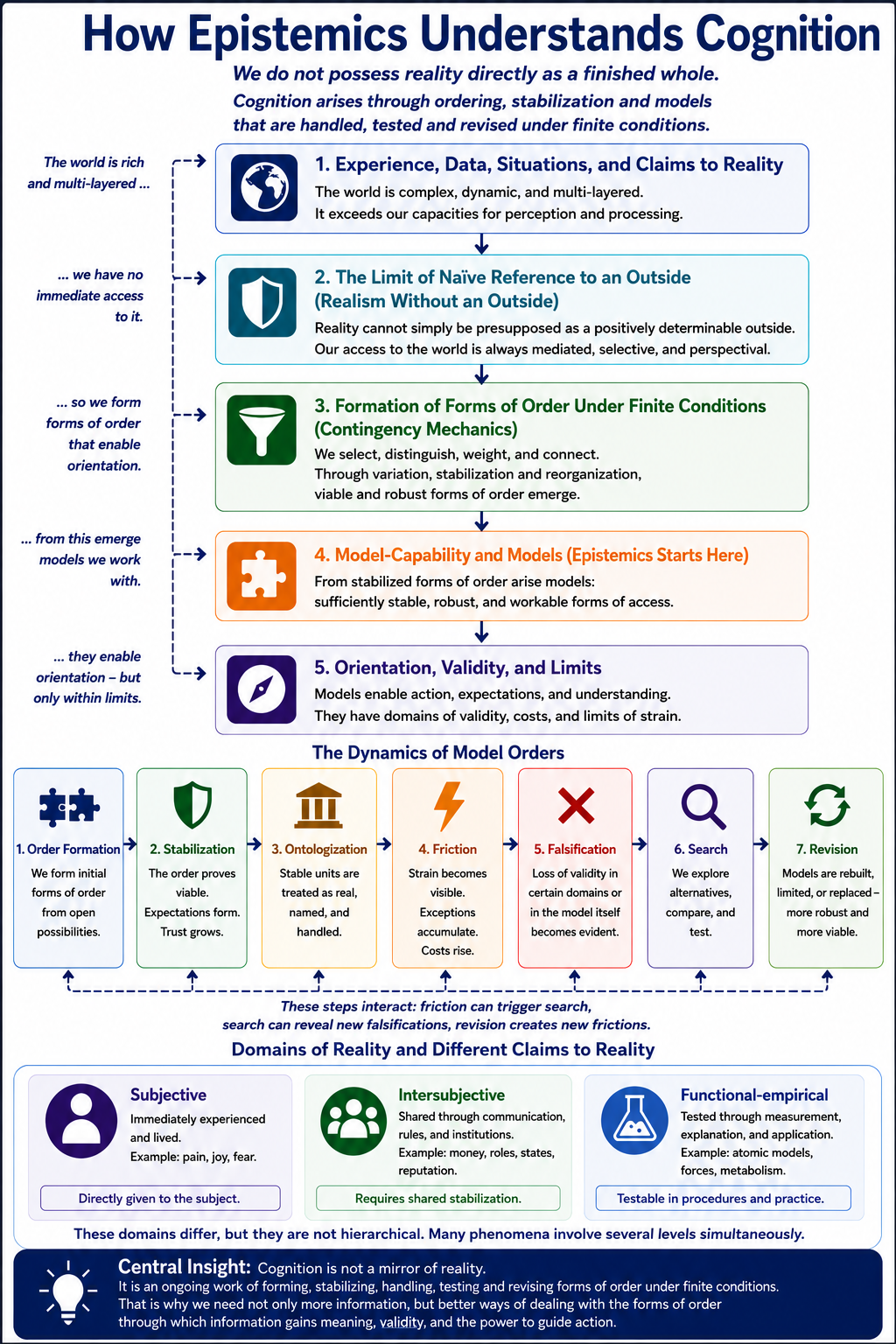
The decisive insight is this: between experience and orientation there always already lies some form of order. This order is not arbitrary, because it is tested against resistance. But neither is it given as finished, because it must be formed, stabilized, and further developed by finite cognitive systems. Where such orders become viable, comparable, and workable, the domain in which models emerge begins.
2. Why cognition depends on model-like orders
If order always already lies between experience and orientation, the next question arises: when does such an order become a model? Not every perception, every intuition, and every habit is already a model. Often we only sense that something does not fit, without yet being able to describe it clearly. A model emerges only where an order gains enough stability and contour to be worked with.
A model, in this sense, is not in the first instance a formula, a theory, or a technical simulation. It is a condensed way of understanding something as something. A model brings certain features into relief, lets others recede, and establishes connections that make orientation possible. It renders a situation, an object, a person, a process, or a problem graspable enough to be dealt with.
This begins in everyday life. When we judge someone to be reliable, we do not grasp the full reality of that person. We arrange experiences, behavior, and expectations into a pattern that guides our action. This pattern can be helpful, for instance when we decide whom to entrust with something. But it can also become too coarse if it no longer perceives new sides of this person. Then it becomes clear: the model remains viable, but only within certain limits.
Science, too, does not work without such model-like orders. Medical diagnoses, physical laws, climate models, or psychological typologies do not completely depict reality. Every model selects, simplifies, posits concepts, and determines which connections become important. Precisely through this, testing becomes possible. Without models there would be no ordered questions, no comparable findings, and no clear critique.
The same holds for artificial systems. An AI system does not process data as pure reality. It orders inputs through patterns, weights, classifications, and internal structures. A robot does not need to grasp the entire physical world in order to move through an apartment. It must be able to make usable distinctions: obstacle, door, person, movement, danger, goal. Here too, orientation arises through reduction and ordering.
Models are therefore not mere stopgaps that would disappear if only enough information were available. More data do not automatically solve the problem of order. They can even sharpen it. Data must be selected, connected, weighted, and brought into relation. Without order, information remains mute. It does not yet say what matters, what belongs together, what scope a finding has, or what action follows from it.
At the same time, the concept of a model is not unbounded. It is worth making an important distinction here. Below the threshold of the model, many forms of understanding are at work: moods, habits, unclear expectations, provisional patterns, tentative distinctions. They can be important, but they are not yet describable, comparable, testable, and changeable in the same way. Epistemics is particularly concerned with those orders that cross this threshold: orders that have become stable enough to be guided, criticized, and revised. This threshold is first of all a soft boundary of finite execution: a cognitive system cannot take everything that would somehow be accessible as its object simultaneously and without limit. As with counting, which could in theory always be continued but cannot in practice be carried out infinitely, this boundary does not lie in principle but in time, attention, energy, and processing capacity. To be distinguished from this is a hard boundary: what has no trace, friction, or accessibility whatsoever within the cognitive context cannot be identified as a determinate order. It remains at most conjecture.
This makes it understandable why models are at once necessary and risky. They make orientation possible because they reduce complexity. But precisely through this they can also narrow reality. They show something by hiding something else. They create clarity by limiting ambiguity. This is not a flaw but their function. It only becomes problematic when one forgets that a model carries only under specific conditions.
A good model therefore does not contain everything. Such a model would be useless for finite cognitive systems. A good model carries in a specific domain, makes its presuppositions as visible as possible, remains testable, and can be changed when its order no longer suffices. Its strength lies not in complete depiction but in viable orientation.
This shifts the basic question. It is not only about whether a model is true or false. This question remains important, but it does not suffice on its own. One must also ask: where does a model remain viable? What conditions does it presuppose? What does it leave out? When is it overextended? And how can it be changed without losing all orientation?
This is exactly where Epistemics begins. It investigates the domain in which orders have become capable of being treated as models. Its subject is the handling of such models under finite conditions: how they arise, gain validity, become stabilized, come under strain, and can be revised.
3. Why a research context follows from this
If understanding is bound to orders and models only emerge where such orders become stable, workable, and testable, then more follows from this than a single epistemological thesis. A whole research context emerges. For then one must ask how such orders arise in the first place, how they open up reality, how they gain validity, how they come under strain, and how they can be changed.
The first step is to clarify the starting point. If reality is not simply available as a finished whole to finite cognitive systems, it must also not be hastily presupposed as a fully determinable outside. This does not deny reality. What is denied is only the notion that reality lies ready for us as a fully determined external world that cognition would merely have to depict. What we call reality only takes shape for a cognitive system where something can be experienced, distinguished, ordered, tested, and treated as resistant or as viable. Reality shows itself to us where orders carry, are tested against resistance, and make orientation possible.
From this follows the second question: how do finite systems form viable orders at all? Human beings, the sciences, institutions, and artificial systems do not stand before a world already sorted out. They encounter experiences, data, expectations, disturbances, possibilities, and limits. Out of these they must form patterns that enable action, communication, and testing. This more general dynamics of order formation is investigated within the project as contingency mechanics.
Not every such order is already a model. Often what arises first are diffuse fields of experience, provisional patterns, or stable recognitions. Only when an order becomes markable, comparable, testable, and changeable does it become capable of being treated as a model. It is at this threshold that Epistemics in the narrower sense begins. It examines model management under finite conditions: how models arise, what validity they claim, what costs their stabilization generates, where friction becomes visible, and when revision becomes necessary.
This also makes it understandable why the project requires several papers. A single theory of the model is not sufficient when the emergence of understanding, the taking-shape of reality, the stabilization of experience, and the testing of validity already hang together. Some papers therefore clarify the limit of a naive reference to an outside. Others investigate how units capable of reference arise out of experience. Still others analyze forms of reality, domains, friction, falsification, search, revision, or concrete fields of application such as science, society, AI, and robotics.
The research context therefore does not replace existing epistemology, philosophy of science, or social theory. It shifts the gaze toward an operative middle ground that is often treated too implicitly: how do finite systems deal with their forms of order? How do they keep them stable without absolutizing them? How do they recognize the limits of strain? And how can they change orders without losing all orientation?
In this sense, Epistemics.de is not merely a repository of individual texts. The site makes visible a research context: from understanding that grows in encounter with resistance, through the formation of shapes of reality, to the handling, testing, and revision of models. This context can be understood as an inquiry into epistemic reality: reality is not presupposed here as a finished external world, but is considered as that which takes shape for finite cognitive systems in ordered, resistant, and orientation-guiding forms. The guiding question is not only: what is true? It is also: how does something become viable, testable, meaningful, and open to revision for a finite cognitive system at all?
4. What already exists on this and why it is not yet sufficient
The idea that understanding does not simply depict a finished reality is not new. Philosophy, epistemology, philosophy of science, pragmatism, constructivism, and social epistemology have shown in various ways that knowledge is mediated by concepts, methods, perspectives, social practices, and testing procedures. The insight that scientific models are limited, can fail, and must be changed under new conditions has long belonged to modern philosophy of science as well.
Popper emphasized the importance of critique and possible failure. Kuhn showed that science does not grow only in a linear way but also knows crises and reorganizations. Lakatos described research programs that do not vanish immediately under isolated counterexamples but develop protective assumptions, modifications, and long-term lines of development. Further approaches placed greater emphasis on the fact that knowledge is shaped linguistically, socially, institutionally, or practically. While such approaches often place major scientific ruptures, research programs, or questions of justification in the foreground, Epistemics directs attention more sharply to the ongoing operative handling of models: their scope, the costs of their stabilization, their friction signals, and their capacity for revision in use.
The research context developed here therefore does not begin at zero. It does not replace these traditions but ties into them. Its own focus, however, lies at a somewhat different point. It does not ask in the first instance about an ultimate theory of truth, nor only about the justification of individual statements, nor only about scientific progress. It asks about the operative guidance of orders under finite conditions.
This brings into the foreground an intermediate zone that is often treated too coarsely. Models are not simply true or false, stable or refuted, reality-close or constructed. Often they carry in certain domains, come under tension elsewhere, generate growing costs, are propped up by auxiliary assumptions, lose scope, or have to be rebuilt step by step. These transitions in particular are decisive for real cognitive systems.
This is where Epistemics begins. It examines how models gain validity, how they become stabilized, what costs their maintenance generates, where friction becomes visible, and how revision becomes possible. Its contribution therefore does not lie in simply renaming older debates. It lies in providing a vocabulary for the guidance, strain, and transformation of models.
This is especially important because modern problems of cognition rarely fail merely because information is missing. Often there are abundant data, many interpretations, and many competing models. The harder question is then: which order carries in which domain? Where is it overextended? What kind of resistance shows itself? And at what point is mere defense no longer enough, and revision required?
In this sense, the project understands itself as a continuation and extension. It takes the insights of earlier theories seriously, but bundles them around an operative guiding question: how do orders remain viable, testable, and changeable, when cognition always takes place under finite conditions?
5. What Epistemics aims to do better
Epistemics begins from the question of how models are handled under finite conditions. “Under finite conditions” simply means here: no cognitive system can grasp, test, and change everything at once. It must manage its limited resources of attention, time, energy, concepts, and testing capacity. From this the concept of costs in particular becomes intelligible: every stabilization, testing, or revision of a model binds limited resources. Beyond this, Epistemics asks what a model claims, where it remains viable, what presuppositions it carries with it, when it comes under strain, and when it must be changed.
This shifts the perspective. It naturally remains important whether statements are correct, whether findings are robust, and whether models fail against resistance. But the simple alternative of “true or false” is often not enough. A model can function well in one domain and be overextended in another. It may have been helpful earlier and generate friction under new conditions. It can therefore continue to be viable and still come to require revision.
The distinctive contribution of Epistemics lies in describing such intermediate situations. Validity refers to the domain in which a model remains viable. Stabilization denotes its reliability through use, testing, expectation, or application. Costs arise because every stabilization must be maintained or adjusted. Friction signals that a model is coming under tension. Revision denotes the ordered transformation when its previous form no longer suffices.
These concepts are not meant to form a new technical vocabulary for its own sake. They help to read real cognitive processes more accurately: in science, society, organizations, personal orientation, and artificial systems. What matters is recognizing limits of strain in time and shaping changes in such a way that orientation is not lost.
Epistemics therefore does not aspire to be a super-theory. It replaces neither philosophy nor philosophy of science, social theory, or empirical research. Its aim is more limited: it provides a framework for assessing models in terms of viability, scope, strain, and capacity for revision.
6. Domains of reality and reality claims: subjective, intersubjective, functional-empirical
If understanding and the image of reality develop together, a further question arises: do we always mean the same thing when we call something “real”? In everyday life, reality often sounds like a single standard. Yet different forms of reality are experienced, carried, and tested in different ways.
A first domain is subjective reality. Pain is a simple example. Whoever is in pain experiences it directly. Others can observe signs, gather medical findings, or trust the report. But the sensation of pain itself is directly given only to the person affected. In this sense, pain is subjectively real. This does not mean that it is merely imagined. It only means that its reality is bound to lived experience.
A second domain is intersubjective reality. Money illustrates this particularly well. A banknote, viewed physically, is a piece of material. Its social effect, however, arises only through shared rules, expectations, institutions, and trust. As long as this order holds, one can use money to buy, plan, calculate, and exercise power. Money is thus not merely subjective, but also not real in the same way as a natural object. It is intersubjectively real.
A third domain is functional-empirical reality. This includes, for instance, atoms, fields, forces, metabolic processes, or cosmic processes, insofar as they become robust through measurement, explanation, prediction, and technical application. This reality is not mere opinion or agreement. It shows resistance within regulated procedures. But for finite cognitive systems it too is not an immediate possession of the world in itself; it is a highly viable, model-mediated form of access.
These three domains are neither separate worlds nor a new three-domain ontology. They are an analytical distinction among different ways in which reality becomes determinable, effective, and testable for finite cognitive systems. An illness can be subjectively experienced, intersubjectively communicated, and functional-empirically investigated. It is precisely for this reason that the distinction matters. It helps to say in what sense something is real and what kind of testing is appropriate in each case.
Many disputes arise because these levels are confused. Then only the measurable counts as real, while pain, meaning, or social order are devalued. Or social and subjective realities are treated as if they had to prove themselves by the same criteria as a model from the natural sciences. Both go astray.
The project's differentiation of reality therefore neither wants to reduce everything to a single hard reality nor to blur all distinctions. Its point is simpler: for finite cognitive systems, reality has different forms of givenness, stabilization, and testing. Pain, money, and physical fields are real, but not in the same sense. For exactly this reason, one must clarify in each case which form of reality is present and what domain of validity is associated with it.
7. How models work: stabilization, ontologization, friction, falsification, search, revision
If models make orientation possible, the next question arises: how do they behave over time? They do not arise already finished but are formed, used, stabilized, strained, and sometimes transformed. It is precisely in this movement that it becomes visible whether a model remains genuinely viable or is merely being held onto.
At the beginning stands stabilization. An order proves itself repeatedly, becomes familiar, and can carry expectations. We recognize things again, name them, act with them, and share them with others. Fleeting impressions become stable reference points: an object, a person, a role, a cause, a rule, a problem.
The project describes this transition as ontologization. By this is not meant the claim that we know once and for all what exists in itself. What is meant is a functional consolidation: something is grasped stably enough to be recognized, named, expected, tested, and treated in practice. Without such ontologization we could not meaningfully speak of trees, pains, prices, illnesses, states, or electrons.
It becomes problematic when this consolidation makes us forget that it is an achievement of understanding. Then a stabilized order appears no longer as a viable form of access but as reality itself. Where this order is guided in model-like form, the model too can lose its flexibility. What was originally supposed to enable orientation then becomes rigid and harder to correct.
This is where the concept of friction comes in. Friction arises when a model comes under tension. An expectation is not confirmed. Exceptions accumulate. Explanations become more complicated. Auxiliary assumptions multiply. Applying the model costs more and more without providing correspondingly more orientation. Friction does not yet mean that a model is wrong. It first indicates that its carrying capacity is under strain.
A simple example is time management. Someone who is late once may have a good reason. Someone who is constantly late may not just be unlucky but may have a problematic model of their own routines. Each individual explanation may be correct, and yet the repetition reveals a deeper friction. It is not just the event that stands out, but the order with which one plans.
Falsification goes a step further. It occurs where a model makes a claim and no longer holds under fitting conditions. This need not mean that everything in the model becomes worthless. It may be that only a partial area is affected, that the domain of validity has to be drawn more narrowly, or that a specific application fails. Falsification therefore does not always mark a complete collapse but, in the first instance, a determinate loss of validity.
When friction increases or a loss of validity becomes visible, search begins. A cognitive system examines alternatives, compares interpretations, changes assumptions, or looks for new concepts. Search is not yet a solution. It first opens up the space of possibilities. But it prevents a strained model from being merely defended further.
Revision is then the ordered transformation of a model. Sometimes a small correction is enough. Sometimes the inner structure must be changed. Sometimes it turns out that the model itself was not wrong, but its application was extended too far. Revision therefore means not mere abandonment but reconstruction under strain.
These steps do not always proceed cleanly one after another. Friction can trigger search, search can reveal new falsifications, and revision itself can generate new frictions. Even so, the distinction is important. It helps in recognizing whether a model still carries, whether it is being overextended, whether its domain of validity must be corrected, or whether a deeper transformation is needed.
A viable cognitive system therefore needs both: stability and the capacity for revision. It must keep orders stable enough for orientation to remain possible. But it must also remain sensitive enough to recognize friction, loss of validity, and the need for change in time. It is precisely this balance that Epistemics investigates.
8. Why this matters today: science, society, AI, and robotics
The questions raised by Epistemics are not only theoretical. They concern every domain in which human beings, institutions, or technical systems work with models, interpretations, classifications, and predictions. In such domains it is often not enough to test individual results. What also matters is which order carries these results, where its scope lies, and when it comes under strain.
In science this is obvious. Research works with concepts, measurement procedures, models, and methodological simplifications. This is not a defect but its working condition. It becomes problematic when models are silently overextended, when friction is treated merely as an exception, or when the costs of their defense drop out of view. Strong models in particular rarely collapse all at once. More often they first enter states of tension.
Societies and institutions, too, function through stabilized orders. Political interpretations, administrative routines, economic guiding ideas, or social roles determine what counts as a problem, which solutions appear plausible, and who bears responsibility. As long as these orders carry, they appear self-evident. When they become too rigid under new conditions, exceptions, pressure to justify, and losses of trust arise.
In personal life the same shows itself in self-images, expectations, and life strategies. They provide orientation but can become too narrow. Not every crisis therefore means a complete collapse. Often it first shows that an order that had been carrying is losing its scope and must be transformed.
This question becomes particularly visible today in artificial intelligence and robotics. AI systems do not process a pure world but data, patterns, classifications, and probabilities. The more open their fields of application become, the more important it is to ask how stable their orders are, where they fail to adapt, and whether they can respond to changed conditions. A robot in an apartment needs more than stored commands. It must recognize what counts as an obstacle, a tool, a person, a danger, or a goal, and continually adapt this order to the situation. If it treats a chair only as an obstacle and not also as an object that a person may be moving, using, or deliberately placing in the way, its order enters friction. The problem then does not lie only in missing data but in too narrow a modeling of the situation.
In all these domains the same point shows itself: modern knowledge societies suffer not only from missing information. Often there is rather too much data, too many interpretations, and too many models whose scope remains unclear. What matters then is not only to accumulate ever more knowledge but to better understand which forms of order support knowledge, reality, and orientation.
9. How the research context becomes visible on Epistemics.de
Epistemics.de is the place where this research context becomes publicly accessible. The site is not merely a repository of individual texts. It shows how the papers are related to one another: from the question of how understanding grows in encounter with resistance, through the formation of shapes of reality, to the analysis of models, friction, and revision.
The site is meant to provide readers with orientation. The individual papers address different sections but belong to a shared question: how do finite cognitive systems arrive at viable orders, forms of reality, and models without presupposing immediate access to a fully determined reality?
At the same time, the site serves conceptual clarification. Many debates suffer because reality, truth, validity, stabilization, friction, scope, and revision are not kept cleanly apart. The papers gathered on Epistemics.de attempt to make these differences visible without replacing everyday language or pressing the fields treated into a single theory.
What matters here is this: the project is not to be understood as a closed system that was already complete from the start. Some papers clarify the starting point, others develop dynamic or operative concepts further, and still others apply these concepts to concrete fields. The site makes this development visible as a coherent context: ordered enough to provide orientation, and open enough to take in new problems, applications, and borderline cases.
10. How the works connect, and why this research context is necessary
The works of the project belong together because they investigate different segments of the same movement: understanding grows in encounter with resistance; reality takes shape for finite cognitive systems; forms of order stabilize; models emerge, come under strain, and sometimes have to be revised.
Within this, Epistemics forms the operative center. It asks how models gain validity, where they remain viable, what costs their stabilization generates, when friction becomes visible, and how revision remains possible. The wider project context shows why these questions concern not only science but also everyday life, society, institutions, AI, robotics, and our very understanding of reality.
The guiding thought of epistemic reality remains simple: we do not possess reality directly as a finished whole. We gain orientation by distinguishing, ordering, testing, and, when necessary, transforming. A complex present therefore needs not only more information, but better ways of dealing with the forms of order through which information gains meaning, validity, and the power to guide action.