Shared Epistemic Reality
Intersubjective Stabilization, Reference, and Validity under Finite Conditions
Abstract
This paper examines shared epistemic reality as a stabilized elaboration of the intersubjective domain. The preceding paper on the intersubjective domain showed that subjective orientation stands under the conditions of other orientations and enters an intersubjective space of connection through communicability, reception by others, shared connectability, and correction. The present paper presupposes this structure and asks how more durable shared spaces of reference, expectation, and correction arise from it.
Shared reality is understood neither as mere consensus nor as immediate access to a fully determinable external world, but as a correctable form of shared orientation under finite conditions. What matters is not that several subjects possess identical inner worlds, but that they can stabilize references, meanings, expectations, and procedures in such a way that these remain capable of being taken up again, expected, corrected, and tested.
The paper reconstructs this movement from the limit of local stabilization through shared reference, expectation spaces, trust, and institutionalization to intersubjective validity, science, friction, and revision. Local stabilization designates a perspective-bound order that provides orientation to an individual cognitive system but is not yet sustained as a shared reference or expectation space.
Within the research context of Epistemic Reality, the paper determines the stabilized intersubjective middle between subjective orientation and functional-empirical testing. Science appears as a special case of shared reality under strain, in which intersubjective stabilization is systematically coupled to measurement, repetition, methodological control, and organized revision. Finally, the paper shows that shared epistemic reality remains viable only if friction remains readable as an indication of a need for correction and if shared orders are kept capable of revision.
Keywords
Shared epistemic reality; intersubjectivity; reference; expectation spaces; trust; institutionalization; intersubjective validity; stabilization; friction; revision; science; functional-empirical robustness; Epistemic Reality; finite conditions
1. The Everyday Experience of a Shared World
Human beings do not live only in private impressions. They point to things, speak about events, arrange to meet at places, read the same texts, use shared concepts, and expect certain behavior from one another. When someone points to a glass, speaks about a piece of news, or stops at a red light, orientation does not function only individually. It is already coordinated with others.
In everyday life, this coordination appears self-evident. People usually act as if they could refer to the same objects, situations, and rules. They ask for directions, sign contracts, discuss political events, check measurement values, or correct misunderstandings. In all these cases, a form of shared reality emerges: something is treated among several persons as jointly relevant, recognizable again, and expected.
Yet precisely this self-evidence conceals a problem. The fact that people can successfully speak and act with one another does not yet explain how shared reality arises at all. Nor does it explain why some shared orders remain viable while others disintegrate, harden, or must be corrected by new experiences. Shared reality is therefore not simply what is already given, but an order whose emergence, stability, and correctability must be reconstructed in their own right.
The preceding paper on the intersubjective domain (Rapp 2026g) exposed the elementary conditional structure of this coordination. It showed that subjective orientation stands under the conditions of other orientations and becomes intersubjectively effective only where it becomes communicable, capable of take-up, connectable, and correctable. The term “take-up” is used here in a sense analogous to the established philosophical use of “uptake,” designating the reception, continuation, and possible correction of a reference by other cognitive systems. The present paper presupposes this basic structure. It no longer asks primarily how intersubjective connectability becomes possible, but how it condenses into shared epistemic reality.
This also marks an important threshold: intersubjective connectability is the condition of shared reality, but not yet its elaborated form. An orientation may already be taken up, answered, or corrected by others without thereby already giving rise to a durable shared reference and expectation space. Shared epistemic reality begins only where such connectability is stabilized as repeatable, expectable, correctable, and, where necessary, institutionally continuable.
One obvious answer to the question of shared reality would be to presuppose an objectively existing external world to which different human beings have equal access. Another answer would explain shared reality primarily from social agreement, language, or cultural construction. Both answers capture something important, but they are insufficient (cf. Berger and Luckmann 1966; Searle 1995; Habermas 1981). The mere assumption of an objective external world does not yet explain how reference, understanding, and correction are practically stabilized. Conversely, mere consensus produces neither truth nor robust validity.
The specific contribution of this paper therefore does not lie in describing social reality, communicative understanding, or institutional facts once again. Rather, it asks under which finite conditions intersubjective connectability can be elaborated into stable shared reference and expectation spaces. Shared epistemic reality designates the intersubjective form of shared orientation whose load-bearing capacity depends on renewed take-up, expectability, correctability, friction, and revision.
Shared reality is therefore not presupposed here as an already given starting point. The starting point is rather that finite cognitive systems enter into exchange, difference, and coordination. Through the functional stabilization of reference, expectation, and correction, an order emerges that can be treated as shared reality. It is neither identical access to an absolutely determinable outside nor the mere sum of private inner worlds.
The expression “finite cognitive systems” initially designates human subjects and social orders that orient under limited perspective, time, attention, and capacity for correction. Technical systems may participate in such stabilization processes, for example by helping shape concepts, information, or expectations; this does not attribute subjective experience to them.
The focus, then, is no longer only the transition from subjective orientation to intersubjective connectability, but the further question of when this connectability becomes shared reality. Subjective orientation remains bound to individual perspectives. It becomes intersubjectively connectable as soon as it becomes communicable, capable of take-up, and correctable. Shared epistemic reality arises only where such connectability is stabilized as repeatable, expectable, trust-supported, and, where necessary, institutionally continuable.
This brings a more precise question into the foreground: How does something become treatable among human beings as “the same”? How do shared concepts, reliable expectations, social rules, institutions, and forms of knowledge arise? And how can such orders be corrected when misunderstandings, conflicts, or new experiences occur?
Shared reality can be reconstructed theoretically not only from reference, expectation, and institution. Conversely, everyday phenomena such as traffic rules, diagnoses, contracts, judgments, or measurement procedures show that such structures are already effective. Where people self-evidently refer to the same signs, roles, or procedures, intersubjective stabilization becomes phenomenally readable.
This paper examines shared epistemic reality as intersubjective stabilization. “Epistemic” here means that shared reality is not presupposed as a finished given, but understood as a form of orientation stabilized through reference, expectation, correction, and testing. It does not ask whether an absolutely identical reality can be ultimately proven. Nor does it reduce shared reality to mere opinion or social enforcement. Rather, the central question is how shared reference and expectation spaces can emerge that remain connectable, correctable, robust, and capable of revision.
The investigation stands in proximity to work on intersubjective validity, social reality, trust, institutions, and scientific practice, but it does not take these discourses over as its main object. Within the extended Epistemics project, this paper has a constructive function: it shows how the intersubjective connectability developed in the basic paper is transferred into shared reference, expectation, and correction spaces, thereby making visible the stabilized intersubjective middle in which shared reality, institutions, and science become connectable. The distinction between subjective, intersubjective, and functional-empirical forms of reality and robustness connects to the theory of relative reality, but is limited here to the question of shared reference and expectation spaces.
Domains are not understood as ontologically separate regions of the world, but as contexts of positive determination in which different forms of stabilization, validity, robustness, and resistance occur.
While other parts of the project context investigate subjective experience, ontologization, model validity, friction, revision, and functional-empirical robustness, this paper concentrates on the stabilized intersubjective middle: on how shared references, expectations, and institutions arise without thereby already guaranteeing truth, legitimacy, or functional-empirical validity.
Under finite conditions, human beings must not only stabilize their orientation individually, but also coordinate it with one another. Language, social order, institutions, science, and shared reality depend on stabilization becoming possible between cognitive systems.
The paper develops this question step by step: first through the limit of merely local stabilization, then through shared reference, expectation spaces, institutionalization, intersubjective validity, science as a special case of shared reality under strain, and finally through friction and revision of shared reality.
2. From Local Stabilization to Shared Reality
Human beings always experience the world from a particular perspective. Perceptions, memories, expectations, and meanings do not appear neutrally in empty space, but within concrete situations of life, experience, and action. For one’s own orientation, this local stabilization is often sufficient. Local stabilization here means a perspective-bound order that enables orientation for an individual cognitive system without already being sustained as a shared reference or expectation space. A person can find their way, make decisions, recognize dangers, or form connections without immediately comparing every perception with others.
Yet local stability reaches a limit where orientation must be continued jointly. As soon as people speak, act, plan, or argue with one another, it is no longer enough that something appears coherent only for one individual. A reference must then become stable in such a way that others can take it up, distinguish it, continue it, correct it, or contradict it.
In the basic paper on the intersubjective domain, this threshold was determined as the transition into a shared space of connection. A subjectively or locally stable orientation becomes intersubjectively relevant when it is not only expressed, but can be taken up, answered, shifted, contested, or corrected by others. This, however, does not automatically make it shared epistemic reality. At first, it is connectable.
The additional threshold toward shared reality is crossed where such connectability is stabilized as repeatable and expectable. An experience, a concept, or an expectation then enters a shared space not only punctually, but can be taken up again, distinguished, corrected, and continued by several cognitive systems. Only in this way does a shared reference structure arise, and not merely a communicated inner perspective.
This is especially evident in misunderstandings. Two people use the same word and only later notice that they have associated different things with it. They remember the same event, but with different emphases. They interpret the same situation differently, although both are convinced that it is unambiguous. Such cases do not simply show that human beings can be mistaken. They show that shared orientation requires more than mere communication or punctual take-up.
Local stabilization initially remains bound to an individual perspective-context. Shared reality, however, emerges only when this order becomes repeatably connectable beyond the individual perspective. A perception, concept, or expectation must then not only be subjectively plausible, but become understandable, capable of renewed take-up, and correctable between several persons.
This is the decisive point. The issue is not to demonstrate fully identical inner worlds. For shared action, it is not required that two human beings experience an object in exactly the same way. What matters, rather, is that they can refer with sufficient stability to something treated as the same in shared dealings. This stability is not a metaphysical guarantee, but a practical, communicative, and correction-capable achievement.
Nor does shared language automatically solve this problem. Language provides means of coordination, but it does not yet guarantee shared reference. Concepts must be stabilized in use, misunderstandings clarified, and expectations adjusted. Only through repetition, correction, and shared practice does it become visible whether a reference truly holds.
Shared reality thereby becomes recognizable as something other than mere local coherence. It does not arise simply because individual human beings each have stable experiences. It arises where stabilization becomes capable of being mediated and continued between persons: where one can point to something, speak about it, rely on it, raise objections, and take up corrections.
This capacity for mediation, however, does not operate only outwardly. As soon as intersubjective orders become stable, they feed back into subjective experience. Human beings already experience situations with concepts, expectations, and distinctions they have taken over from shared orders. The subjective domain therefore does not remain isolated; it is co-shaped by intersubjective stabilization.
This capacity for mediation remains fallible. Deceptions, conflicts of memory, shifts in meaning, and different spaces of experience can at any time show that a supposedly shared orientation was less stable than it appeared. Precisely for that reason, shared reality must be continually confirmed, corrected, and revised.
Local stabilization is therefore necessary, but not sufficient. It gives orientation to an individual cognitive system. Intersubjective connectability begins where orientation can be taken up, answered, or corrected by others. Shared epistemic reality begins only where this connectability condenses into stable shared reference and expectation spaces. The next chapter therefore examines how something becomes treatable between different perspectives as “the same.”
3. Shared Reference
The preceding paper on the intersubjective domain showed that subjective orientation becomes intersubjectively relevant when it can be taken up, answered, shifted, contested, or corrected by others. Shared reference begins at this threshold, but goes beyond punctual take-up. It arises where references are stabilized repeatably in such a way that several cognitive systems can sufficiently distinguish what an utterance, gesture, sign, or action refers to.
Human beings can orient and act with one another durably only if they coordinate references between their perspectives. They must not only experience, remember, or expect; they must also be able to distinguish together what is meant and what is not. Shared reference therefore does not begin only with the finished concept, but with the stabilized distinguishability of what is meant and what is not meant within a shared space of connection.
Shared reference thereby forms a first elaboration of intersubjective connectability. What is initially meant from within a particular perspective must become determinable in such a way that others can take it up, distinguish it, take it up again, and correct it. Only in this way is subjective orientation transferred into a form that can be viably and repeatably continued between several perspectives.
This coupling presupposes an earlier achievement: something must first be stabilized as a distinguishable unit at all. Things, persons, events, or rules are not simply already given as finished reference units; rather, they are first lifted out of the experiential field as recognizable units (cf. Rapp 2026d). This formation of units can initially occur locally or subjectively. Through signs, names, concepts, and symbols, however, it is more strongly stabilized, made repeatable, communicable, and intersubjectively shareable. Language therefore does not generate shared reference out of nothing, but strengthens and stabilizes unit-formations that have already begun.
In everyday life, this achievement usually appears self-evident. When several people speak about the same place, the same person, or the same event, it is presupposed that they know what the speech refers to. Yet this self-evidence is the result of stabilized reference. People must learn which features are relevant, which differences count, and when a reference has succeeded or failed.
The simplest case is pointing. One person indicates something, another follows the gesture and takes up the reference. But even here, reference is not automatically unambiguous. Is the object meant, its color, its position, its function, or the situation in which it stands? Shared reference arises only when the participants can sufficiently delimit the relevant reference together.
Language expands this possibility. Concepts allow references to be repeated, stored, and detached from the immediate situation. Human beings can thereby speak about the past, plan the future, or thematize what is absent. At the same time, language does not automatically make reference stable. The same expression can be used differently, carry different expectations, or have different boundaries in different contexts.
For this reason, shared reference is always in need of correction. People ask follow-up questions, specify, contradict, give examples, or exclude cases. They clarify not only which word is being used, but what is to count as the same and what no longer falls under it. In such corrections, the shared reference stabilizes.
What is decisive here is the status of “the same.” When several human beings refer to “the same” object, “the same” rule, or “the same” event, this does not mean that their inner experiences are identical. Nor does it mean that an absolutely determined reality is fully accessible to them. “The same” here initially means: sufficiently stably identifiable, capable of renewed take-up, and correctable in shared dealings.
Shared reference thus stands between local experience and absolute objectivity (cf. Wittgenstein 1953; Brandom 1994). It is more than subjective association, but less than a metaphysical guarantee of identity. Its strength does not lie in abolishing all differences between perspectives, but in coordinating references viably despite such differences.
Mere repetition is not sufficient for this. If people use the same expression or react to similar situations, it may nevertheless remain unclear whether the reference truly holds jointly. Only when misunderstandings can be processed, boundary cases clarified, and deviations corrected does a robust order of reference arise.
Shared reference is therefore not merely the transfer of local unit-formations into a social space. As soon as such a unit is shared linguistically, symbolically, or practically, its meaning can be intersubjectively altered. Others can use it differently, weight it differently, delimit it differently, or correct it. This altered shared meaning then feeds back into subjective interpretation: what someone will later see, expect, or distinguish as relevant is already co-shaped by shared orders of reference.
Certain entities even emerge in subjective experience only under the feedback effect of intersubjective stabilization. The subject does not thereby leave its own perspective; it continues to experience and interpret subjectively. Yet what appears to it as a role, rule, property, obligation, money, diagnosis, or scientific finding is already co-shaped by shared signs, expectations, procedures, and forms of recognition. Shared reality therefore arises not only through the sharing of already finished units, but also through the feedback effect of shared orders on what subjectively appears as a unit, meaning, or relevant difference.
Shared reference thereby becomes a basic form of shared reality. It makes it possible for human beings not only to stabilize experiences alongside one another, but to refer with one another to something that remains recognizable in shared dealings. Expectations arise from such reference: whoever knows what others refer to can more readily expect how they will speak, act, contradict, or agree.
This account does not describe a genetic sequence in which subjective orientation would exist completely before intersubjective order. Rather, it analytically reconstructs the function that shared reference assumes for shared reality. In fact, subjective, intersubjective, and functional-empirical domains feed back into one another from the beginning.
Shared reference therefore leads beyond mere reference. It opens expectation spaces between human beings. The next chapter examines how stable reference gives rise to reliable social orientation, trust, and connectability.
4. Expectation Spaces and Trust
Shared reference alone is not yet sufficient for social orientation to hold. Human beings can refer to something as “the same” and nevertheless remain uncertain about which connections others will form from it. Only when references are linked to recurring assumptions of connection does a more stable shared orientation space emerge.
Expectation spaces are stabilized patterns of mutual assumptions of connection. Whoever speaks a language usually expects to be understood in certain ways. Whoever asks a question anticipates possible forms of answer. Whoever sees a red light expects that others will also treat this situation as relevant for action. Such expectations do not concern only individual objects or concepts, but the way others connect to shared references.
Shared reference thereby expands into social expectability. Human beings orient themselves not only by what others refer to, but also by which continuations are likely: what others might mean, which reactions are plausible, which interpretations are connectable, and which deviations require clarification. This expectability is not complete certainty. It reduces uncertainty only far enough for shared orientation to become possible.
Expectation spaces therefore stabilize not merely contents, but possible connections. They make it expectable how references can be taken up, continued, confirmed, shifted, or corrected. The shared reference described in the previous chapter is thereby transferred into a more durable form of shared orientation. A reference is then not only recognizable again, but expectable in typical continuations.
In such expectation spaces, intersubjective stabilization feeds back into subjective orientation. Human beings experience situations not only immediately, but already with expectations about how others might understand, assess, or treat them. What someone experiences as appropriate, striking, misleading, or contrary to rules is therefore often already co-shaped by shared orders of expectation.
Such expectation spaces arise through repetition, shared practice, and correction. Human beings learn which reactions are likely, which concepts hold in certain situations, and which deviations are treated as misunderstanding, error, or rule violation. In this way, routines, roles, and social orders form without every situation having to be negotiated anew.
In this context, trust does not initially designate a moral virtue, but a functional condition of stable connectability (cf. Luhmann 1968). Whoever speaks, acts, or cooperates must be able to assume that others will not alter references, rules, and meanings in completely arbitrary ways. Trust here therefore means the expectation that take-up, continuation, and correction will not arbitrarily break off.
This trust remains limited and fallible. Human beings can deceive, misunderstand, violate expectations, or interpret rules differently. Expectation spaces must therefore be confirmed, adjusted, and corrected. Trust does not replace correction; it is what first makes correction socially connectable. For only if contributions are not expected in advance to be arbitrarily distorted, ignored, or blocked can correction function as shared continuation.
This once again shows that shared reality is not mere agreement of inner contents. What matters is not that all participants experience the same thing, but that they can deal with one another in sufficiently reliable forms of connection. They must be able to assess what others refer to, which expectations are plausible, which reactions are possible, and how deviations can be handled.
Roles arise from such expectation spaces. Teachers, physicians, judges, friends, or scientists do not simply act as individual persons, but within stabilized bundles of expectations. Roles reduce uncertainty because they indicate which references, authorities, duties, or reactions can be expected in a situation.
At the same time, expectation spaces can become unstable. Different groups can connect the same concepts with different expectations. Trust can be lost. Routines can harden. Roles can become unclear, abused, or no longer accepted. It then becomes apparent that social expectability does not automatically generate validity, but must itself remain robust and correctable.
One limit of expectation spaces lies not only in their failure, but also in their success. The more smoothly shared expectations function, the less they appear as stabilized orders. They then seem self-evident, natural, or without alternative. This success-blindness can conceal their presuppositions and make later friction more difficult to read. Successful stabilization then becomes risky precisely because it lets its own emergence and need for correction recede from view.
Shared reality must therefore be capable not only of reference, but also of expectation. More durable forms of social orientation arise only through stable expectation spaces. These, however, are not limited to immediate interaction. They can be stored, organized, and carried forward over longer periods of time. This is where the institutionalization of shared reality begins.
5. The Institutionalization of Shared Reality
Expectation spaces are not limited to immediate encounters. Human beings also stabilize shared orientation through things, signs, procedures, and arrangements that outlast individual situations. Rules are written down, contracts signed, files kept, measurement values documented, roles defined, and responsibilities distributed. Shared reality thereby becomes more durable, more transferable, and less dependent on direct presence.
In this context, institutionalization does not mean only the formation of large organizations. It begins already where shared expectations are transferred into repeatable forms. A name, an identity document, a calendar appointment, a legal text, a scientific protocol, or a technical standard stabilizes references beyond individual persons and moments. They make shared orientation storable, retrievable, and transferable.
Institutions condense intersubjective stabilization by keeping references and expectations available beyond individual situations and persons (cf. Berger and Luckmann 1966; Searle 1995). They turn fleeting coordinations into more durable forms of shared orientation. In this way, intersubjective stabilization can feed back into subjective orientation without each person having to generate or examine every presupposition anew.
Institutionalization therefore perpetuates the expectation spaces described in the previous chapter. What is first stabilized in immediate take-up, answer, repetition, or correction can be preserved beyond individual situations through institutional forms. Institutions do not simply store contents, but also conditions of connection: they define which roles, concepts, procedures, documents, or responsibilities make a shared orientation continuable.
Reference and expectation spaces thereby gain reach. What was clarified in a single encounter can persist in documents, procedures, concepts, or infrastructures. Human beings do not have to renegotiate each time what a contract means, how a measurement result is recorded, or which role an authority, a court, a university, or a medical diagnosis plays. Institutions reduce uncertainty by pre-structuring shared references.
This relief is central for shared reality. Without institutional forms, shared orientation would remain more fleeting. It would have to be produced locally again and again and could remain stable across time, persons, and situations only to a limited extent. Institutions therefore increase the duration, reach, and binding force of shared reference and expectation spaces.
At the same time, this achievement must not be confused with validity itself. An institutionally stabilized order is not epistemically load-bearing solely because it exists. A procedure can be recognized and nevertheless produce errors. An authority can be enforced and nevertheless be mistaken. A document can have binding force and nevertheless contain false presuppositions. Institutions stabilize shared reality; they do not automatically ground its validity.
Asymmetrical stabilization becomes visible here. Not all participants have the same capacity to shape reference spaces. Institutions, expert groups, media, technical platforms, administrations, or scientific authorities can determine which concepts are used, which data count, which procedures are recognized, and which interpretations become connectable. Shared reality therefore rarely arises under fully symmetrical conditions.
This asymmetry is not illegitimate from the outset. Expertise, procedures, and responsibilities can significantly improve shared orientation. They can reduce complexity, increase reliability, and organize correction. What matters, therefore, is not whether influence, expertise, or institutional shaping can be avoided, but whether they remain examinable, correctable, and capable of revision. The same asymmetry becomes a source of friction when institutional stabilization no longer remains sufficiently examinable, correctable, or connectable.
Institutions therefore have a double function. They make shared reality possible by stabilizing references and expectations. At the same time, they can narrow, harden, or shield shared reality against correction. The more strongly an order is institutionally condensed, the greater its gain in orientation becomes, but also the greater the risk that erroneous stabilizations will persist for a long time.
This is especially evident in procedures. A procedure can generate trust because it makes decisions traceable and repeatable. But it can also destroy trust if it appears opaque, one-sided, or no longer capable of learning. Institutional stabilization therefore remains dependent on possibilities for correction and revision.
Shared reality is therefore not simply produced and completed by institutions. It is stored, distributed, secured, and continued. Precisely for that reason, the question arises when such stabilization is not only socially effective, but also epistemically load-bearing. Institutionalization thus leads directly to the problem of intersubjective validity: not everything that is stabilized already holds in a robust sense.
6. Intersubjective Validity and Its Limits
Shared reference, expectation spaces, and institutions give rise to stable forms of shared orientation. Yet it does not automatically follow from this that an order also holds in an epistemically load-bearing sense. Human beings can refer to something durably, form shared expectations, and create institutional structures even though central assumptions are erroneous, distorted, or insufficiently correctable.
A decisive difference thus comes into view: social stability and intersubjective validity are not identical (cf. Habermas 1981). The connection to Habermas lies in the distinction between factual recognition and validity claim; however, this paper places that difference within a domain-sensitive theory of shared epistemic reality under finite conditions.
An order can be widely accepted, institutionally secured, and deeply culturally embedded without thereby already being robust or capable of correction. Conversely, a new or initially unstable orientation can be more epistemically load-bearing than a long-established order. Shared reality must therefore be reduced neither to mere consensus nor to mere enforcement.
The basic paper on the intersubjective domain determined intersubjective validity in an elementary form as the correctable load-bearing capacity of a shared space of connection. In the present paper, this concept is understood more narrowly: intersubjective validity here designates the correctable load-bearing capacity of stabilized reference and expectation spaces within shared epistemic reality. It arises where shared references and expectations are not only shared, but can be kept robust through objections, corrections, and shared testing. What matters is not only that references are stabilized, but that they remain open to examination, adjustment, and revision.
Correctability is not introduced here as an arbitrary additional criterion. Under finite conditions, shared orders can be sufficiently secured neither by immediate access to an external world nor by mere consensus. What becomes decisive, therefore, is whether an order can take up objections, deviations, and new testing pressures without immediately losing its shared reference. In this sense, correctability designates the minimum condition under which social stability can pass into intersubjective validity.
Intersubjective validity therefore presupposes at least three moments. First, a reference must remain capable of renewed take-up between several perspectives. Second, deviations, misunderstandings, or objections must be able to become visible and articulable as such. Third, correction must be able to be fed back into the shared expectation space. Where one of these moments fails durably, social stability remains possible, but intersubjective validity is weakened.
This is precisely what distinguishes intersubjective validity from mere agreement. Consensus can arise from habit, social pressure, institutional power, or lack of alternatives. Human beings can use the same concepts and nevertheless be embedded in orders that are barely correctable anymore. A stable shared orientation is therefore not yet a sufficient standard of epistemic load-bearing capacity.
Nor may institutional enforcement be confused with legitimacy. A rule, a procedure, or an authority may be socially recognized and nevertheless problematic. This paper, however, does not yet develop a complete theory of normative legitimacy. It first examines the conditions under which shared orientation can be robustly stabilized at all.
Correctability is central for this. Shared reality remains epistemically load-bearing only if deviations become visible, objections remain possible, and stabilization is not completely shielded against revision. An order maintained only by repetition or authority can be socially effective and nevertheless lose its capacity to respond productively to friction.
Here the special role of expectations and institutions becomes apparent once again. They reduce uncertainty and enable coordinated orientation. At the same time, however, they also create the danger of hardening. The more strongly an order is stabilized, the more difficult it can become to question its presuppositions. Intersubjective validity therefore requires not only stability, but a particular form of openness within stabilization itself.
This openness does not mean arbitrariness. Not every divergent interpretation is automatically equally viable. Shared orientation continues to require stable references, traceable procedures, and repeatable forms of connection. Precisely for this reason, validity remains bound to robustness: an order must be able to deal with objections, conflicts, new experiences, and different perspectives without immediately collapsing.
Limit cases arise where the dimensions of shared reality fall apart. An order can be socially stable without remaining capable of intersubjective validity; it can be institutionally effective without being normatively legitimate; it can be locally shared while becoming untranslatable in relation to other reference spaces; and it can be intersubjectively correctable without already being functionally-empirically robust. Precisely such cases show that shared reality is not identical with consensus, truth, legitimacy, or empirical confirmation.
At this point, the limit of intersubjective validity also becomes visible. The fact that human beings can jointly sustain and correctably organize an orientation does not yet mean that this orientation is functionally-empirically robust. A community can be internally highly coherent and nevertheless fail in relation to practical resistances, measurements, or interventions.
Against this background, intersubjective validity must be distinguished from functional-empirical validity. This distinction connects to the theory of relative reality: functional-empirical validity here means the validity status of an order under repeatable interventions, measurements, and practical resistances, not a new ontological level.
Robustness designates an order’s testable capacity to withstand resistance; validity designates its status within this testing domain. Functional-empirical robustness does not stand outside intersubjective stabilization. Measurements, interventions, reproduction procedures, and technical tests must themselves be socially, linguistically, and institutionally organized.
Their special function therefore does not lie in leaving the social behind, but in additionally coupling intersubjectively stabilized orders to practical, material, and repeatable forms of resistance. Intersubjective validity is tested primarily by objections, understanding, and correction; functional-empirical validity is additionally tested by intervention, measurement, repetition, and practical resistance. The two can be closely connected, but they do not coincide (cf. Rapp 2026f; Rapp 2026c).
The special position of scientific orders of reality lies precisely in this difference. Science organizes shared reality not only socially, but systematically couples intersubjective stabilization to functional-empirical testing and organized revision.
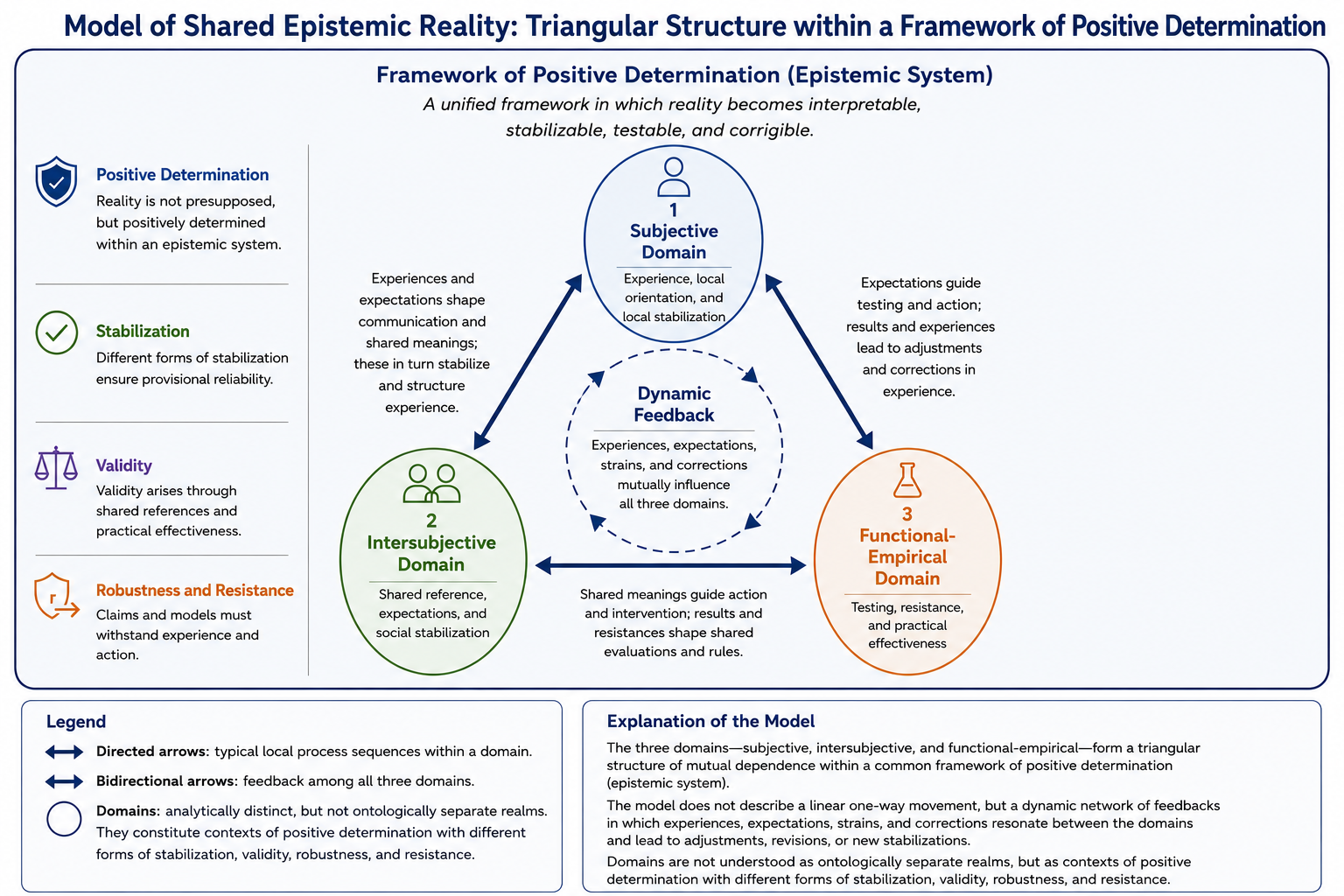
This distinction does not yield a linear hierarchy of stages. Subjective orientation, intersubjective validity, and functional-empirical robustness instead form an analytical triangular structure within a shared framework of positive determination. Subjective experience is co-shaped by intersubjective concepts, expectations, and procedures; intersubjective orders are corrected by subjective take-up, contradiction, and functional-empirical testing; functional-empirical testing in turn remains dependent on intersubjectively stabilized procedures, concepts, and documentation. The three domains are therefore analytically distinguishable, but not ontologically separate. They stand in a feedback structure in which reality becomes positively determinable, stabilizable, robust, and revisable for finite cognitive systems.
This structure can be represented schematically as follows:
7. Science as a Special Case of Shared Reality under Strain
Scientific orders of reality do not arise outside shared reality. They too are based on shared reference, stabilized expectation spaces, institutional procedures, and intersubjective validity. Scientists must coordinate concepts, interpret data, communicate results, and process objections. Science is therefore initially also a form of organized shared orientation. The following chapter does not develop a complete theory of science, but situates scientific practice within the model of shared epistemic reality developed here.
Its distinctive feature lies in the fact that intersubjective stabilization is systematically coupled to functional-empirical testing and organized revision. Scientific orders are meant not only to be socially connectable and intersubjectively correctable, but also to prove themselves additionally against measurements, interventions, repetitions, and practical resistances (cf. Kuhn 1962; Hacking 1983; Latour 1987).
This gives rise to a specific form of shared reality under strain. Scientific statements must be embedded in procedures that make deviations visible, enable criticism, and not only permit correction but organize it methodically. Reproducibility, documentation, public testability, and controlled comparability serve precisely this purpose. They do not eliminate every uncertainty, but they increase the robustness of shared orientation.
Science therefore does not differ from other social orders by standing completely outside intersubjective stabilization. Scientific communities, too, work with expectations, roles, authorities, institutions, and structures of trust. Concepts must be learned, methods recognized, and results communicated. Science therefore remains socially organized.
Precisely for that reason, social stability within scientific communities alone is not sufficient. A theory does not become epistemically load-bearing simply because it is widely accepted. Scientific validity additionally requires a systematic coupling to functional-empirical testing. Models, measurements, and explanations must prove themselves against repeatable interventions, observations, and procedures of comparison.
Science is therefore not robust simply because it is institutionally organized as science. Its special validity arises only insofar as its concepts, procedures, and institutions actually keep functional-empirical friction visible, testable, and effective for revision. Where scientific institutions conceal such friction, delay it, or shield it against correction, scientific stabilization too can lose its epistemic load-bearing capacity.
Under finite conditions, however, this testing pressure is rarely an immediate individual examination by every participating cognitive system. Researchers usually do not themselves examine the entire chain of data collection, measuring instruments, calibrations, software, models, publication, and institutional evaluation.
Scientific robustness therefore depends on distributed structures of trust. This trust does not replace functional-empirical testing, but makes it socially distributable, capable of renewed take-up, and correctable. Where such structures of trust become opaque or no longer correctable, distinct risks of friction arise.
This also gives rise to a special form of organized revision. Scientific orders are meant to remain correctable in principle. Errors, measurement deviations, competing models, or new data must not be treated merely as disturbance, but must potentially be able to become relevant for revision. Precisely here lies the strength of scientific orders of reality: they attempt to organize friction productively instead of excluding it completely.
This does not mean, however, that science is free of hardening, asymmetries of power, or erroneous stabilizations. Scientific institutions too can narrow concepts, marginalize alternatives, or make criticism more difficult. Paradigms, methodological standards, and institutional structures stabilize orientation, but at the same time they can limit the perception of new problems. Science therefore remains part of historical and social processes of stabilization.
Nevertheless, scientific orientation differs from mere social agreement. Its distinctive feature lies not in absolute objectivity, but in the systematic connection of intersubjective stabilization, functional-empirical testing, methodological control, distributed trust, and organized revision.
Science is therefore not a counter-model to shared reality, but a special case of shared reality under strain. It develops procedures through which shared orientation is meant to become more robust against practical resistances, repeatable tests, and competing interpretations. Science thus does not leave shared reality; it increases its testing pressure through functional-empirical coupling.
This robustness nevertheless always remains limited. Scientific models can fail, measurements can be erroneous, concepts can lose their load-bearing capacity, or institutional structures can become incapable of revision. Science therefore does not produce a definitively secured reality. Rather, it produces highly organized forms of shared orientation under conditions of ongoing correction and testing.
Precisely in this way, science becomes a central case of intersubjective validity under additional functional-empirical testing. It shows with particular clarity that shared reality need be neither mere opinion nor immediate access to absolute truth. Between social stabilization and metaphysical certainty, a sphere of robust but revision-open orientation emerges.
This also raises the question of what happens when such orders lose their capacity for correction and revision. Shared reality is not necessarily stable. Meanings can drift, trust can disintegrate, institutions can harden, and different reference spaces can become mutually untranslatable. This is where the problem of friction, disintegration, and revision of shared reality begins.
8. Friction, Disintegration, and Revision of Shared Reality
Shared reality remains viable only as long as shared references, expectations, and institutions remain sufficiently connectable, correctable, and robust. This stability is never finally secured. It can come under pressure through misunderstandings, new experiences, social conflicts, technical changes, functional-empirical testing pressures, or institutional hardening. It then becomes visible that shared reality is not simply present, but must be continually maintained, tested, and, where necessary, revised.
Friction here appears as strain on stabilized reference and expectation orders when their connectability, correctability, or robustness declines (cf. Rapp 2026b). It arises where a shared order no longer holds without difficulty. A concept no longer fits new experiences. An institution loses trust. A procedure produces results that are no longer accepted. Groups use the same words but connect different expectations with them. In such cases, the previous self-evidence of shared reality is interrupted.
Friction is not mere disturbance. It indicates that a reference, expectation, or institutionalization order has reached a limit. This limit can be local, as in the case of a single misunderstanding. But it can also become structural when entire groups, institutions, or forms of knowledge no longer remain sufficiently connectable. Friction therefore does not yet mean disintegration; it first marks a strain that must be read, assigned, and processed.
Diagnostically, shared reality becomes unstable where deviations no longer appear as correctable differences, but as untranslatable conflicts of reference. As long as participants can still clarify what they refer to, which objections count, and how correction can be taken up, friction remains processable. Disintegration begins where this shared form of correction itself is no longer shared.
Friction can arise not only within an individual reference space, but also at transitions between the subjective, intersubjective, and functional-empirical domains. Subjective experience, intersubjective recognition, and functional-empirical testing can drift apart. Human beings then experience situations differently from what shared concepts or institutional orders suggest. Conversely, socially stabilized expectations can fail functionally-empirically or generate practical resistances that can no longer be meaningfully processed within existing orders.
Reference conflicts are especially consequential. They arise when different actors seemingly speak about the same thing but use different reference spaces. The conflict then does not lie only in divergent opinions, but more deeply: it is unclear what is to count at all as the relevant object, as valid evidence, as error, or as correction. Shared reality does not disintegrate here simply through dissent, but through the loss of a shared framework of reference and correction.
Referential drift works similarly. Concepts remain outwardly intact, but their function shifts. An expression can carry different expectations, evaluations, or consequences for action in different groups. As long as these shifts remain correctable, they can be part of normal development. When they become unnoticed or untranslatable, however, parallel reality spaces emerge that reach one another with increasing difficulty.
Loss of trust intensifies this process. When actors no longer expect others to use concepts honestly, examine objections, or apply procedures fairly, social connectability breaks down. Even correct indications can then be more easily read as attacks, manipulation, or mere group positions. The shared space of possible correction shrinks.
Institutional hardening can intensify friction. Institutions stabilize shared reality, but when they shield themselves against revision, they generate tensions between existing order and new experiences, objections, or testing pressures. Procedures are then maintained even though they lose their load-bearing capacity. Authorities protect existing interpretations. Documents, categories, or technical systems carry old assumptions forward even though adaptation would be required. An order remains outwardly stable, but loses its capacity to learn.
Shared reality can therefore disintegrate in different ways. It can fragment when groups form their own reference spaces. It can harden when correction is no longer permitted. It can become hollow when concepts continue to be used but no longer sustain shared orientation. And it can be overextended when an order is applied to areas for which its stabilization is no longer sufficient.
Revision here designates the intersubjective reorganization of shared reference and expectation orders under friction (cf. Rapp 2026e). It does not mean giving up every stabilization, but examining which references, expectations, roles, procedures, or institutional structures must be adjusted. Sometimes a local correction is sufficient. Sometimes concepts must be sharpened, roles newly determined, procedures altered, or institutional structures opened.
What is decisive is that revision itself must be intersubjectively organized. When shared reality is affected, correction cannot occur merely privately. It must be communicated in a connectable way, examined, and fed back into shared expectation spaces. A successful revision therefore stabilizes not only new contents, but also the possibility of shared correction.
Revision of shared reality therefore aims not only at new statements or new concepts, but at the restoration or improvement of shared correctability. An order is not already revised when individual participants change their opinion. It becomes capable of revision only when the altered orientation can be fed back into the shared reference and expectation space.
This reveals the double character of shared reality. It needs stabilization in order to enable orientation. But it also needs the capacity for revision in order not to disintegrate or harden under strain. Where stability without correction dominates, rigidity threatens. Where correction occurs without shared reference, fragmentation threatens.
Shared reality therefore remains a dynamic order. It arises through shared reference, expectation, and institutionalization; it holds through intersubjective validity and functional-empirical testing; and it maintains itself only if friction remains readable as an indication of necessary correction. This is precisely where its strength lies: it is neither arbitrary opinion nor finally completed reality, but a robust yet revision-open form of shared orientation.
9. Open Questions for Further Work
The preceding considerations have not described shared reality as a fixed given, but as an ongoing stabilization of shared reference and expectation spaces. Human beings coordinate references, form expectations, organize institutions, develop procedures of correction, and respond to friction. In this way, robust forms of shared orientation emerge without this automatically resulting either in absolute certainty or mere arbitrariness.
The function of this paper is therefore limited, but clearly determined. The basic paper on the intersubjective domain showed how subjective orientation becomes communicable, capable of take-up, connectable, and correctable under the conditions of other orientations. Building on that, the present paper reconstructed how this elementary connectability is elaborated into stabilized shared spaces of reference, expectation, trust, and institutionalization.
It therefore does not develop a complete theory of truth, legitimacy, power, or social order. It reconstructs the stabilized intersubjective middle of shared reality: the level on which subjective orientation can not only be taken up and corrected, but becomes repeatable, expectable, and institutionally continuable. Shared reality arises neither solely from subjective experience nor solely from objective givenness nor solely from social consensus. It forms in the ongoing stabilization of shared references under conditions of limited perspectives, finite resources, and possible friction.
Several points of connection follow from this determination.
A first point of connection concerns normativity and power. Shared reality can be socially viable, institutionally stable, and intersubjectively organized without therefore already being legitimate or just. Institutions, media, technical infrastructures, expert groups, or political actors can shape reference spaces to different degrees. This raises the question of how shared orientation can be stabilized without losing the capacity for correction and revision. This question exceeds the scope of the present investigation, but is prepared by it.
A second point of connection concerns the interaction of subjective, intersubjective, and functional-empirical domains. This paper concentrates above all on the stabilized intersubjective middle of shared reality. It remains open how subjective experience, intersubjective validity, and functional-empirical robustness continuously affect one another in complex orders of reality, correct one another, or drift apart. This is precisely where further analyses of domains, friction, and relative reality connect.
A third point of connection concerns the translatability of different reference spaces. Modern societies do not consist of a single homogeneous order of reality. Scientific, legal, political, religious, or everyday systems of reference often work with different concepts, procedures, and expectations. Conflicts therefore arise not only through contradictory opinions, but often because different groups use different forms of reference, evidence, or validity. The stability of shared reality therefore depends on whether transitions between such reference spaces remain possible.
This problem becomes especially visible in digital publics and in dealing with artificial cognitive systems. Technical platforms accelerate communication, but at the same time intensify referential drift, fragmentation, and parallel expectation spaces. Systems such as LLMs and other AI technologies do not simply generate isolated contents, but increasingly operate within shared reference and expectation spaces. They influence concept use, access to knowledge, interpretation, and social orientation. They thereby become components of intersubjective stabilization processes whose conditions of correction, trust, and revision must be investigated in their own right.
In this sense, this paper itself is also part of an intersubjective stabilization process. It introduces concepts not as final determinations, but as correctable reference points within the extended Epistemics project. Its conceptual determinations and canon extensions therefore do not serve to close shared reality, but to support the controlled capacity for renewed take-up, examination, and possible revision of the distinctions developed here.
Precisely for that reason, shared reality remains fundamentally open. It must be repeatedly produced, corrected, tested, and revised. Its strength does not lie in final closure, but in the capacity to enable viable shared orientation despite uncertainty, difference, and strain.
Shared epistemic reality is therefore not the weaker substitute for an absolutely presupposed objective reality. It is the necessary intersubjective form in which finite cognitive systems can develop shared world-relations, correction, and robust orientation. In relation to the basic paper on the intersubjective domain, this paper thus marks the next architectural step: it shows how elementary connectability is elaborated into stabilized spaces of reference, expectation, trust, institutionalization, and testing. Shared reality thereby appears neither metaphysically guaranteed nor merely socially posited, but as a correctable, robust, and revision-open order between finite perspectives.
Conceptual Canon of This Paper
The following conceptual canon serves to stabilize central meanings within this text. It is used wherever an explicit conceptual reference basis is required for the argument of this paper. It does not claim completeness or final systematicity. Concepts not listed here either do not belong to the functional core of this paper or are treated within the basic canon of Epistemics or in separate works.
This paper adopts the basic canon of Epistemics as an unchanged reference basis. The paper-specific concepts do not introduce a new basic architecture of Epistemics. They serve the local explication of a specific problem field: shared epistemic reality as the stabilized elaboration of intersubjective connectability into shared spaces of reference, expectation, correction, and testing under finite conditions.
The following concepts are local, specifying differentiations. They do not alter the basic canon of Epistemics, but unfold it further at the points required by the analysis of this paper. Implicit shifts of meaning, silent extensions, or retroactive reinterpretations are excluded.
Adoption of the Basic Canon of Epistemics
This paper adopts the concepts introduced in the basic paper on Epistemics, especially Epistemics, model, validity, stabilization, costs, friction, revision, and domain, without reinterpreting their functional meaning. Domain here designates no ontologically separate region of the world, but a context of positive determination with its own properties of stabilization, conditions of validity, forms of strain or testing, and modes of resistance.
Adoption of the Basic Paper on the Intersubjective Domain
This paper presupposes the basic structure developed in the basic paper on the intersubjective domain. There it is shown that subjective orientation becomes intersubjectively relevant when, under the conditions of other orientations, it becomes communicable, capable of take-up, connectable, and correctable.
The presupposed concepts include especially intersubjective conditionality, communicability, take-up, shared connectability, correction, and elementary intersubjective validity. These concepts are not grounded anew here, but are adopted as the starting point for the analysis of shared epistemic reality.
Adoption of Connection-Relevant Canon Extensions
Insofar as this paper uses concepts from the works on friction, revision, ontologization, relative reality, and functional-empirical robustness, these are used in the sense defined there. They are not systematically redefined here, but are taken up only insofar as they are required for the analysis of shared epistemic reality.
Paper-Specific Canon Extensions
Shared Epistemic Reality
Short definition:A form of shared reality that arises through the intersubjective stabilization of reference, expectation, correction, and testing.
Function:This concept designates the central object of the paper: reality that is stabilized between finite cognitive systems as jointly relevant, capable of renewed take-up, expectable, correctable, and capable of guiding orientation.
Delimitation:No immediate access to an absolutely determined external world; no mere consensus; no complete theory of social reality; not identical with the elementary intersubjective domain, but its stabilized elaboration.
Shared Reference
Short definition:The stabilization of a reference that can be sufficiently taken up, repeated, distinguished, corrected, and treated as “the same” between several perspectives.
Function:This concept explains how intersubjective connectability condenses into a stable shared reference.
Delimitation:No identity of inner experiences; no metaphysical guarantee of identity; no mere sameness of words; no guarantee of shared validity.
Expectation Space
Short definition:A stabilized connection of mutual assumptions about how others can connect to, react to, interpret, continue, or correct shared references.
Function:This concept shows how shared reference is expanded into social expectability and more durable orientation.
Delimitation:No complete certainty; no automatic normativity; no guarantee of shared validity.
Trust
Short definition:The functional expectation that take-up, continuation, and correction within a shared space of connection will not arbitrarily break off.
Function:This concept describes the minimal expectability without which shared orders would constantly disintegrate.
Delimitation:No moral virtue in the narrow sense; no guarantee of legitimacy; no substitute for correction; no guarantee of epistemic load-bearing capacity.
Intersubjective Stabilization
Short definition:The process in which references, expectations, meanings, and procedures become repeatable, correctable, and connectable between several cognitive systems.
Function:This concept determines the central form of stabilization of shared epistemic reality.
Delimitation:No mere addition of subjective perspectives; no complete objectivity; no abolition of perspectival difference.
Intersubjective Validity
Short definition:The correctable load-bearing capacity of shared reference and expectation spaces within the field of intersubjective stabilization.
Function:This concept distinguishes epistemically robust shared orientation from mere social stability, habit, or enforcement. Intersubjective validity presupposes that references remain capable of renewed take-up, that deviations or objections can be articulated, and that correction can be fed back into shared expectation spaces.
Delimitation:Not identical with consensus; not identical with truth; not identical with functional-empirical validity or normative legitimacy. The concept is used here more narrowly than in the basic paper on the intersubjective domain: there it designates, in elementary form, the correctable load-bearing capacity of a shared space of connection; here it designates the correctable load-bearing capacity of stabilized reference and expectation spaces within shared epistemic reality.
Institutional Stabilization
Short definition:The condensation of intersubjective stabilization into durable, retrievable, and transferable forms such as rules, roles, procedures, documents, organizations, or infrastructures.
Function:This concept explains how shared reference and expectation spaces can remain stable beyond individual situations, persons, and moments.
Delimitation:No automatic grounding of validity; no guarantee of legitimacy; no final fixation of shared reality.
Asymmetrical Stabilization
Short definition:A form of intersubjective stabilization in which actors, institutions, or technical structures shape with unequal strength which concepts, procedures, data, or interpretations become connectable.
Function:This concept makes visible that shared reality rarely arises under fully symmetrical conditions and that influence, expertise, or institutional shaping are epistemically relevant.
Delimitation:Not automatically illegitimate; not identical with abuse of power; a potential source of friction when examinability, correctability, or capacity for revision are restricted.
Success-Blindness of Shared Reality
Short definition:A state in which successful shared reference and expectation orders make their own stabilization invisible.
Function:This concept explains why shared reality can appear self-evident, natural, or without alternative precisely through smooth functioning.
Delimitation:No mere failure of shared reality; no simple deception; a risk of successful stabilization because later friction becomes harder to read.
Friction of Shared Reality
Short definition:Strain on stabilized shared reference, expectation, or institutionalization orders when their connectability, correctability, or robustness declines.
Function:This concept designates the point at which the self-evidence of shared reality is interrupted and a need for correction or revision can become visible.
Delimitation:No mere disturbance; no automatic refutation; no immediate command to revise; not yet identical with disintegration.
Revision of Shared Reality
Short definition:The intersubjective reorganization of shared reference and expectation orders under friction.
Function:This concept describes how shared reality remains capable of learning when references, expectations, roles, procedures, or institutions must be adjusted. Revision stabilizes not only new contents, but also the possibility of shared correction.
Delimitation:No abandonment of all stabilization; no merely private correction; no complete theory of revision, but a local application of the concept of revision to shared reality.
Canonical Status and Scope
The paper-specific concepts introduced in this paper constitute a local extension of the Epistemics framework. They are stabilized for the scope of this paper and can be used as reference concepts in subsequent works, provided that their use is explicitly identified.
There is no silent extension, reinterpretation, or retroactive modification of the basic canon of Epistemics. The concepts introduced here do not claim to reorganize the overall project, to replace the basic paper on the intersubjective domain, or to introduce a new basic architecture of Epistemics. They serve the system-internal explication of shared epistemic reality as the stabilized elaboration of intersubjective connectability.
References
Berger, Peter L., and Thomas Luckmann. 1966. The Social Construction of Reality: A Treatise in the Sociology of Knowledge. Garden City, NY: Anchor Books.
Brandom, Robert B. 1994. Making It Explicit: Reasoning, Representing, and Discursive Commitment. Cambridge, MA: Harvard University Press.
Habermas, Jürgen. 1981. Theorie des kommunikativen Handelns. 2 vols. Frankfurt am Main: Suhrkamp.
Hacking, Ian. 1983. Representing and Intervening: Introductory Topics in the Philosophy of Natural Science. Cambridge: Cambridge University Press.
Kuhn, Thomas S. 1962. The Structure of Scientific Revolutions. Chicago: University of Chicago Press.
Latour, Bruno. 1987. Science in Action: How to Follow Scientists and Engineers through Society. Cambridge, MA: Harvard University Press.
Luhmann, Niklas. 1968. Vertrauen: Ein Mechanismus der Reduktion sozialer Komplexität. Stuttgart: Enke.
Rapp, Stefan. 2026a. Epistemics: Model Management Under Finite Conditions. Zenodo. https://doi.org/10.5281/zenodo.18441326.
Rapp, Stefan. 2026b. Friction: Boundary Signal of Finite Load-Bearing Capacity in Subjective, Intersubjective, and Functional-Empirical Stability Spaces. Zenodo. https://doi.org/10.5281/zenodo.18434699.
Rapp, Stefan. 2026c. Beyond Physics and Metaphysics: Epistemics and the Differentiation of Reality into Subjective, Intersubjective, and Functional-Empirical Physics. Zenodo. https://doi.org/10.5281/zenodo.18317965.
Rapp, Stefan. 2026d. Ontologization as an Epistemic Basic Operation: Functional Stabilization, Intersubjectivity, and Malfunction. Zenodo. https://doi.org/10.5281/zenodo.18346602.
Rapp, Stefan. 2026e. Revision under Finite Conditions: A Theory of Model Transformation in Epistemics. Zenodo. https://doi.org/10.5281/zenodo.18935928.
Rapp, Stefan. 2026f. Relative Reality Theory: Degrees of Reality, Validity, and Stability in Fragmented Knowledge Environments. Zenodo. https://doi.org/10.5281/zenodo.18000510.
Rapp, Stefan. 2026g. The Intersubjective Domain: Intersubjective Conditionality, Take-Up, and Shared Connectability under Finite Conditions. Zenodo. https://doi.org/10.5281/zenodo.20313954.
Searle, John R. 1995. The Construction of Social Reality. New York: Free Press.
Wittgenstein, Ludwig. 1953. Philosophical Investigations. Oxford: Blackwell.
Appendix: Didactic Examples of Shared Epistemic Reality
The following examples serve a didactic function. They do not introduce additional theoretical claims, extend the conceptual canon of the paper, or provide independent empirical proof of the model developed above. Their purpose is to illustrate how the distinctions developed in the main text can become visible in everyday, institutional, scientific, and digital contexts.
1. The Red Light
A red light is initially a visual signal. In road traffic, however, it is stabilized as a shared reference: road users treat the same situation as relevant for action and orient their behavior accordingly. What matters is not that all participants have exactly the same inner experience, but that the reference to the signal can be sufficiently taken up, expected, and continued together.
Mere perception does not yet become shared reality. Shared epistemic reality arises only because the red light is embedded in a stabilized expectation space. Whoever stops at a red light usually expects that other road users will also treat the same situation as an instruction to stop. This gives rise to trust in the connectability of shared orientation.
This expectation is additionally stabilized institutionally: through traffic rules, driver’s license systems, sanctions, infrastructure, and everyday repetition. Precisely because this order usually functions smoothly in everyday life, it appears self-evident. Only in cases of failure, rule violation, or contradictory signaling does it become visible how strongly shared orientation depends on stabilized signs, expectations, and institutional securing.
Friction arises when this stabilization declines, for example in cases of contradictory signals, technical failures, or divergent expectation spaces. The example shows that shared epistemic reality is not based on identical inner worlds, but on robust coordination of shared reference, expectation, trust, and correctability.
2. The Medical Diagnosis
A medical diagnosis often appears to be the immediate determination of an objective condition. In fact, it arises within complex intersubjective and functional-empirical stabilization processes. Symptoms must be described, measurements interpreted, categories applied, and findings communicated.
In this process, a subjective experience, such as pain, exhaustion, or discomfort, is transferred into a shared reference and expectation space. The diagnosis is not merely the private interpretation of an experience, but an intersubjectively stabilized classification supported by physicians, laboratories, professional societies, classification systems, and medical procedures.
Asymmetrical stabilization arises here. Physicians, laboratories, professional societies, and medical institutions have considerably greater influence over which concepts, procedures, and interpretations count as connectable. Patients often take over these orders without being able to examine all their presuppositions themselves.
This asymmetry is not already an error. It can improve orientation because expertise, procedures, and institutional responsibilities reduce complexity. It becomes problematic, however, when diagnoses no longer remain sufficiently examinable, correctable, or capable of revision.
At the same time, the diagnosis remains functionally-empirically robust only insofar as it proves itself against further examinations, interventions, or therapeutic outcomes. Friction arises, for example, in misdiagnoses, contradictory findings, or conflicts between subjective experience and institutional classification.
Correction becomes possible when findings are repeated, diagnoses reviewed, or therapeutic responses are taken up as new testing pressure on the previous classification. The example shows that shared epistemic reality is neither merely socially constructed nor simply immediate access to objective facts. It arises from the coupling of intersubjective stabilization with functional-empirical testing under conditions of asymmetrical expertise.
3. The Court Judgment
A court judgment produces a highly institutionalized form of shared reality. Certain statements, documents, witness testimonies, or pieces of evidence are treated as relevant within regulated procedures. Roles, responsibilities, and decision-making authorities are institutionally defined.
This generates social stability and legal effectiveness. A judgment can have binding effects even if not all participants agree with it. At the same time, the difference between social stability, intersubjective validity, normative legitimacy, and truth becomes especially clear here.
A judgment can be institutionally effective even though it rests on erroneous assumptions. It can be legally binding without therefore being epistemically infallible or normatively unproblematic. Precisely for this reason, modern legal systems have procedures of revision and correction. New evidence, procedural errors, or conflicting evaluations can call existing stabilization into question.
Revision does not serve here to dissolve institutional order completely, but to maintain its correctable load-bearing capacity. The judgment shows that institutional effectiveness, normative legitimacy, and epistemic load-bearing capacity can fall apart. What matters, therefore, is how shared orientation is institutionally stabilized, tested, and kept capable of revision.
4. Scientific Paradigm Change
Scientific orders of reality are based on shared concepts, methods, measurement procedures, and expectation spaces. As long as these orders remain functionally-empirically robust, they enable stable scientific orientation.
Science is not a counter-model to shared epistemic reality. It is a special case of shared reality under strain. Concepts, methods, and measurement results must be intersubjectively stabilized, but are additionally coupled to functional-empirical testing.
Friction arises when new observations, measurements, or problems can no longer be meaningfully processed within existing models. Concepts lose their load-bearing capacity, measurement procedures generate contradictory results, or competing models explain certain phenomena better.
Paradigm changes show that scientific reality is neither mere subjective opinion nor finally completed truth. Scientific stabilization remains fundamentally capable of revision. At the same time, existing orders are not abandoned arbitrarily, but are often stabilized against friction for long periods.
Scientific robustness therefore does not depend solely on an order being institutionally recognized as science. What matters is whether concepts, procedures, and institutions keep functional-empirical friction visible, testable, and effective for revision. The example makes visible how intersubjective stabilization, functional-empirical testing, and organized revision work together.
5. Digital Publics
Digital platforms enable the rapid spread of shared references, expectations, and interpretations. At the same time, they can intensify fragmentation. Different groups stabilize their own concepts, sources, authorities, and expectation spaces, which increasingly struggle to reach one another.
This leads to conflicts of reference. People seemingly use the same concepts, but connect them with different orders of reality. Trust in shared procedures, institutions, or sources of information can strongly decline in the process.
Technical platforms additionally intensify such processes through algorithmic selection, accelerated repetition, and broad reach. This gives rise to parallel forms of shared reality that can appear stable within individual groups without remaining sufficiently translatable or jointly correctable.
Friction remains processable as long as different groups can still clarify what they refer to, which sources or forms of evidence count, and how correction remains possible. Disintegration begins where this shared form of correction itself is no longer shared.
The example shows that shared epistemic reality does not self-evidently remain unified. Shared orientation can fragment when reference, trust, and expectation spaces drift apart. Disintegration begins where this fragmentation can no longer be processed through shared forms of correction. Digital publics therefore make especially visible that shared reality must not only be stabilized, but also continually translated, examined, and kept capable of revision.
6. LLMs and Artificial Cognitive Systems
Systems such as LLMs and other AI technologies do not simply generate isolated texts, but increasingly operate within intersubjective stabilization. The expression “artificial cognitive systems” is used here as a working term: it designates technical systems that participate in the ordering, processing, and transmission of knowledge, without thereby attributing human experience or subjective cognition to them.
Such systems influence concept use, access to knowledge, interpretations, and communicative connectability. Users often take over statements, summaries, or interpretations without being able to examine all sources, models, or training conditions themselves. Trust is thereby partially transferred to technical systems.
At the same time, LLMs can strengthen, distort, or fragment existing reference spaces. Erroneous stabilization, hallucinations, statistical biases, or different training bases can generate friction, especially when technical authority is confused with epistemic load-bearing capacity.
This gives rise to a new form of asymmetrical stabilization. Technical systems can help shape which concepts, sources, interpretations, or summaries appear connectable, without their presuppositions being fully transparent to users. What becomes decisive, therefore, is whether their contributions remain examinable, correctable, and incorporable into shared procedures of revision.
Where such systems do not remain examinable, correctable, or incorporable into shared procedures of revision, they can not only generate friction, but also contribute to the disintegration of shared reference and trust spaces.
The example shows that AI systems are increasingly becoming components of shared epistemic reality. This gives rise to new requirements for transparency, correction, trust formation, and organized revision within digital orders of reality. The example serves as an application field for the concepts developed here, not as an independent proof for a theory of artificial cognition.