Relative Reality Theory
Degrees of Reality, Validity, and Stability in Fragmented Knowledge Environments
Abstract
Contemporary debates in philosophy, science, media studies, and technology are increasingly shaped by conflicts over what counts as real. These conflicts are frequently framed as contests between realism and relativism, objectivity and construction, facts and narratives. This paper argues that such oppositions conceal a more fundamental problem: the absence of a coherent framework for distinguishing modes and degrees of reality.
Relative Reality Theory (RRT) develops a systematic account of reality as a graded and mode-specific status rather than as an absolute property. Reality is understood as a function of experiential immediacy, intersubjective stability, and functional efficacy. On this basis, RRT reconstructs distinct modes of reality, subjective, intersubjective, and functional reality, without dissolving them into a unified ontological hierarchy or reducing them to mere opinions.
RRT provides a conceptual framework for analyzing real-world phenomena such as scientific models, media realities, political narratives, simulations, and virtual environments. By clarifying the conditions under which something can count as real in a given sense, the theory avoids both ontological absolutism and arbitrary relativism. It provides tools for identifying category mistakes, resolving apparent conflicts of reality, and understanding why certain realities remain stable despite contestation.
The paper positions RRT as a philosophical ordering framework rather than as an operative or technical theory of model management. Its aim is not to calculate or optimize reality claims, but to clarify their modes, scope, limits, and conditions of validity. In doing so, RRT contributes to contemporary epistemology and philosophy of science by providing a precise vocabulary for navigating reality under conditions of pluralism, mediality, and systemic complexity.
Keywords
relative reality; degrees of reality; validity; epistemology; philosophy of science; reality domains; truth and stability; realism and relativism
1. The Problem of Reality Conflicts
Conflicts over reality have become a defining feature of contemporary intellectual and public discourse. Scientific models compete with everyday experience, media narratives call empirical data into question, and digital simulations increasingly shape social, political, and economic decisions. In many of these contexts, what is at issue is not simply a specific factual claim, but the more fundamental question of in what sense something can count as real. Conflicts therefore often appear as disputes over truth, even though they frequently arise from differing implicit assumptions about the modes, scopes, and conditions of reality.
This paper reconstructs such conflicts neither as expressions of a general crisis of knowledge nor merely as a problem of false information. Rather, its aim is to develop a structural framework within which distinct modes of reality and validity can be distinguished as forms of stabilized orders of reality. In this respect, RRT belongs to the framing texts of the Epistemics Project: it describes possible spaces of reality and validity within which epistemic processes may later begin, without itself already providing a theory of those processes.
Traditional philosophical approaches tend to conceive of reality either as an objective, observer-independent realm or as a construction dependent on language, culture, or cognition. Both perspectives capture important aspects of how reality is experienced and described. In recent discussion, pluralist and perspectivist approaches have shown that access to reality is not simply given without presuppositions, but can be perspectival, plural, and conceptually structured (Goodman 1978; Putnam 1981; Giere 2006; Chang 2012). Work in social ontology and social theory has at the same time made clear that social reality cannot be reduced to mere private opinion, but exhibits its own forms of stabilization and validity (Searle 1995; Luhmann 1995; Fricker 2007; Goldman 1999; Lackey 2008). In the philosophy of science, moreover, it has become apparent that models, representations, and empirical adequacy stand in a more complex relation than simple oppositions between “reality” and “mere construction” would suggest (van Fraassen 1980; Oreskes, Shrader-Frechette, and Belitz 1994; Kitcher 1993; Godfrey-Smith 2006; Parker 2020). RRT does not replace any of these lines of inquiry. Rather, the paper addresses the question of how different forms of reality, validity, and stability can be distinguished within a shared ordering framework in such a way that their conflicts become more precisely describable.
This problem is not confined to abstract philosophy. In the sciences, models and simulations produce representations that are neither purely descriptive nor merely fictional, yet at the same time generate real explanatory and predictive effects, a tension that has been addressed in different ways within the philosophy of science (van Fraassen 1980; Oreskes, Shrader-Frechette, and Belitz 1994; Kitcher 1993; Godfrey-Smith 2006; Parker 2020). In media environments, narratives acquire stability and influence even when their empirical grounding is limited. In political discourse, subjective experiences are frequently treated as objective facts, while functional constraints are dismissed as mere interpretations. Across all these domains, conflicts arise less from a lack of information than from the absence of clear criteria for distinguishing different kinds of reality.
The central thesis of this paper is that many contemporary conflicts of reality are category mistakes. They often arise when claims that can be stabilized within a particular mode of reality and validity are implicitly treated as though they must possess the same range and status under the conditions of another mode. What is real in a given sense is then erroneously read as though it were real in every sense, or as though it had to prove itself under alien conditions of validity. The underlying problem therefore often lies not in a lack of information, but in the conflation of different spaces of reality and validity and of the corresponding forms of stability, range, and challenge associated with them.
RRT responds to this conceptual gap not by asking whether something is real in absolute terms, but rather in what sense, to what degree, and within which domain a phenomenon can count as real. Reality is conceived as a graded status grounded in experiential immediacy, intersubjective stability, and functional efficacy. In this way, RRT provides a systematic vocabulary for distinguishing different modes of reality without undermining the validity proper to each.
The aim of this paper is not to replace existing ontological theories or to propose a new metaphysical foundation. Rather, it offers an independent ordering framework for reconstructing relative modes of reality, that is, different forms in which reality and validity can appear as stabilized orders of reality.
The paper thus operates on a different level from Epistemics in the narrower sense: whereas Epistemics investigates how models are formed, stabilized, tested, and revised within particular spaces of validity, RRT describes the structure of such possible spaces of validity themselves. Its contribution therefore lies not in explaining epistemic operations, but in explicating those orders within which such operations can meaningfully begin.
1.1 Proposed Contribution
This paper makes five specific contributions:
- It defines reality as a graded status within a three-dimensional evaluative space composed of experiential immediacy, intersubjective stability, and functional efficacy, rather than treating reality as a binary ontological predicate.
- It separates degrees of reality, that is, the relative strength and resilience of reality claims, from reality domains, that is, the distinct modes in which such claims can attain validity, and shows that many so-called disputes over reality arise from the conflation of these two levels.
- It develops a minimal analytic typology of errors for contemporary conflicts of reality, distinguishing domain-transfer errors, degree inflation, range errors, and the displacement of constraint as recurrent patterns.
- It distinguishes validity from truth within the RRT framework. Validity denotes the mode-appropriate locatability of a claim; truth denotes the stability of that claim under the forms of challenge relevant to its respective mode.
- It reconstructs a constraint-sensitive pluralism in which different modes of reality can be simultaneously legitimate without being subsumed into a unified hierarchy or relativized to mere opinions.
2. Theoretical Framework of Relative Reality Theory
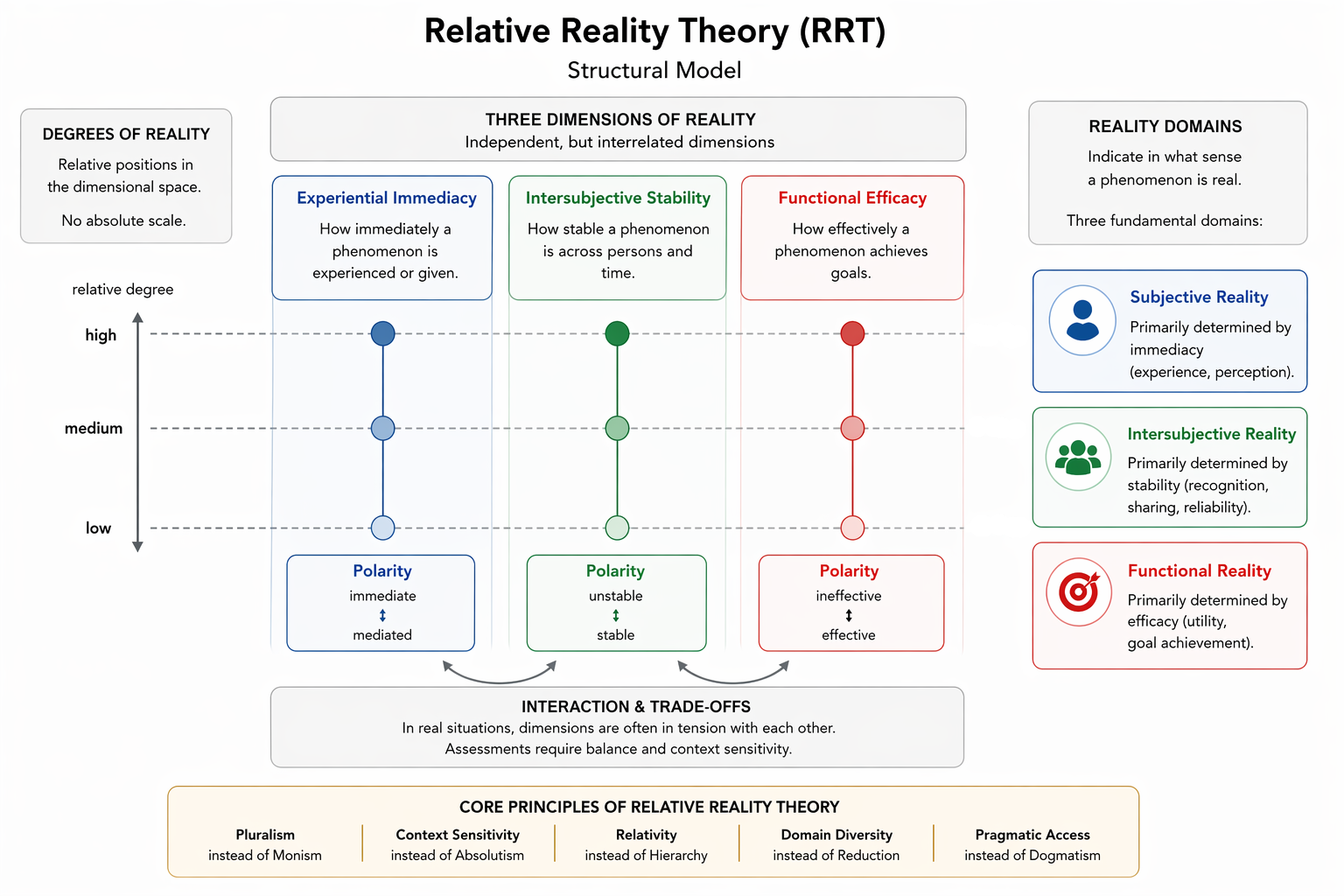
2.1 Basic Assumptions and Dimensional Framework
RRT does not formulate a universal architecture of cognition, nor does it offer a theory of epistemic operations. Rather, it reconstructs different ways in which orders of reality can appear in stabilized form and in which reality claims can become effective, shareable, or binding in correspondingly different ways. The emphasis accordingly lies not on final pronouncements about being as such, but on a functional explication of relative modes of reality.
Central to RRT is the assumption that reality claims always arise within contexts and acquire their meaning only within particular orders of experience, communication, and efficacy. A phenomenon does not count as real simply because it is asserted to be so, but because within a particular mode of reality and validity it fulfills the criteria that make it effective, shareable, or binding. RRT thereby stands in proximity to pluralist and perspectivist approaches such as those of Goodman, Putnam, Giere, and Chang (Goodman 1978; Putnam 1981; Giere 2006; Chang 2012), yet goes beyond them, because what moves to the center is not only the multiplicity of ways of accessing the world, but the systematic reconstruction of different modes of validity and stability themselves.
These criteria do not constitute an ontological hierarchy in the classical sense. Rather, they define different orders of possible validity and stabilization within which reality claims can be located. RRT explicates such orders without thereby already deriving how models are formed, tested, or revised within them.
The choice of these three dimensions is therefore not an external stipulation, but follows from the conception of truth already presupposed within RRT as stability under mode-specific forms of contestation. Reality claims can be challenged in structurally different ways, and these forms of challenge are irreducibly distinct. A claim can first be examined in experiential terms: Is it actually experienced in this way? It can second be examined from the intersubjective side: Is it shareable, reproducible, and stable across contexts? And it can third be examined from the functional side: Does it hold under intervention, stress, and resistance? These three forms of contestation cannot be reduced to one another. Anyone who recognizes only one or two of them systematically obscures the ways in which reality claims can fail in particular contexts. The three dimensions of RRT are therefore not to be read as an external taxonomy of the real, but as the structural consequence of the fact that reality is determined relative to irreducibly different forms of contestation. Thus, the threefold structure follows not despite, but from the theory’s own conceptual core.
Definition of the Dimensions
RRT distinguishes three dimensions of reality. Experiential immediacy designates the degree to which a phenomenon is directly given in the first-person perspective, without cognitive intermediaries. A phenomenon exhibits high experiential immediacy when it imposes itself upon the subject as unavoidable phenomenal content, independently of interpretation, assent, or utility. High experiential immediacy is characteristic of pain, fear, or immediate perceptual impressions. Intersubjective stability designates the degree to which meanings, descriptions, or representations remain reproducible, communicable, and coherent across multiple actors and over time. A phenomenon possesses high intersubjective stability when it enables shared understanding and coordinated reference even under conditions of repetition, variation, and dissent. Functional efficacy designates the degree to which a phenomenon reliably constrains action or produces consistent effects within a system, independently of individual assent or conviction. A phenomenon exhibits high functional efficacy when attempts to ignore, reinterpret, or negate it systematically fail because of persistent causal or structural resistance. These three dimensions jointly determine a phenomenon’s degree of reality. They function as analytic axes by means of which different modes of stabilized reality-order can be described and compared, without already constituting a complete theory of epistemic processes.
These dimensions are analytically distinguishable, yet empirically intertwined. Most phenomena exhibit combinations of experiential, intersubjective, and functional reality. Conflicts arise when the dominant dimension of a given phenomenon is overlooked, or when a reality claim that is valid within one dimension is implicitly transferred to another. RRT treats such misallocations as category mistakes rather than as signs of irrationality or untruth.
It is important to note that RRT does not propose a linear scale on which all forms of reality are reduced to a single measure. Instead, it opens a multidimensional space in which reality claims can be located and compared relative to specific questions and contexts. A phenomenon may be experientially highly real without exercising functional constraints, or functionally highly effective while remaining experientially remote and abstract.
2.2 Truth as Domain-Specific Stability
Within this framework, truth is conceived as a form of stability under mode-specific conditions of use and contestation. Stability here does not denote merely temporal duration or social consolidation, but robustness with respect to the disturbances that are relevant within a given mode of reality and validity.
A claim counts as true in this sense insofar as it remains coherent and effective under the forms of challenge appropriate to its mode. In the subjective domain, this concerns disturbances of experience or internal incoherences; in the intersubjective domain, dissent, reinterpretation, and communicative revision; and in the functional domain, stress tests, interventions, and resistance.
Truth in this framework thus means neither mere persistence nor mere enforcement, but resilient stability under precisely those conditions that are relevant as tests within the respective mode.
Stability that is maintained exclusively through insulation from criticism, through coercion, or through informational closure does not satisfy these conditions. It does not count as truth within the terms of RRT. Truth accordingly designates not mere durability or majority opinion, but a constraint-sensitive and context-sensitive form of stability.
Through this relational and graded conception of reality, RRT is able to accommodate pluralism without collapsing into relativism. It preserves the legitimacy of different reality domains while making their limits explicit. In this way, the framework establishes the conceptual preconditions for a more precise analysis of contemporary conflicts of reality and prepares the ground for examining concrete cases in science, media, and social systems.
3. Degrees of Reality
A central contribution of RRT consists in the introduction of degrees of reality as an alternative to binary classifications. Rather than treating reality as an all-or-nothing property, RRT understands it as a graded status that varies along the dimensions described in the theoretical framework.
Degrees of reality arise from the interplay of experiential immediacy, intersubjective stability, and functional efficacy. A phenomenon attains a higher degree of reality within a particular mode of reality when it strongly fulfills the criteria relevant to that mode. What is decisive is that a high degree of reality in one dimension does not automatically entail a high degree in another. Precisely this non-reducibility is not a weakness of the model, but its central explanatory strength.
The graded character of reality does not imply a single uniform scale on which all forms of reality could be measured in the same way. Rather, degrees of reality are domain-specific. In subjective reality, their degree is determined primarily by the immediacy, intensity, and inescapability of experience. In intersubjective reality, it depends primarily on communicability, social reproducibility, and institutional stabilization. In functional reality, it is determined primarily by resistance, efficacy, and the resilient persistence of consequences under intervention. RRT therefore understands gradation not as a domain-neutral unitary metric, but as a relative measure within different conditions of validity and stability. A single scale across all domains would not neutrally capture these differences, but would already constitute a category mistake.
A high degree of reality within the experiential mode obtains when an experience is immediate, compelling, and beyond voluntary dismissal. Pain, emotional suffering, or perceptual illusions can in this sense be experientially maximally real, even in the absence of external corroboration. Their reality lies in their unavoidable presence for the subject, not in their correspondence with an external state of affairs. RRT treats such phenomena as fully real within the experiential mode without extending that status beyond its appropriate scope of validity.
A high degree of reality within the intersubjective mode obtains when meanings, descriptions, or narratives achieve durability and coherence across social contexts. Scientific concepts, legal categories, and cultural symbols acquire reality in this sense by being reproducible, communicable, and institutionally stabilized. Their degree of reality grows with consistency, temporal persistence, and their capacity to coordinate understanding and action among multiple actors. Dissent does not cancel intersubjective reality, but instability and fragmentation diminish its degree.
A high degree of reality within the functional mode obtains when a phenomenon reliably constrains behavior or produces consistent effects independently of individual interpretation. Physical regularities, technical systems, and economic mechanisms are paradigmatic examples of this dimension. Their reality manifests itself through resistance: they continue to operate even when ignored, misunderstood, or contested. In this sense, functional reality is often experienced indirectly, through its consequences rather than through immediate intuition.
Degrees of reality are thus context-sensitive and purpose-relative. A phenomenon may be highly real for a particular question and only marginally so for another. A scientific model may be functionally highly effective and intersubjectively stable while remaining experientially abstract. Conversely, a personal narrative may be experientially intense and socially significant without exercising functional constraints beyond its immediate context.
RRT explicitly emphasizes that higher degrees of reality do not imply normative superiority. Privileging the functional mode in general risks marginalizing experiential or intersubjective phenomena. Conversely, the primacy of subjective immediacy can obscure external constraints. The theory therefore proposes an analytic stance in which degrees of reality are always assessed relative to the questions posed and the reality modes relevant in each case.
By introducing degrees of reality, RRT offers a structured means of comparing reality claims without forcing them into a single hierarchy. This approach explains why certain disputes persist despite shared information: the parties frequently operate with different implicit assumptions about which degree of reality is relevant. Making these assumptions explicit allows disagreements to be reframed, delimited, or clarified at the appropriate level.
4. Reality Domains
While degrees of reality describe how strongly a phenomenon is real within a given mode, reality domains specify in what sense it is real. RRT distinguishes reality domains in order to make visible different modes of stabilized reality-order and to prevent the conflation of conditions of validity that belong to fundamentally different ways of being real. In this sense, reality domains do not designate separate worlds, but different spaces of possible reality and validity within which claims can become present, shareable, or effective in different ways. Their function is to distinguish analytically among different forms of relation to reality without reducing them to a unified ontological hierarchy.
RRT distinguishes three primary reality domains: subjective, intersubjective, and functional reality. These domains designate different modes of stabilized orders of reality in which claims can become present, shareable, or effective in correspondingly different ways. They coexist without being reducible to one another and differ in their respective forms of access, stabilization, and validity. In this respect, RRT stands in proximity to social-ontological and social-epistemological approaches, such as those of Searle, Luhmann, Fricker, Goldman, and Lackey (Searle 1995; Luhmann 1995; Fricker 2007; Goldman 1999; Lackey 2008), while extending their focus by reconstructing not only social facts or shared epistemic conditions, but the systematic relation among subjective, intersubjective, and functional modes of reality.
Subjective reality is anchored in the first-person perspective. It encompasses sensations, emotions, perceptions, and inner states that are immediately given to a subject. The defining characteristic of this domain is immediacy: subjective realities impose themselves without requiring external confirmation. Their validity rests not on agreement or utility, but on presence. To deny the reality of subjective phenomena constitutes a category mistake, since their mode of reality is experiential rather than external.
Intersubjective reality emerges through shared meanings, symbols, and practices. Language, narratives, social roles, and institutional categories belong to this domain. Intersubjective realities depend on communication and repetition. They acquire stability through mutual recognition and coordinated use. Their reality is neither purely subjective nor strictly independent of human practices. Rather, it is sustained through collective participation and temporal continuity.
Functional reality refers to constraints and effects that operate independently of individual experience or consensus. It encompasses physical processes, technical systems, biological mechanisms, and economic dynamics insofar as these reliably produce consequences. Functional realities typically become visible when they resist intentions or expectations. Their defining characteristic is not immediacy or meaning, but persistence under intervention.
These domains are analytically separable, but empirically closely intertwined. Analytic separability does not entail phenomenal purity. Most phenomena occupy multiple domains simultaneously, though often with unequal weight. A scientific model may be intersubjectively stabilized, for example through peer review, and functionally effective in its predictions, while remaining inaccessible to immediate experience. A social norm may be intersubjectively robust and experientially palpable while becoming functionally fragile when its institutional supports erode.
Conflicts of reality frequently arise when claims that are valid within a particular mode of reality are implicitly extended to another. Subjective experiences are then presented as functionally decisive facts, while functional constraints are dismissed as mere interpretations. RRT interprets such misattributions not as expressions of bad faith or intellectual incapacity, but as failures to differentiate between modes of reality and conditions of validity.
By making reality domains explicit, RRT provides a framework for analyzing such conflicts without reducing them to mere differences of opinion or questions of evidence. Clarifying these domains serves to render visible different modes of reality and the conditions of validity associated with each. On this basis, reality claims can be assessed according to the criteria appropriate to their respective mode of reality, without reducing them to a single order.
5. Truth, Validity, and Conflicts of Reality
5.1 Truth within the Framework of RRT
Within the framework of RRT, truth is understood neither as absolute correspondence between propositions and an observer-independent reality nor as a mere product of consensus, conviction, or social persistence. Instead, truth in the sense of RRT designates the stability of a claim within a particular mode of reality and validity. A claim counts as true insofar as it remains coherent and effective under the conditions of use, contestation, and stress relevant to that mode. This characterization does not claim to be a general theory of epistemic truth, but rather a mode-specific reconstruction of how truth can appear within relative orders of reality.
5.2 Validity and Truth: An Analytic Distinction
In RRT, validity and truth are analytically distinguishable because the two concepts answer different questions. Validity concerns the mode-appropriate locatability and applicability of a claim, that is, the question of whether and in which reality mode a claim can meaningfully be situated at all. Truth, by contrast, concerns not this placement itself, but the stability of an already valid claim under the forms of contestation relevant to that mode. A claim may therefore be misplaced and for precisely that reason be inaccessible to any meaningful truth assessment. It follows that not every conflict of reality is best read first as a conflict of truth. Often, the primary error already lies at the level of validity, namely where a claim is placed within a reality mode to which it is structurally unsuited. From this perspective, many persistent conflicts of reality rest not primarily on false answers, but on unresolved or confused validity. In such cases, the underlying disturbance begins not with a false answer, but with a faulty placement.
5.3 The Emergence of Conflicts of Reality
Conflicts of reality arise when competing claims are assessed according to incompatible criteria of validity. Such conflicts are particularly common in contemporary discourse, especially in debates at the intersection of science, politics, and personal experience. Subjective testimonies are dismissed as unreal because they cannot withstand standards of functional efficacy, while functional constraints are rejected as illegitimate because they collide with lived experience. In both cases, the problem lies not primarily in untruth, but in the misallocation of modes of reality and conditions of validity.
5.4 Types of Reality Errors
From the perspective of RRT, many persistent conflicts of reality can be traced to a minimal analytic typology of errors. This is not intended as a complete or exhaustive taxonomy, but as the reconstruction of four recurrent patterns derived from typical mismatches among mode, degree, scope, and functional binding. Domain-transfer errors occur when a claim that is valid within a particular mode of reality is implicitly treated as valid in another mode as well. This happens, for example, when subjective experience is presented as a functional constraint, or when functional constraints are dismissed as mere interpretations. Degree inflation occurs when the reality status of a phenomenon is attributed an exaggerated strength, for instance when locally stable intersubjective narratives are treated as globally binding realities. Scope errors arise when the contextual scope of a reality claim is overextended, such as when domain-specific validity is tacitly assumed to be universal. The displacement of constraint occurs when the binding force of functional constraints is obscured despite persistent resistance, typically through the reinterpretation of functional constraints as optional perspectives. These error types imply neither irrationality nor bad faith. They point instead to systematic mismatches among domains, degrees, scopes, and forms of functional binding.
5.5 Case Study 1: Scientific Models and Functional Constraints
Contemporary scientific controversies frequently involve tensions between model-based predictions and experience-related or observation-near expectations. Climate models, epidemiological simulations, and financial risk models are often criticized as “unreal” because their outputs are not directly observable or intuitively accessible. From the perspective of RRT, this constitutes a domain-transfer error. Scientific models are neither merely fictional constructions nor simple reflections of an immediately given object. They typically exhibit low experiential immediacy, medium to high intersubjective stability through peer review and methodological standardization, and high functional efficacy insofar as their projections constrain planning, policy, and intervention. Their functional reality is manifest not in direct intuition, but in the resistance encountered when projected constraints are ignored. This is precisely where the need arises for a differentiated language of reality capable of distinguishing intersubjective stabilization from functional efficacy without severing the two.
RRT reconstructs this conflict by clarifying that what is at issue is not the existence of the modeled phenomena, but which reality domain is decisive for evaluating the claim. Once functional validity is recognized as the relevant criterion, the apparent opposition between “models” and “reality” dissolves into a question of scope and relevance rather than truth.
5.6 Case Study 2: Political Narratives and Lived Experience
Political and social debates frequently set subjective testimonies against functional or institutional constraints. Lived experiences of insecurity, exclusion, or economic pressure are sometimes dismissed as “not real” because they conflict with aggregated data or systemic indicators. Conversely, functional constraints such as budget limits or infrastructural capacities are rejected as mere interpretations when they run counter to personal or collective narratives.
RRT interprets such conflicts as combinations of domain-transfer errors and degree inflation. Subjective experiences possess high experiential immediacy and can acquire intersubjective stability within particular communities. They do not, however, automatically establish functional constraints. At the same time, functional realities retain their efficacy independently of recognition or assent.
The conflict persists because experiential validity is implicitly treated as functionally decisive, while functional resistance is obscured or reinterpreted. RRT reframes the dispute by separating the legitimacy of subjective reality claims from their range. Recognizing experiential reality does not entail functional authority; likewise, recognizing functional constraints does not negate lived experience. The conflict thereby shifts from mutual negation to a structured negotiation of relevance and priority.
5.7 Relevance Rather Than Disputes over Facts
RRT redirects the focus of such disputes from disagreements over facts to disagreements over relevance and range. Rather than asking which claim is simply true, the theory asks which mode of reality is decisive in a given context and which conditions of validity are to be applied. This reframing does not eliminate dissent, but renders it structurally transparent and limits its escalation. RRT explicitly does not imply that all modes of reality are of equal standing in every context. Certain questions, for instance those concerning physical constraints or technical feasibility, require the prioritization of functional reality. Other questions, concerning meaning, suffering, or identity, are primarily anchored in subjective or intersubjective modes. The theory prescribes no fixed hierarchies, but enables context-sensitive judgments about which modes should carry greater weight in a given situation.
By distinguishing truth from validity and locating both within differentiated modes of reality, RRT provides a conceptual instrumentarium for understanding why certain conflicts persist despite shared information and good intentions. It shows that many disputes are conducted not over what is true, but over which mode of reality is being invoked. Making this distinction explicit is a necessary precondition for more coherent analysis and more productive dialogue.
6. Discussion and Limits
RRT is conceived as a framework of order, not as a comprehensive ontological system and not as a theory of model management under finite conditions. Its central contribution consists in making explicit different modes of possible reality and validity as forms of stabilized orders of reality. This is precisely where its role within the Epistemics Project lies: RRT reconstructs the structure of possible spaces of reality and validity within which epistemic processes may later begin, without elaborating those processes itself. It thus remains self-standing, yet compatible with Epistemics in the narrower sense, whose questions begin only within spaces of validity that are already distinguishable as such.
A significant strength of RRT lies in its capacity to render implicit assumptions about reality explicit. Many contemporary debates tacitly presuppose a unified, undifferentiated concept of reality. This systematically produces misunderstanding as soon as claims from different modes of reality are directly compared. By distinguishing reality domains and degrees of reality, RRT exposes these hidden presuppositions and reframes disputes by shifting the focus from “true versus false” to questions of validity, scope, and modal difference. This shift can reduce conceptual confusion and make visible where substantive disagreements genuinely remain.
In this regard, RRT is connectable to several current lines of research without being reducible to any of them. With pluralist and perspectivist approaches, it shares the insight that reality cannot usefully be treated as a uniformly accessible block (Goodman 1978; Putnam 1981; Giere 2006; Chang 2012). With social-ontological and social-epistemological work, it shares an interest in social and intersubjective conditions of stability, recognition, and shared reference to reality (Searle 1995; Luhmann 1995; Fricker 2007; Goldman 1999; Lackey 2008). With the philosophy of science of models, it shares an attention to representation, empirical adequacy, and the nontrivial standing of scientific models (van Fraassen 1980; Oreskes, Shrader-Frechette, and Belitz 1994; Kitcher 1993; Godfrey-Smith 2006; Parker 2020). Its specific contribution, however, lies neither in a further theory of social facts, nor in an additional theory of models, nor in a general defense of relativism or realism, but in the systematic reconstruction of relative modes of reality and validity within which such debates become mutually delimitable and comparable in the first place.
A further strength of the theory lies in its flexibility. RRT establishes no fixed hierarchy among reality domains and privileges no single mode of reality or validity as universally decisive. This allows it to encompass a broad spectrum of phenomena, from subjective experience through scientific modeling to institutional practices. The theory is thus applicable across disciplines without requiring the respective subject matters to be reduced to a common ontology.
This flexibility simultaneously marks a central limitation. RRT deliberately refrains from specifying decision procedures, measurement rules, or formal criteria for assigning degrees of reality. This preserves the conceptual openness of the framework, but also means that the theory by itself does not resolve conflicts and does not provide action-guiding directives. Its function is diagnostic and clarificatory, not instrumental, and is not to be confused with a theory of epistemic model operations.
A further limitation concerns the level of abstraction at which RRT operates. By thematizing reality primarily as an order of possible validity rather than as a process of its production, questions concerning how modes of reality arise, how they influence one another, and how they transform over time are left open. These questions are not denied, but deliberately bracketed. Addressing them would require additional theoretical commitments that lie outside the intended scope of RRT. Phenomena with simultaneous subjective, intersubjective, and functional relevance constitute a particular testing zone for the approach. They do not refute the framework, but mark an area of heightened complexity in which later refinements would be productive.
Finally, RRT does not claim to replace existing philosophical theories of reality, truth, or knowledge. Rather, it understands itself as complementary to such approaches and provides a framework within which their insights can be related to different modes of reality and validity and made mutually comparable. Readers who expect a fundamental metaphysics or a formal theory of epistemic procedures will therefore find the theory deliberately incomplete.
These limits are not weaknesses, but boundary conditions. They define what RRT was developed to do and, with equal clarity, what it was not developed to do. By respecting these limits, the theory preserves its analytic clarity and avoids overextension into domains where other forms of explanation are required.
7. Conclusion
This paper has introduced Relative Reality Theory as a conceptual framework for analyzing contemporary conflicts of reality. By understanding reality not as an absolute property, but as a graded and mode-specific status, RRT provides an instrumentarium for distinguishing different forms of relation to reality, validity, and stability without reducing them to a single order. Its central contribution lies in the reconstruction of reality along the dimensions of experiential immediacy, intersubjective stability, and functional efficacy, and in the resulting distinction between degrees of reality and reality domains. On this basis, many apparent conflicts over truth become intelligible as conflicts among different modes of reality and validity. The contribution of RRT accordingly lies not in forcing final decisions, but in making the structure of such conflicts visible, clarifying their scope, and rendering category mistakes diagnosable.
In an intellectual landscape increasingly characterized by simulations, mediated knowledge, and competing narratives, the need is growing for a precise vocabulary for how reality can vary in sense and in degree. RRT responds to this need not by displacing existing theories, but through a framework of order that draws together insights from pluralist, social-ontological, social-epistemological, and philosophy-of-science debates around a shared structural question (Goodman 1978; Searle 1995; Fricker 2007; van Fraassen 1980; Parker 2020). Its value lies not in resolving all conflicts or replacing epistemic procedures, but in making visible the orders of reality within which meaningful dissent, limited validity, and different forms of stability first become intelligible.
Canonical Concept Set of This Paper
The following canonical concept set serves to stabilize the core meanings within this text. It is employed wherever the argument of this paper requires an explicit conceptual reference basis. It makes no claim to completeness or to a definitive systematic coverage. Terms not included here either do not belong to the functional core of this paper or are treated separately in other works of the Epistemics Project.
The canonical concept set is to be understood as the explicitly stabilized reference basis of this paper. It forms the point of departure for the conceptual work of this text and may be used in subsequent works that build on the Theory of Relative Reality as a reference canon, provided that such use is explicitly acknowledged. Modifications, refinements, or extensions of this canon are in principle possible, but must be explicitly marked, locally delimited, and justified. Implicit shifts of meaning, silent extensions, or retroactive reinterpretations are excluded.
Relation to the Epistemics Project
This paper understands itself as an independent philosophical framework of order within the Epistemics Project. It does not adopt the full operative canonical vocabulary of Epistemics in the narrower sense, but stands in systematic compatibility with later epistemic analyses. The terms introduced here do not serve to describe model management, revision, or epistemic operations, but to clarify relative modes of reality, validity, and stability within which such operations may later begin.
Canonical Terms of This Paper
Reality
Short definition: Relatively determinable status of a phenomenon as real within a particular mode of presence, stability, or efficacy.
Function: Serves the reconstruction of what can count as real in a given sense.
Distinction: Not an absolute ontological status; not a merely subjective attribution.
Degree of Reality
Short definition: Relative strength, resilience, or density of reality of a phenomenon within a particular mode of reality.
Function: Enables the comparative determination of how strongly a phenomenon appears as real under the conditions relevant to its mode.
Distinction: Not a domain; not a claim about absolute existence.
Reality Domain
Short definition: Mode in which a phenomenon can count as real.
Function: Distinguishes subjective, intersubjective, and functional reality as different orders of validity, stability, and testing conditions.
Distinction: Not a mere degree of intensity; not an ontological realm in the strong metaphysical sense.
Validity
Short definition: Mode-appropriate locatability and applicability of a claim within a particular reality domain.
Function: Clarifies whether and in what sense a claim can be meaningfully situated and assessed at all.
Distinction: Not identical with truth; not mere social assent.
Truth
Short definition: Stability of a valid claim under the conditions of use, contestation, and stress appropriate to its respective mode of reality.
Function: Determines truth as mode-specific resilient stability.
Distinction: Neither mere correspondence nor mere consensus nor mere persistence.
Functional Efficacy
Short definition: Degree to which a phenomenon reliably produces consequences or constrains action, independently of individual assent or interpretation.
Function: Marks that form of reality that manifests itself especially in resistance to being ignored, reinterpreted, or negated.
Distinction: Not mere pragmatic usefulness; not a reduction to subjective experience.
Category Mistake
Short definition: Misallocation of a claim among different reality domains, degrees of reality, or conditions of validity.
Function: Serves the diagnosis of many conflicts of reality in which claims are tacitly extended beyond their appropriate mode.
Distinction: Not a mere false assertion; not a purely psychological error.
Canonical Status and Scope of Validity
The terms introduced in this paper constitute a local canonical stabilization for the scope of validity of this text. They serve to specify a philosophical framework of order of relative reality and may be used as reference terms in subsequent works, provided that such use is explicitly acknowledged.
No silent extension, reinterpretation, or retroactive modification of other canonical structures of the Epistemics Project is undertaken. Any future deviation, refinement, or further extension of this canon must be explicitly marked, locally delimited, and justified. Implicit shifts of meaning or informal canonical extensions are excluded.
References
Carnap, Rudolf. 1950. “Empiricism, Semantics, and Ontology.” Revue Internationale de Philosophie 4 (11): 20–40.
Chang, Hasok. 2012. Is Water H2O? Evidence, Realism and Pluralism. Dordrecht: Springer.
Daston, Lorraine, and Peter Galison. 2007. Objectivity. New York: Zone Books.
Floridi, Luciano. 2011. The Philosophy of Information. Oxford: Oxford University Press.
Fricker, Miranda. 2007. Epistemic Injustice: Power and the Ethics of Knowing. Oxford: Oxford University Press.
Giere, Ronald N. 2006. Scientific Perspectivism. Chicago: University of Chicago Press.
Godfrey-Smith, Peter. 2006. Theory and Reality: An Introduction to the Philosophy of Science. Chicago: University of Chicago Press.
Goodman, Nelson. 1978. Ways of Worldmaking. Indianapolis: Hackett.
Goldman, Alvin I. 1999. Knowledge in a Social World. Oxford: Oxford University Press.
James, William. 1907. Pragmatism: A New Name for Some Old Ways of Thinking. New York: Longmans, Green, and Co.
Kitcher, Philip. 1993. The Advancement of Science: Science without Legend, Objectivity without Illusions. Oxford: Oxford University Press.
Kuhn, Thomas S. 1962. The Structure of Scientific Revolutions. Chicago: University of Chicago Press.
Lackey, Jennifer. 2008. Learning from Words: Testimony as a Source of Knowledge. Oxford: Oxford University Press.
Luhmann, Niklas. 1995. Social Systems. Stanford: Stanford University Press.
Oreskes, Naomi, Kristin Shrader-Frechette, and Kenneth Belitz. 1994. “Verification, Validation, and Confirmation of Numerical Models in the Earth Sciences.” Science 263 (5147): 641–646.
Parker, Wendy S. 2020. Modeling and Evidence. Cambridge: Cambridge University Press.
Putnam, Hilary. 1981. Reason, Truth and History. Cambridge: Cambridge University Press.
Quine, W. V. O. 1960. Word and Object. Cambridge, MA: MIT Press.
Rapp, Stefan. 2025. Contextual and Global Falsification of Scientific Models: An Integrated Theory of Epistemic Validity. Zenodo. https://doi.org/10.5281/zenodo.17714966.
Rapp, Stefan. 2026. Epistemics: Model Management Under Finite Conditions. Zenodo. https://doi.org/10.5281/zenodo.18441326.
Rapp, Stefan. 2026. Beyond Physics and Metaphysics: Epistemics and the Differentiation of Reality into Subjective, Intersubjective, and Functional-Empirical Physics. Zenodo. https://doi.org/10.5281/zenodo.18317965.
Searle, John R. 1995. The Construction of Social Reality. New York: Free Press.
van Fraassen, Bas C. 1980. The Scientific Image. Oxford: Clarendon Press.
Wittgenstein, Ludwig. 1953. Philosophical Investigations. Oxford: Blackwell.
Appendix: Didactic Examples for Relative Reality Theory
The following appendix is intended to clarify central distinctions within Relative Reality Theory. It does not replace a systematic application of the theory, but is meant to show, by way of example, how reality domains, degrees of reality, validity, and category mistakes can be analytically distinguished in concrete cases. The examples are deliberately simple. Their purpose is not empirical completeness, but didactic clarification. It is important here that the same object does not simply “move” unchanged through all domains. Rather, each example shows how an initial phenomenon takes on different forms of articulation and connection in different domains. The sequence of the examples does not imply any hierarchy of the domains. Some cases begin primarily with subjective reality, others with functional or intersubjective reality.
1. Acute Pain vs. Fleeting Discomfort
Acute pain and fleeting discomfort belong primarily to subjective reality. In both cases, there is an immediately given experience that requires no external confirmation in order to be real for the subject. Yet the two phenomena are not real to the same degree. Acute pain is generally more immediate, more intense, and more inescapably present in experience than a weak, diffuse discomfort. It imposes itself more strongly, is more difficult to dismiss voluntarily, and therefore possesses a higher degree of reality within subjective reality.
This case shows that subjective reality should not be understood in binary terms. A phenomenon is not subjectively real merely because it is experienced; within this domain, it can also vary in strength. What matters here above all are the presence, intensity, and inescapability of experience. Pain becomes intersubjectively relevant where it is communicated, described, acknowledged, or diagnostically classified. It becomes functionally relevant where it constrains behavior, reduces resilience, triggers avoidance reactions, or is associated with medically identifiable effects. A category mistake would arise if the strong subjective reality of pain were taken to imply, directly and without qualification, an equally high intersubjective or functional reality. That pain is subjectively highly real does not yet mean that its social recognition, explanatory classification, or functional consequences are clarified to the same extent.
2. A Greeting Ritual
A greeting ritual, such as a handshake, a formulaic greeting, or a culturally established gesture, is an example of primarily intersubjective reality. Its reality lies neither first in an intense inner experience nor primarily in physical compulsion, but in social repetition, shared expectation, recognizability, and normative stabilization. A ritual possesses a higher degree of intersubjective reality to the extent that it is broadly understood within a community, reliably reproduced, and actually expected in social situations.
Such a ritual becomes subjectively relevant where it is experienced as polite, alien, unpleasant, binding, or identity-forming. It becomes functionally relevant where its observance or omission has real consequences for social interaction, for example by facilitating or obstructing access, signaling trust, marking distance, or generating misunderstandings and tensions. This case shows that intersubjective reality is neither mere private opinion nor pure fiction. A category mistake would arise if one treated a socially stable ritual as a mere subjective feeling or, conversely, immediately transformed its intersubjective validity into a universal functional constraint. The example makes visible that social reality possesses its own forms of stability without thereby becoming identical with functional reality.
3. A Scientific Model
A scientific model, such as a climate model, an epidemiological simulation, or a physical model, generally possesses little experiential immediacy. It is not given to everyday experience in the same way as pain or direct perception. What is subjectively relevant here is rather that a model may be understood, found plausible, rejected, or experienced as orienting. Its primary strength, however, usually does not lie in subjective immediacy.
A model gains intersubjective stability through methodological standardization, disciplinary connectedness, reproducibility, criticizability, and peer review. It becomes functionally efficacious where its results structure predictions, constrain planning, influence political decisions, or guide technical interventions. This case makes clear that low immediacy is not the same as low reality. In scientific contexts in particular, something can be highly real in the functional sense even if it is not immediately intuitive. A category mistake would arise if one demanded from a model the same form of presence as from subjective experience, or if one inferred from its lack of intuitive immediacy that it lacks functional reality. RRT allows a differentiated description here: low subjective immediacy, often high intersubjective stabilization, and, under certain conditions, high functional efficacy.
4. Money
Money is a particularly vivid case of the interplay between intersubjective and functional reality. Subjectively, money may be associated with wishes, security, status, anxiety, or fear of loss. These subjective attachments are real, but by themselves they say little about the intersubjective or functional status of money. Money becomes intersubjectively relevant through collective recognition, repeated use, institutional backing, and symbolic order. In this sense, it possesses a high degree of intersubjective reality.
Money becomes functionally efficacious where it actually enables or blocks action, structures exchange, mediates prices, opens or closes access, and retains real consequences even when individuals subjectively reject its validity. Precisely for this reason, money is a good example of the fact that socially constituted reality must not be confused with arbitrariness. That money is intersubjectively generated and stabilized does not mean that it is functionally inconsequential. Conversely, it would be reductive to describe its reality only in functional terms while rendering its social stabilization invisible. A category mistake would arise if one treated money either as a mere fiction or, conversely, entirely ignored its social production. This case shows particularly clearly how different reality domains can interact without thereby collapsing into a single homogeneous reality.
5. Black Ice on the Road
Black ice is an example that begins not primarily with subjective reality, but with functional reality. Whether a driver notices the ice, believes in it, or initially underestimates it does not change the fact that it alters actual conditions of motion and braking. Its functional reality shows itself in resistance, limitation, and consequences under intervention. The vehicle responds differently, braking distances increase, and loss of control becomes more likely. In this sense, black ice is functionally real before it has been fully subjectively processed or intersubjectively stabilized.
The situation becomes subjectively relevant where uncertainty, fear, surprise, or caution are experienced. It becomes intersubjectively relevant where warnings, traffic reports, shared descriptions, or institutional responses are added. Precisely because this example begins primarily from the functional side, it shows particularly well that the domains do not form a hidden sequence. A category mistake would arise if one attempted to relativize the functional reality of black ice merely because it had not yet been fully grasped subjectively or widely communicated intersubjectively. The case shows that conflicts of reality arise not only when subjective claims are overextended, but also when functional constraints are acknowledged too late or insufficiently.
Concluding Remark
The examples show that, within the framework of RRT, reality is understood neither as a unitary ontological property nor as a merely subjective attribution. Rather, it appears as a relative, graded, and domain-specific status. Subjective, intersubjective, and functional reality can overlap, reinforce one another, or enter into tension. What matters here is that identical objects do not simply pass unchanged through all domains. More often, an initial phenomenon acquires different forms of connection in different domains: as experience, as socially stabilized meaning, or as functional enablement, limitation, and consequence. For precisely this reason, it is analytically necessary to distinguish among reality domains, degrees of reality, validity, and category mistakes. The didactic purpose of this appendix is to make these distinctions visible in simple cases without reducing the theory itself to examples.