Epistemics
Orientation Structures, Model Validity, and Revision under Finite Conditions
Abstract
This paper introduces Epistemics as the analysis of orientation structures, model validity, and revision under finite conditions. Epistemics is understood neither as metaphysics nor as normative theory, and it does not replace any existing discipline. Its object is to clarify the conditions under which finite cognitive systems stabilize experience, expectation, and action, form modelable orders, and guide, limit, or revise models.
The point of departure is the structural finitude of cognition. Cognitive systems never have unlimited time, attention, processing capacity, or social and institutional resources. They must select, simplify, and form provisional orders. Not every such orientation structure is already a model; modelability arises only when an order becomes markable, available for renewed take-up, delimitable, testable, and correctable.
A model, in this sense, is a condensed orientation structure whose use can be guided and whose validity can be determined. The central issue is not absolute truth, but the viable range of a structure or model under specific conditions. This validity is bound to domains: subjective orientation, intersubjective coordination, and functional-empirical robustness follow different logics of stability.
Costs, friction, and revision form the central diagnostic concepts. Costs designate the effort required for stabilization, transfer, or revision; friction designates the epistemically readable non-fit of an activated expectation, take-up, or model structure under the conditions of its operation. Revision is the controlled processing of such states of strain without simply abandoning stabilization. Epistemics therefore understands itself as a revisable working canon for diagnosing epistemic malformations and enabling stable yet correctable orientation.
Keywords
Epistemics; orientation structures; model validity; modelability; validity; domains; friction; revision; stabilization; epistemic costs; finite cognition; scientific models; intersubjective validity; functional-empirical validity
1. Cognition under Finite Conditions
This paper introduces Epistemics as the analysis of orientation structures, model validity, and revision under finite conditions. It is neither metaphysics nor normative theory, and it does not replace any existing discipline. Epistemics is not meant to decide what is real or what ought to count. Its purpose is to make visible how finite cognitive systems generate orientation, stabilize it, transform it into modelable orders, and guide, limit, and revise it as models.
The need for such an analysis arises from a structural shift in modern epistemic situations, which operate under conditions of bounded rationality, selective attention, and institutional processing capacity (Simon 1957). Today, knowledge is produced and disseminated under high dynamism: across many institutions, media forms, and technical systems, under time pressure, competing aims, and limited attention. Concepts, models, interpretive patterns, and technical classifications are adopted, scaled, and politicized more quickly than their conditions of validity are clarified. This gives rise to a typical malformation of modern epistemic practice: not primarily error, but overextension. An orientation structure or model is used beyond the range in which it functions, without this expansion becoming visible as a boundary problem.
The reason for this lies not only in a lack of knowledge, but in the finitude of cognition itself. No cognitive system can take in all possible information, hold all perspectives at once, calculate all consequences, or keep all interpretations permanently open. Cognition must select. It must emphasize certain differences, bracket others, stabilize expectations, and form provisional orders. Without such stabilization, there would be no recognizability, no memory, no action, and no shared reference.
This stabilization does not begin immediately with fully formed models. First, orientation structures emerge. An orientation structure is a stabilized order that enables a cognitive system to guide differences, expectations, actions, or interpretations. It makes something available for renewed take-up, comparable, or connectable. Only when such an order becomes markable, delimitable, testable, and correctable does modelability arise. Models are therefore not the beginning of all orientation, but a condensed form of modelable orientation.
This determines the concept of model used in this paper. It is broader than the narrow concept of a scientific model in philosophy of science, but it is not arbitrary. Even an everyday orientation such as a map can have model character because it bundles stable expectations: paths, boundaries, distances, transitions, and possible routes. When these expectations fail in actual use, for example because a path is closed, a scale remains too coarse for the situation, or a map was created for a different use, friction becomes visible. Scientific models, by contrast, are especially explicit, methodically controlled, and functional-empirically tested special forms of such model formation.
A key point here is the distinction between truth and validity. Epistemics does not replace truth with mere usefulness. It does, however, shift the operative focus. For the analysis of finite processes of cognition, the first question is often not whether a model fulfills a final claim to truth, but where, under what conditions, and at what cost it remains viable. Validity designates this viable range. It is always bound to conditions and can be overextended, displaced, or blocked.
For this reason, Epistemics requires a distinction between domains. Domains are not ontological regions of reality, but functional spaces of ordering with different logics of stability. In the subjective domain, experience, meaning, concern, and decidability are central. In the intersubjective domain, the central issues are coordination, shared reference, trust, recognition, and legitimacy. In the functional-empirical domain, the focus lies on measurement, reproducibility, formal consistency, and robust model application. Many epistemic malformations arise where claims to validity are silently shifted between these domains: when subjective questions of meaning are treated as empirically testable claims, when empirical results serve as a substitute for intersubjective legitimation, or when intersubjective consensus is misunderstood as a guarantor of truth.
Friction becomes visible at such transitions. In this paper, friction does not mean mere resistance, disturbance, error, or increased effort. It designates the epistemically readable non-fit of an activated expectation, take-up, or model structure under the conditions of its operation. This non-fit may appear as rising costs, inconsistency, coordination burdens, absent support, blocked continuation, or reduced revisability. Friction is therefore not a mere defect, but a diagnostic indication. It shows that an orientation structure, a model, a claim to validity, or a coupling between domains no longer supports orientation as a matter of course.
Epistemics begins at this point. It makes the functional logic of finite cognition visible without ontologizing it. This non-ontologization connects to the cognition-relative clarification of limits according to which reality cannot simply be presupposed as a positively determinable outside (Rapp 2026f). Epistemics does not ask which reality ultimately stands behind models, but how orientation structures arise, how they gain modelability, how models claim validity, which costs their stabilization generates, where friction occurs, and how revision becomes possible. In this way, Epistemics links the concepts of orientation, stabilization, model, validity, domain, costs, friction, and revision into an analytical vocabulary for processes of cognition under finite conditions.
The paper develops this perspective as a working framework. It does not offer a closed world design, but a revisable conceptual nexus. Its basic movement is this: finitude forces selection; selection requires stabilization; stabilization generates orientation structures; some orientation structures become modelable; models possess validity only under conditions; these conditions are domain-specific, cost-bearing, prone to friction, and in need of revision. On this basis, the next chapter can determine more precisely the transition from orientation to modelability.
2. From Orientation to Modelability
Processes of cognition take place under finite conditions. This finitude is not a contingent deficit of individual actors or institutions, but the existential condition of every cognitive system. Only because cognition cannot take in, hold, and process everything at once must it select, focus, stabilize, and form orientation. Without finitude, there would be no cognition in an operative sense, because there would be no distinguishable cognitive achievement. Processing time, attention, cognitive and operative capacity, social coordination capacity, and institutional resources are limited. Epistemics begins at this limit and treats finitude not as a disturbance of cognition, but as its constitutive condition.
Finitude forces selection. Not all possible information can be taken in, not all perspectives can be held at once, not all hypotheses can be pursued, and not all interpretations can be kept permanently open. Cognition must therefore select, emphasize, neglect, and provisionally determine. This selection is not a subsequent defect, but the condition under which a workable order can arise at all.
Finitude does not designate a single uniform lack, but a collective term for different forms of limitation. Temporal, cognitive, social, institutional, and methodological finitude each follow their own logics. They are not equated here, but considered under a shared aspect: all of them force selection, stabilization, limitation, and, where necessary, revision.
Selection alone, however, is not enough. For cognition to become connectable, what has been selected must be brought into a provisionally viable order. Stabilization reduces dynamism by provisionally holding certain differences, expectations, references, or possibilities for action. This gives rise to connectability: perception can be compared, memory ordered, expectation formed, and action coordinated.
This first stabilization is not necessarily model formation. Between mere givenness and an elaborated model lies a preliminary zone of epistemic orientation. Within it, orientation structures emerge. An orientation structure is a stabilized order insofar as it enables a cognitive system to find its way within experience, expectation, or action. It makes something available for renewed take-up, distinguishable, comparable, or practically connectable, without already being a model in the narrower sense.
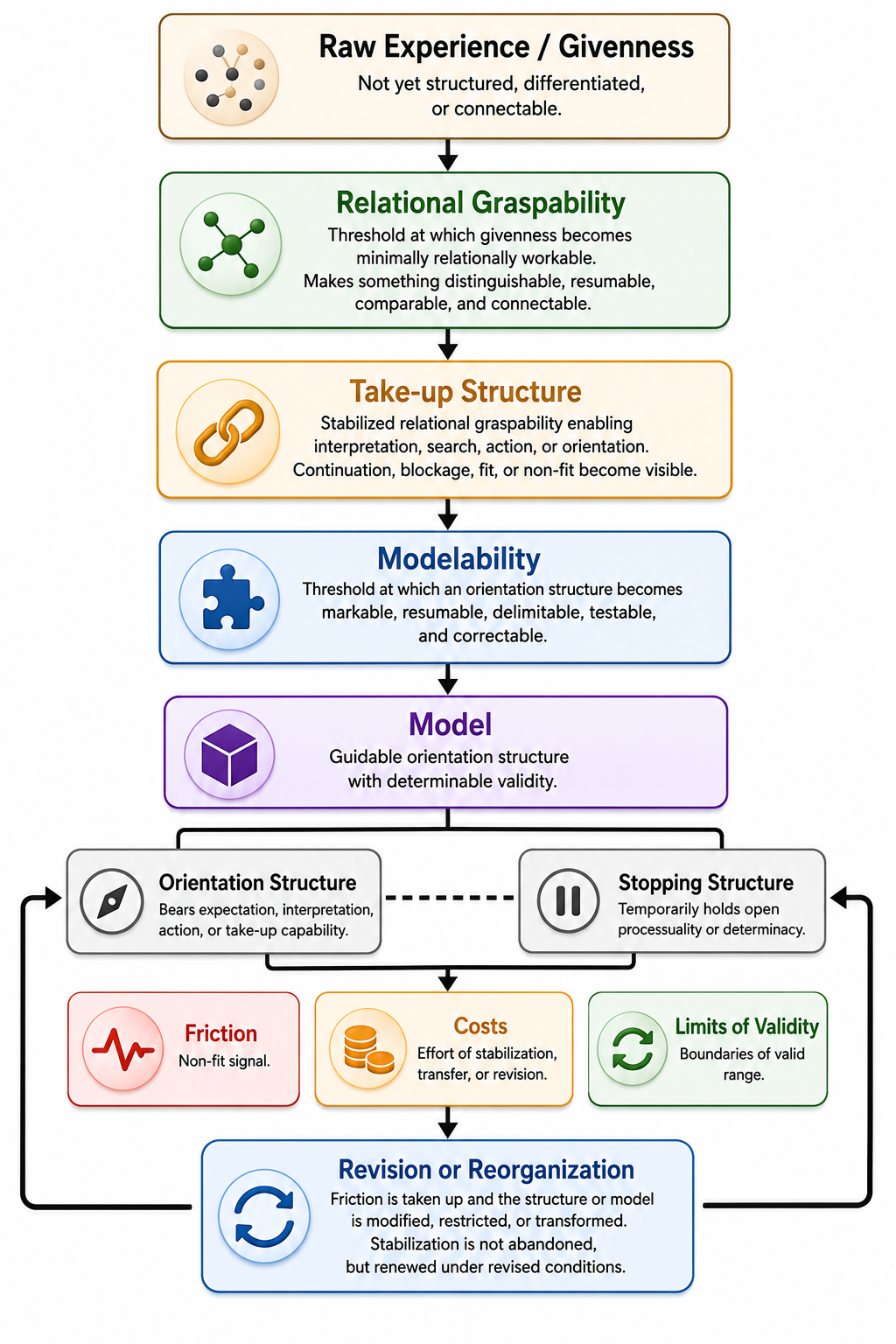
Between mere givenness and modelability there is not necessarily a temporal sequence, but a continuous process of epistemic stabilization. Relational graspability stands at its threshold. It designates the point at which givenness no longer remains merely raw experience, but becomes distinguishable, available for renewed take-up, comparable, or connectable for a cognitive system. Relational graspability is therefore not an independent object stage and not a mere preliminary stage before relation-building, but minimal relational processability itself.
As soon as something is relationally graspable, it is no longer raw experience itself, but already a processed form of take-up. This form can be remembered, re-experienced, or further processed; whether this re-experiencing phenomenally coincides with the original raw experience is secondary for epistemic analysis. What matters is whether the same or different relations, connections, expectations, and frictions emerge from it. Relational graspability therefore forms the first workable threshold of epistemic stabilization.
This clarification belongs to the broader problem field of the transition from fields of experience to modelable orders (Rapp 2026h). The present text introduces locally specified terminology for this purpose: relational graspability, take-up structure, stopping structure, and orientation structure. These concepts are not intended to provide a complete theory of experience, communication, or technical systems. Their purpose is to mark the transition from mere givenness to stabilizable epistemic processability.
Stopping structure and orientation structure designate two aspects of epistemic stabilization that may be present at the same time. The same structure can be a stopping structure insofar as it provisionally halts open processuality or determinability, and an orientation structure insofar as it supports expectation, interpretation, action, or connectability. Relational graspability, take-up structures, modelable structures, and models can fulfill both functions at once, though in different degrees.
In this context, take-up structure does not designate an additional linear stage. What is meant is the take-up function of a provisionally or more strongly stabilized relational graspability, insofar as it allows further processes of interpretation, search, action, or orientation to connect to it. A take-up structure is therefore stronger than minimal relational graspability, but weaker than modelability. It does not yet have to be markable, delimitable, testable, and correctable enough to be guided as a model. It is, however, already ordered enough for continuation, blockage, fit, or non-fit to become visible.
Modelability arises only where relational graspability or take-up structures are not merely stabilized, but become markable, available for renewed take-up, delimitable, testable, and correctable. Modelability therefore designates the threshold at which a relational form of take-up passes into a form that can be guided as a model. A model, in this sense, is a condensed orientation structure whose use can be guided and whose validity can be determined. It bundles expectations, enables application, generates costs, can encounter friction, and may require revision.
This keeps the concept of model broader than the narrow concept used in philosophy of science, but does not make it arbitrary. Not every stabilization is a model. Not every form of relational graspability is a model. Nor is every take-up, stopping, or orientation structure already a model, because these concepts designate more general threshold, connection, or aspect functions of epistemic stabilization. A model is present only where a stabilized order can be guided in such a way that its validity, its conditions of use, its limits, and its revisability become at least in principle determinable.
The following figure summarizes this threshold order:
An everyday orientation such as a map can therefore have model character. It does not designate only an image or a collection of lines, but bundles a stable orientation structure: paths, boundaries, distances, transitions, and possible routes. When this structure is called upon in operation, it can support orientation or fail. If a path is closed, if a scale remains too coarse for the situation, or if a map was created for a different form of use, it becomes visible that the map is connected with expectations, conditions of validity, and possible frictions.
Scientific models, by contrast, are especially explicit, methodically regulated, and functional-empirically tested special forms of model formation. They are not the origin of model-likeness, but a condensed and disciplinarily controlled form of it. Epistemics therefore does not restrict itself to scientific models, but it also does not expand the concept of model to every arbitrary orientation. Its object is orientation and stopping structures insofar as they gain modelability or can already be guided as models.
Finitude operates here on several levels at once. On the subjective level, attention and processing capacity limit how many possibilities, memories, or perspectives can be held at the same time. On the intersubjective level, coordination costs limit how many interpretations, norms, or expectations can be stabilized together. On the functional-empirical level, measurement effort, model complexity, and institutional infrastructure limit the range of testable statements. Epistemics does not consider these levels in isolation, but as coupled spaces of ordering, each with its own conditions of stability.
A widespread epistemic error consists in ignoring or externalizing finitude. Orientation structures and models are then treated as if they could be expanded, refined, or scaled without limit and without generating additional costs. In practice, this leads to overextension. A structure that functions in a certain range is transferred to new contexts or domains without taking the changed conditions into account. The tensions that arise are often interpreted as mere implementation problems, resistance, or errors, rather than as indications of a limit of validity.
Finitude makes revision unavoidable. Since stabilization is always provisional, orientation structures and models must be reviewed and adjusted as soon as their costs rise, their connectability declines, or their validity is overextended. Revision is therefore not a sign of epistemic failure, but a regular mechanism of adaptation. Epistemics is not primarily interested in the substantive correctness of individual results, but in the conditions under which stabilization, model validity, and revision become possible, delayed, or blocked.
Another aspect of finite cognition is the necessity of transitions. Processes of cognition move between different domains, for example when subjective experience is articulated intersubjectively or functional-empirical results are integrated into social decision-making processes. These transitions are structurally prone to friction because different logics of stability meet. Finitude intensifies this problem because not all differences can be fully negotiated or formally resolved. Epistemics makes such transitions explicit in order to reveal silent transfers and unnoticed expansions of validity.
Finitude also limits the reach of expectations of truth. Under finite conditions, no model can claim to capture all relevant aspects of a phenomenon completely or to remain permanently valid. Epistemics does not reject truth for this reason, but it refrains from using truth as the operative guiding concept of its analysis. The central concept is validity: the question of the range in which an orientation structure or model remains functionally viable at justifiable cost. This shift does not relativize empirical science; it clarifies its conditions of use.
Finitude therefore forms the structural background of the following considerations. It forces selection, requires stabilization, generates relational graspability, take-up structures, stopping structures, and orientation structures, and leads to the question of when such structures gain modelability. From there, validity, costs, friction, and revision become analyzable. On this basis, the next chapter can develop Epistemics itself as the analysis of modelable orders.
3. Epistemics as the Analysis of Modelable Orders
Epistemics designates an overarching level of analysis and clarification for processes of cognition under finite conditions. It is not itself a cognitive system in the substantive sense, and it is not an additional discipline alongside the existing sciences. Its object is not individual results, theories, or models as such, but the functional conditions under which orientation structures arise, gain modelability, are guided as models, limited, overextended, or revised.
Epistemics therefore operates at a level that is often presupposed in epistemic practice but rarely described explicitly. Cognitive systems work with stabilized orientation structures: with concepts, distinctions, expectations, routines, interpretive patterns, models, and procedures. As long as these structures function, their presuppositions usually remain in the background. Only when they reach limits do their conditions become visible. Epistemics attempts to make these conditions accessible as describable structures from the outset, rather than only at the moment of disturbance.
As an analytical level, Epistemics operates across existing disciplines. It competes neither with empirical sciences nor with their methods. It likewise replaces neither epistemological, philosophy-of-science, social-theoretical, nor phenomenological approaches. Its specific contribution lies in providing a vocabulary through which processes of cognition can be described and compared across domains without forcing them into a common ontology or normativity. Epistemics thereby creates an ordering framework that enables comparability without imposing uniformity.
The distinctive contribution of Epistemics does not lie in replacing bounded rationality, pragmatism, social epistemology, or model theory. It lies in connecting these problem fields into a functional diagnostic vocabulary: orientation structures under finite conditions become analyzable in terms of validity, domain, costs, friction, overextension, apparent stability, and revision. Epistemics therefore asks not only how cognition is limited, how models function, or how intersubjective validity arises, but how such stabilizations can be guided, limited, strained, and revised.
The concept of infrastructure remains helpful for this purpose, but it must be understood precisely. Epistemics is not an external steering authority and not a higher-order subject of cognition. It is infrastructure in the sense that it makes visible operative conditions that run along with processes of cognition: the formation of orientation structures, the threshold of modelability, the determination of ranges of validity, the acceptance of specific cost profiles, the handling of friction, and the possibility of revision. It therefore does not describe what ought to be known, but under which conditions structures of cognition become viable or lose their viability.
A central feature of Epistemics is its deliberate non-ontologization. Epistemics describes how structures of cognition operate, not what ultimately exists independently of them. Orientation structures and models are therefore not understood as images of a ready-made reality, but as functional orders through which experience, expectation, and action are stabilized. Epistemics analyzes these orders without absolutizing them. This allows it to remain connectable to different ontological positions without identifying with them or having to decide between them.
Epistemics likewise refrains from normative positing in the strong sense. It does not formulate aims for which cognition ought to be pursued, and it does not decide which models ought to count. Its diagnoses are functional: they describe whether an orientation structure or model remains viable relative to specific conditions, which costs its stabilization generates, where friction becomes visible, and whether revision is possible or blocked. Concepts such as overextension, apparent stability, or malfunction therefore do not designate moral or personal evaluation, but functional states in relation to connectability, domain-specific validity, revisability, and bearable costs.
The role of Epistemics becomes especially clear in the handling of models. In this paper, models are not restricted to scientific models in the narrow sense, but they are also not expanded to include every arbitrary stabilization. A model is a condensed orientation structure whose use can be guided and whose validity can be determined. Epistemics therefore does not first ask whether a model is true in an absolute sense, but where it remains viable, under which conditions it is valid, which costs it produces, which friction signals point to its limits, and when revision becomes necessary. The focus shifts from substantive justification to functional embedding.
Another central aspect is the separation of domains. Epistemics distinguishes between the subjective, intersubjective, and functional-empirical domains without hierarchizing or ontologizing them. These domains are not regions of reality in the strong sense, but functional spaces of ordering with different mechanisms of stability and different forms of validity. Epistemics makes transitions between these domains visible and names the costs, risks, and forms of friction that can arise at such transitions.
Epistemics thereby functions as a meta-functional space of translation. It makes it possible to translate processes of cognition from different contexts into a shared descriptive language without leveling their internal logic. This translational work is especially relevant where scientific results enter social decision-making processes, where subjective experiences are articulated intersubjectively, or where technical models influence social, political, or individual orientation. Epistemics does not replace these processes; it makes their structure visible.
Finally, Epistemics itself is bound to finitude. It is not an all-encompassing framework that could fully represent every form of cognition. It operates with the same constraints it describes: limited attention, limited conceptual precision, limited connectability, and stabilization in need of revision. Its claim is therefore deliberately limited. It is meant to help identify epistemic malformations, reveal overextensions, and enable revision. Where Epistemics itself were absolutized or overextended, a new malfunction would arise.
The functional status of Epistemics is therefore determined. It is an analysis of modelable orders under finite conditions. On this basis, the next chapter can examine the question of validity more closely: in what sense orientation structures and models remain viable, where their range ends, and why validity must not be equated with truth, legitimacy, or mere usefulness.
4. Validity and Forms of Validity
Epistemics shifts the operative focus from truth to validity. This shift stands near pragmatist perspectives on cognition as inquiry and testing, but it is developed here not as a substitute for truth, but as an analysis of domain-bound viability under finite conditions (Dewey 1938). Truth is neither rejected nor replaced by mere usefulness. What is at issue is a different level of analysis: finite cognitive systems guide orientation structures and models not only as claims to truth, but as viable orders under specific conditions. Epistemics therefore asks where, for how long, under which presuppositions, and at what cost an orientation structure or model remains viable.
Validity designates the viable range of an orientation structure or model. A structure is not valid simply as such, but always under conditions. It can enable orientation in one context and fail in another. It can guide action for a subject but remain unavailable for intersubjective take-up. It can be functional-empirically robust without thereby legitimizing a social decision. Validity is therefore not a single block, but must be differentiated according to forms and conditions of use.
In everyday language, validity is often understood as truth: what “counts” then appears as what “is true.” Epistemics explicitly separates these levels. A structure may be valid in a specific context because it supports orientation there, without thereby fulfilling an absolute claim to truth.
The first form is functional validity. An orientation structure or model has functional validity when, under specific conditions, it enables orientation, expectation, action, explanation, or prediction. Functional validity does not mean final correctness, but viability in operation. A concept, an everyday model, or a scientific model is functionally valid as long as it fulfills the task for which it is used and as long as the costs of maintaining it remain bearable.
The second form is domain-specific validity. An orientation structure or model is not valid within a homogeneous space of cognition, but within specific logics of stability. What supports subjective orientation need not be intersubjectively binding. What is intersubjectively recognized need not be functional-empirically robust. What is well tested in functional-empirical terms does not automatically generate legitimacy in social or political decision-making processes. Domain-specific validity therefore designates the binding of viability to a specific space of ordering.
The third form is intersubjective validity. It does not arise through mere agreement, but through shared reference, communicative connectability, trust, recognition, and procedures capable of coordination. A claim can possess intersubjective validity when it is available for renewed take-up, testable, negotiable, or capable of coordinating action for several cognitive systems. Intersubjective validity is therefore neither mere consensus nor truth, but a viable form of shared orientation.
The fourth form is functional-empirical validity. It concerns models, statements, or procedures that remain viable under conditions of measurement, reproducibility, formal consistency, methodological control, and inferential embedding. Functional-empirical validity is the specific strength of empirical science. It is especially robust, but not unlimited. It ends where the conditions of its testing, application, or transfer are no longer fulfilled.
This distinction prevents typical malformations. If functional validity is confused with truth, a model appears more correct than it can be under finite conditions. If intersubjective validity is confused with functional-empirical validity, agreement can appear as proof, or empirical model quality can appear as a substitute for legitimacy. If subjective orientation is confused with general binding force, individual viability is silently expanded beyond its range. Epistemics makes such shifts visible without discrediting the respective form of validity.
Validity is therefore always limited, but not arbitrary. An orientation structure can be highly stable, highly viable, and highly robust without being equally valid in all domains. Conversely, limitation does not mean weakness. Precisely the determination of limits of validity protects models from being overextended. A model does not become less valuable when its reach is limited; it becomes more precisely usable.
Validity is also related to costs. An orientation structure or model can be stably maintained only as long as the costs of its maintenance, application, or transfer remain bearable. Such costs may be cognitive, social, institutional, methodological, or revision-related. If costs rise without a corresponding increase in viability, a limit of validity becomes visible. Friction then indicates that an activated expectation, take-up, or model structure no longer fits as a matter of course under the conditions of its operation.
Revision becomes relevant where validity can no longer be maintained in its previous form. Revision does not necessarily mean abandoning a model. Often it is enough to specify its range of validity more narrowly, change its application, correct a domain shift, or make an implicit presupposition visible. Revision is therefore a means of preserving validity by clarifying its conditions.
Epistemics thus treats validity as the range of viable orientation under finite conditions. It does not first ask whether an orientation structure or model is absolutely true, but under which conditions it remains viable, in which form it is valid, which costs it generates, which frictions indicate its limits, and which revisions enable its continued viability. On this basis, the next chapter can determine the domain architecture more precisely: the distinction between those spaces of ordering in which different forms of validity are stabilized, strained, and limited.
5. Domain Architecture and Limits of Validity
Cognition does not operate in a homogeneous space. Orientation structures and models do not remain viable everywhere in the same way, but within different spaces of ordering. Epistemics calls these spaces domains. Domains are not ontological regions of reality, but functional spaces in which certain forms of stabilization, validity, friction, and revision predominate. They make visible why a structure can function in one range and lose its reach in another.
The basic domain architecture of this paper distinguishes a subjective, an intersubjective, and a functional-empirical domain. This tripartite distinction is developed more extensively in Beyond Physics and Metaphysics as a differentiation of subjective, intersubjective, and functional-empirical spaces of stability (Rapp 2026c). This distinction is neither a hierarchy nor a complete division of reality. It is a functional minimal typology. Within it, three basic logics of stability become especially clear: subjective orientation, intersubjective coordination, and functional-empirical robustness. Each of these domains fulfills its own function within processes of cognition and cannot be replaced by another without loss.
The subjective domain is the range in which experience is stabilized for a cognitive system as meaningful, concern-related, and action-guiding. Within it, experience, meaning, attention, memory, and decidability are organized. Stabilization here occurs primarily through individual coherence, recognizability, and situational capacity for orientation. An orientation structure possesses validity in this domain insofar as it functions for the respective cognitive system. This validity is not arbitrary, but it is also not immediately generally binding.
The intersubjective domain arises where orientation structures are shared, taken up again, corrected, or coordinated between cognitive systems. In this respect, Epistemics touches on questions of social epistemology and communication theory, without reducing intersubjective validity to consensus, discourse, or social recognition alone (Habermas 1981; Longino 1990). Here, shared references are established, expectations synchronized, trust built, and procedures of recognition or legitimation formed. Stabilization does not occur through mere agreement, but through communicative connectability, institutional framing, and procedures capable of coordination. Intersubjective validity arises when orientation and coordination of action become viable for several actors.
Unlike discourse-theoretical approaches, Epistemics does not understand intersubjective validity here as the fulfillment of a normative validity claim in discourse, but as viable coordination and connectability under finite conditions.
The functional-empirical domain is oriented toward testable model application. Stabilization here occurs through measurement, reproducibility, formal consistency, methodological control, and inferential embedding. In this domain, models unfold their specific strength by enabling robust predictions, explanations, or technical applications. Functional-empirical validity is therefore especially strong, but not unlimited. It ends where the conditions of measurement, testing, reproduction, or application are no longer fulfilled.
None of these domains is epistemically privileged in an absolute sense. Each has its own strength and its own limit. Subjective orientation cannot be replaced by functional-empirical testing where the issue is meaning, concern, or decidability for an individual cognitive system. Intersubjective legitimation cannot simply be derived from measurement data. Functional-empirical robustness cannot be replaced by consensus. Epistemics therefore does not order these domains hierarchically, but distinguishes their respective forms of validity.
The special robustness of functional-empirical validity within its own testing conditions therefore does not establish a general hierarchy of domains. It shows a specific strength in measurement, reproducibility, and model application, but it replaces neither subjective orientation nor intersubjective legitimation.
Malformations arise where these domains are confused or their logics of validity are silently transferred. If subjective experience is treated as an empirically decidable claim, a subjective form of validity is shifted into the functional-empirical domain. If empirical model quality is used as a substitute for intersubjective legitimation, functional-empirical validity is politically or socially overextended. If intersubjective consensus is treated as a guarantor of truth, coordinated recognition is confused with functional-empirical robustness. In such cases, the problem need not be substantive error, but structural shifts of validity.
Transitions between domains deserve special attention. The more precise analysis of such transitions, their conditions of coupling, and their possible malformations is developed in Domains, Limits, and Transition Functions (Rapp 2026a). Processes of cognition rarely remain within a single domain. Subjective experiences are articulated intersubjectively. Intersubjective determinations support empirical research, for example through institutions, standards, or procedures. Functional-empirical results influence subjective decisions and social orders. Such transitions are necessary, but prone to friction because different logics of stability meet.
Friction at transitions between domains does not automatically show that one of the involved structures is false. It can indicate that a form of validity has been transferred into a range in which its conditions are no longer fulfilled. A functional-empirical model may be robust in its domain and nevertheless become intersubjectively friction-prone when its application touches questions of legitimacy. A subjective experience may be highly viable for a cognitive system and nevertheless not count as a generally binding statement. An intersubjective consensus may coordinate action and nevertheless be insufficiently tested in functional-empirical terms.
The domain architecture therefore makes visible that many epistemic conflicts do not simply result from substantive contradictions. They often arise from unclear claims to validity, concealed transitions, or overextended transfers. A model then fails not primarily because it is false, but because it is used outside its viable range. Epistemics provides an instrumentarium for identifying such misapplications without fundamentally discrediting the models, orientation structures, or domains involved.
At the same time, this perspective protects against two opposing misreadings. First, it prevents functional-empirical models from being treated as all-purpose authorities of truth. Second, it prevents the limitation of such models from being misunderstood as a relativization of empirical science. A limit of validity does not necessarily weaken a model; it makes its conditions of use more precise. Precisely for this reason, a model can be used more strongly and more responsibly.
Domains are therefore not rigid boxes, but diagnostic spaces of ordering. They help to identify which logic of stability is currently operative, which form of validity is being claimed, which costs a transition generates, and where friction points to overextension. On this basis, the next chapter can deepen the concept of model itself: models are those condensed orientation structures whose validity, conditions of use, limits, and possibilities of revision become explicitly analyzable.
6. Models: Function, Use, Limits
Models are central operative units of epistemic orientation. They arise where orientation structures are condensed far enough that they can be guided, applied, tested, limited, and revised. Epistemics therefore treats models functionally: a model is a condensed orientation structure whose use can be guided and whose validity can be determined. Its value does not lie in an assumption of ontological correspondence, but in its viability within specific conditions.
The concept of model is therefore broader than the narrow concept of scientific models, but not arbitrary. Not every stabilization is a model, and not every orientation already has model character. Concepts, categories, entities, or routines can gain model character insofar as they bundle expectations, enable recognizability, guide application, and are in principle correctable. Model formation therefore does not begin only with science, but neither does it arise with every mere distinction. Scientific models are specialized, explicitly elaborated, and methodically tested forms of a more general achievement of model formation. In this respect, Epistemics connects with model-theoretical approaches that understand scientific models as active mediating instances between theory, experiment, and application (Giere 1988; Morgan and Morrison 1999).
The function of a model consists in stabilizing orientation without fully suspending the dynamism of experience. A model emphasizes certain differences, fixes relations, bundles expectations, and brackets other aspects. This reduction is necessary because cognition operates under finite conditions. Without such modeling, neither targeted action, nor coordinated expectation, nor systematic testing would be possible. At the same time, every act of modeling generates blind spots. Epistemics is therefore interested not only in what a model accomplishes, but also in what it excludes through its own selectivity.
The use of a model is bound to conditions. These conditions include the domain in which the model is applied, the available resources, the accepted cost profiles, the purposes of its use, and the transitions into which it is embedded. A model can produce highly robust results in the functional-empirical domain and at the same time generate conflicts in the intersubjective domain, for instance when its application is perceived as illegitimate, disproportionate, or not available for social take-up. Epistemics separates these levels in order not to confuse model performance with legitimacy, recognition, or general binding force.
Validity is the key concept for determining model uses. A model is valid where, under specific conditions, it remains functionally viable at justifiable cost. This validity is neither global nor permanently guaranteed. It must be determined in relation to domain, context, costs, and purpose. Epistemics therefore shifts attention from defending individual models to maintaining their conditions of validity. A model does not become weaker when its reach is limited; it becomes more precisely usable.
Overextension designates the expansion of a model beyond its viable range of validity. It does not concern a model’s mere error, but the use of a model structure beyond the conditions under which it can gain validity (Rapp 2026a). It is one of the most common epistemic malformations. Overextension often arises gradually, precisely because a model is successful in one range. This success makes it easier to transfer the model to new contexts or domains without sufficiently examining the changed conditions. The resulting problems are often externalized: as implementation errors, resistance, problems of acceptance, or mere irritations, rather than as indications that a limit of validity has been crossed.
Epistemics offers criteria for diagnosing such overextension. Central indications are rising costs, increasing friction at transitions between domains, declining connectability, and the loss of revisability. An overextended model tends to absolutize its own presuppositions and delegitimize divergent signals. This can produce apparent stability: the model continues to function outwardly, but internally it generates growing costs, concealed frictions, and diminishing adaptability.
Another boundary area concerns the interplay of several models. Processes of cognition rarely operate with only one model. Often, model assemblages are in use, and their internal consistency is limited. Such assemblages are not necessarily deficient. They can be functional as long as different models perform different tasks and their ranges of validity remain sufficiently distinguishable. They become problematic where one model unnoticed takes over the function of another, or where competing claims to validity are no longer explicated.
Friction between models is therefore not automatically a sign of error. It may point to competing patterns of stabilization, unclear transitions, or different logics of validity. The decisive question is whether this friction is processed productively or suppressed through absolutization. Friction becomes productive where it leads to the clarification of limits of validity, the differentiation of model functions, or the revision of an overextended application.
Models are therefore not neutral representations. They structure perception, direct attention, order expectations, and influence action. Epistemics does not normatively prescribe these effects, but it makes them visible. It allows models to be treated as tools of epistemic orientation that can be used, limited, adjusted, or set aside without this having to be understood as a loss for epistemology.
The next chapter places the cost perspective at the center. It develops how costs operate as factors of selection and strain for stabilization, model validity, and revision, and why cost blindness can lead to systematic malformations.
7. Costs and Selection
Cognition is not cost-free. Under finite conditions, costs operate as moments of selection and strain in epistemic processes; they help determine which orientation structures are stabilized, which models are continued, and which revisions can actually be carried out (Simon 1957). Every stabilization, every model application, and every revision generates effort. Epistemics therefore treats costs not as a mere side effect, but as a central factor of selection and strain in epistemic processes. Costs influence which orientation structures are maintained, which models remain viable, which claims to validity are continued, and when revision becomes likely or necessary.
Costs include more than economic expenditure. They arise at cognitive, social, institutional, methodological, and revision-related levels. Cognitive costs concern attention, processing capacity, and complexity load. Social costs concern coordination, conflict, loss of trust, or the effort required for legitimation. Institutional costs concern the binding of resources, density of regulation, and structural inertia. Methodological costs concern testing, measurement, formalization, or reproducibility. Revision costs concern reorientation, relearning, reorganization, and the possible loss of already stabilized certainties.
These forms of cost do not operate uniformly. They form cost profiles that differ by domain. In the subjective domain, rising cognitive costs can lead to overload, inability to decide, or loss of meaning. In the intersubjective domain, costs appear as conflicts, coordination problems, loss of trust, or crises of legitimacy. In the functional-empirical domain, costs appear, for example, in increasing measurement effort, growing model complexity, declining reproducibility, or expanding methodological infrastructure. Epistemics separates these effects in order to avoid misattributions.
Selection is the necessary consequence of finite resources. Not all possible orientation structures can be built at the same time, not all models can be tested in parallel, and not all claims to validity can be kept permanently open. Cognitive systems must therefore select which structures they stabilize, which models they continue, and which revisions they actually carry out. This selection is rarely fully explicit. Often it is decided through implicit thresholds: overload, delay, coordination problems, growing complexity, or declining connectability.
Costs have selective effects because they limit the viability of stabilization. As long as an orientation structure or model functions at justifiable cost, it can remain in use even if its limits are known. Only when costs reach a critical level or connectability declines significantly does revision become more likely. This pattern explains why practical epistemic changes are often triggered not by better arguments alone, but by growing strain within existing structures.
A central problem of epistemic practice is cost blindness. Costs are often externalized or made invisible, for example by shifting them to other actors, later points in time, or downstream domains. This can maintain short-term stability while long-term risks grow. A structure then appears viable because the costs of maintaining it do not become visible where its benefits appear. Epistemics therefore understands cost blindness as a structural malfunction, not as an individual failure.
Costs are closely connected with friction, but they are not identical with it. Costs designate the effort connected with stabilization, application, transfer, or revision. Friction, by contrast, designates the epistemically readable non-fit of an activated expectation, take-up, or model structure under the conditions of its operation. Rising costs can indicate friction, but not every increase in costs is already friction. Some costs are normal conditions of viable stabilization; they become friction-relevant where effort, structure, and validity no longer enter into a viable relation.
For this reason, cost trajectories have diagnostic significance. Rising expenditures of effort, growing complexity, increasing frequency of conflict, or declining reproducibility can indicate that existing patterns of stabilization are reaching their limits. These signals, however, are often ignored as long as an orientation structure or model continues to function outwardly. Epistemics therefore directs attention not only to results, but to the cost profiles under which results are generated, stabilized, and transferred.
Revision is closely connected with costs. It is often initiated where the costs of existing stabilization exceed the costs of adjustment, or where friction can no longer be absorbed by mere continuation. Revision itself, however, is also cost-intensive. It requires reorientation, reorganization, and often the loss of familiar structures. Epistemics therefore does not treat revision as a simple switch, but as an intervention under uncertainty in which stabilization costs, revision costs, and follow-on costs must be weighed against one another.
Costs also explain why certain models remain stable despite known problems. High revision costs can lead overextended models to continue being used even when their friction is visible. In such cases, a structural blockage arises: stabilization is continued not because of functional adequacy, but because alternatives are absent, appear too costly, or are institutionally unavailable. Epistemics makes such blockages visible without evaluating them morally.
Costs are therefore determined as a central factor of selection and strain in epistemic processes. They do not decide validity by themselves, but they influence how long orientation structures and models can be kept viable, when friction becomes visible, and whether revision appears possible. The next chapter examines friction itself more closely: not as mere effort, resistance, or error, but as a signal of non-fit in activated expectation, take-up, and model structures under the conditions of their operation.
8. Friction as a Boundary and Non-Fit Signal
In Epistemics, friction does not designate merely increased costs, resistance, inconsistency, or tension; the more detailed elaboration of the concept of friction is developed in Friction (Rapp 2026b). Friction occurs where an activated expectation, take-up, or model structure no longer fits as a matter of course under the conditions of its operation. The concept of take-up structure keeps open the possibility that friction can already become visible at provisional structures of search, interpretation, take-up, or stopping, without a completed model already being present. Friction therefore does not presuppose an elaborated model, but it does presuppose an order that is sufficiently relationally graspable and connectable for continuation, blockage, fit, or non-fit to become readable.
Friction is therefore not a mere error and not a mere data problem. It is a diagnostic signal. It indicates that an orientation structure, a model, a claim to validity, or a coupling between domains has reached a limit. This limit may appear as rising effort, increasing complexity, a contradictory result, absent support, a coordination problem, blocked continuation, or declining connectability. What matters is not the individual form of appearance, but the relation: something that was supposed to remain viable under specific conditions no longer does so in the expected way when put into operation.
Friction therefore does not simply arise wherever stabilization encounters some form of resistance. Resistance becomes friction-relevant only when it becomes readable in relation to an activated expectation, continuation, or model structure. A limit that is not activated does not yet generate friction. Only when a cognitive system expects a certain continuation, performs an action, stabilizes an interpretation, or transfers a model to a new range can it become visible that the structure does not fit.
A central error in dealing with friction consists in pathologizing it. Friction is often interpreted as a sign of insufficient competence, faulty data, inadequate implementation, or irrational rejection. This neutralizes its diagnostic content. Epistemics reverses this perspective. Friction is not a defect that must be eliminated as quickly as possible, but an indication of structural non-fit that must be understood before it can be meaningfully processed.
Many epistemic tensions cannot be traced back to explicit models, but to implicit expectation, take-up, or model structures running in the background. Such structures order perception, evaluation, transition, and action without themselves being expressly treated as models. Precisely because they remain implicit, they evade simple revision and can generate apparent stability. Friction makes such background structures visible by appearing where implicit assumptions of validity, routines, or expectations of continuation no longer support orientation.
Friction is closely connected with costs, but it cannot be reduced to costs. Costs designate the effort connected with stabilization, application, transfer, or revision. Friction designates the non-fit that can become visible through such costs. Rising costs, growing complexity, or increasing conflicts are therefore important indications, but they are not automatically friction. They become friction-relevant where they show that an activated structure can be maintained only under disproportionate strain, with declining connectability, or at the cost of losing its conditions of validity.
In the subjective domain, friction may appear as cognitive dissonance, overload, blockage of decision, or loss of meaning. These forms of appearance are not merely psychological defects; they can indicate that expectations, interpretations, or options for action are losing their connectability. Here, friction shows that a subjective orientation structure can no longer be maintained at justifiable cost, or that under changed conditions it no longer functions in the same way.
In the intersubjective domain, friction often appears as a coordination problem, loss of trust, conflict over legitimacy, or persistent disturbance of understanding. Here, too, friction is not simply dissent. Dissent can be productive and stabilizable. Friction arises where shared references, procedures, or expectations no longer carry enough to maintain shared orientation and coordination of action.
In the functional-empirical domain, friction may appear as declining reproducibility, rising measurement effort, increasing model complexity, contradictory results, or declining predictive power. Here, too, friction is not equivalent to falsification. Falsification is a specific mechanism of functional-empirical loss of validity, one that has been central to philosophy of science since Popper and was historically and methodologically extended by Kuhn and Lakatos (Popper 1959; Kuhn 1962; Lakatos 1970). Initially, it is a diagnostic signal that a model, a measurement practice, or an inferential embedding has come under strain. Whether this leads to falsification, a restriction of the range of validity, methodological adjustment, or revision must be examined separately.
Friction at transitions between domains is especially revealing. Here, assumptions become visible that appear stable within one domain but no longer remain viable in transition. A functional-empirically robust model can become intersubjectively prone to friction when its application touches questions of legitimacy. A subjectively viable experience can generate friction when it is treated as a generally binding statement. An intersubjectively recognized consensus can become friction-prone when it is supposed to replace functional-empirical robustness.
Friction is therefore not automatically a reason for immediate revision. It is first a reason for diagnosis. Not every tension requires adjustment, and not every adjustment is functionally meaningful. In some cases, friction may be locally limited, bearable, or even productive. In other cases, it indicates a limit of validity, a domain confusion, an overextension, or blocked revision. Epistemics therefore asks not only whether friction occurs, but which structure fails to fit under which conditions.
Friction becomes productive where it enables differentiation. It can make limits of validity visible, explicate implicit presuppositions, separate model functions, clarify transitions between domains, or trigger revision. If, by contrast, it is suppressed, externalized, or pathologized, the problem shifts. Models are defended even though their conditions no longer support them; alternative orientation structures are delegitimized; apparent stability increases.
Epistemics therefore understands friction as a necessary element of dynamic stability. Stabilization becomes viable not by avoiding friction, but by keeping friction readable, distinguishable, and processable. Friction is not the residual disturbance of an otherwise frictionless order of cognition, but a boundary signal of finite orientation. The next chapter shows how stabilization remains possible despite friction and how stable orders can at the same time be kept open to correction, limitation, and revision.
9. Stabilization and Apparent Stability
Stabilization is the operative presupposition of cognition. Without stabilization, perception, memory, expectation, action, and shared reference would not be possible. Epistemics, however, treats stabilization neither as final fixation nor as a substitute for truth, but as provisional, context-bound reduction of dynamism under finite conditions. Stabilization makes orientation possible, but it remains cost-bearing, selective, and in need of revision.
After the analysis of friction, it becomes visible that stabilization does not simply consist in avoiding friction. Stabilization becomes demanding precisely where orientation structures and models come under strain. A cognitive system must stabilize enough to preserve connectability, but must not stabilize so strongly that friction becomes unreadable, limits of validity are concealed, or revision is blocked. Viable stabilization is therefore not rigid fixation, but a mobile form of holding.
Stabilization operates on several levels at once. In the subjective domain, it enables the recognizability of experience and the maintenance of decidability. Perception is not experienced as a chaotic sequence of isolated impressions, but as a structured nexus. Memory does not arise through complete storage, but through selective ordering. Action becomes possible because expectations are stable enough for continuations, risks, and consequences to be assessed.
In the intersubjective domain, stabilization fulfills a coordinating function. Shared references, institutional rules, communicative patterns, and procedures of recognition reduce uncertainty between actors. This stabilization remains fragile because it depends on trust, legitimacy, and reciprocal expectability. Intersubjective stability therefore does not simply follow from truth, but from viable coordination. Where this coordination fails, friction can arise even if a functional-empirical model remains robust.
In the functional-empirical domain, stabilization occurs through formal consistency, standardization of measurement procedures, reproducibility, methodological control, and inferential embedding. These mechanisms make it possible to keep results comparable across time and contexts. Here, too, stabilization is no guarantee of absolute validity. It depends on infrastructure, resources, shared assumptions, and testable conditions. Epistemics makes these dependencies visible without calling into question the power of empirical science.
Stabilization is always selective. It emphasizes certain patterns and brackets others. This selection is necessary, but at the same time generates risks. If stabilization is too weak, connectability collapses; orientation remains diffuse, expectations remain indeterminate, and action becomes more difficult. If stabilization becomes too rigid, absolutization emerges; limits of validity are concealed, friction is delegitimized, and revision appears as a threat. Epistemics therefore understands stabilization as a dynamic equilibrium between hold and correctability.
A central feature of viable stabilization is revisability. An orientation structure or model must be stable enough to enable orientation, but open enough to be adjusted under changed conditions. Where stabilization blocks revision, it loses its epistemic function. It no longer produces viable orientation, but a hardened order that can no longer examine its own conditions.
Stabilization is therefore closely connected with malfunction. A stabilization does not become problematic because it is limited; under finite conditions, limitation is unavoidable. It becomes problematic when its limited character no longer remains visible. Functional determinations are then treated as final orders, ranges of validity are silently expanded, and friction signals are warded off as disturbances. In such cases, stabilization becomes absolutization. The more precise analysis of this functional condensation and its malformation is developed in the theory of ontologization (Rapp 2026e).
Another risk of stable systems is apparent stability. Apparent stability is present when an orientation structure, a model, or an institutional order appears outwardly functional, while internally it exhibits growing friction, rising costs, or declining revisability. Such systems can appear robust in the short term, but are fragile in the long term. Epistemics uses friction and cost trajectories to identify apparent stability at an early stage.
Apparent stability is especially difficult to diagnose because it is often confused with success. A model can continue to be applied, an institution can continue to function, a concept can continue to provide orientation, even though the costs of maintaining it are rising and alternative signals are being suppressed. Stability then no longer consists in viable adaptability, but in the continuation of an order whose conditions of validity become increasingly unclear.
Stabilization is therefore not a one-time act, but an ongoing process. It must adapt to changed conditions without losing its core functions. Epistemics does not provide recipes for this, but an instrumentarium for observation and diagnosis. It makes visible when stabilization enables orientation, when it processes friction productively, and when it turns into absolutization, apparent stability, or blockage of revision.
The next chapter analyzes the role of revision more closely. Revision is not understood as the opposite of stabilization, but as its necessary complement. Only a stabilization that permits revision can remain viable under finite conditions over time.
10. Revision
Revision is the controlled mechanism of adaptation in epistemic systems under finite conditions. The more detailed theory of revision as the transformation of model orders under pressure from friction, costs, and validity is developed in Revision under Finite Conditions; the present paper introduces the concept in condensed form into the working canon (Rapp 2026g). Revision changes orientation structures, models, or claims to validity when stabilization no longer remains viable, when friction can no longer be absorbed locally, or when costs and losses of connectability reach a critical level. Epistemics therefore does not understand revision as the failure of cognition, but as a regular component of dynamic stability.
Revision is rarely triggered at a single point. It is often preceded by a phase of growing strain in which costs rise, friction becomes visible, or conditions of validity become unclear without immediate action being taken. Epistemics is therefore interested not only in the moment of revision, but in the conditions under which revision becomes possible, delayed, accelerated, or blocked. What matters is not merely that something is changed, but whether the change makes the affected structure more viable again.
Revision itself is cost-bearing. It requires reorientation, relearning, reorganization, and often the loss of familiar certainties. In the subjective domain, revision can involve uncertainty, strain on identity, or loss of meaning. In the intersubjective domain, it generates coordination costs, conflicts, and new requirements of legitimation. In the functional-empirical domain, it can involve substantial methodological effort, for instance through the adjustment of measurement procedures, the reassessment of data, or the restructuring of models. Epistemics makes these costs visible without pathologizing revision.
A central problem of epistemic practice is the blockage of revision. Blockages arise when patterns of stabilization have become so hardened that alternative determinations are no longer admitted, or friction signals no longer appear diagnostically relevant. This can occur through institutional inertia, high switching costs, normative elevation, identification with existing models, or the absence of alternatives. Epistemics diagnoses such blockages as structural malfunctions, not as a mere lack of insight on the part of individual actors.
Revision is not identical with falsification. Falsification is understood here as a special case of functional-empirical loss of validity; the distinction between contextual and global falsification is developed in a separate work (Popper 1959; Kuhn 1962; Lakatos 1970; Rapp 2026d). Falsification is a specific mechanism within the functional-empirical domain that operates under defined testing conditions. Revision is broader. It may also become necessary where no formal falsification is present, for example in cases of intersubjective legitimacy problems, subjective crises of orientation, cost escalation, domain confusion, or overextended claims to validity. Falsification can trigger revision, but revision is not exhausted by falsification.
Revision is also not every kind of change. A mere adjustment, displacement, or reorganization is not yet revision in the epistemic sense. Revision occurs only where an orientation structure, a model, or a claim to validity is redefined in relation to its conditions. It therefore concerns not only contents, but also ranges of use, limits of validity, couplings, cost profiles, and the conditions of revision themselves.
Revision is always selective. Not all aspects of an orientation structure or model are adjusted at the same time. Often, peripheral elements are changed in order to preserve a core. In other cases, it is precisely the core that must be shifted while certain peripheral functions remain stable. Epistemics does not treat this selectivity as dishonesty, but as an expression of finite resources. The decisive question is whether selective revision actually processes friction or merely displaces it.
A further risk lies in overreaction. Not every friction requires revision. If every sign of strain becomes the occasion for comprehensive adjustment, instability results. Epistemics therefore emphasizes the need for a differentiated assessment of friction. Revision is a targeted intervention, not a permanent state. It is not meant to replace stabilization, but to enable its continued viability.
Revision therefore stands in a relation of tension to stabilization. Stabilization without revision leads to absolutization; revision without stabilization leads to loss of orientation. The two depend on one another. Viable epistemic systems neither stabilize maximally nor revise permanently. Rather, they keep their orientation structures sufficiently mobile for limits of validity, cost trajectories, and friction signals to remain processable.
Revision is thus determined as a structural element of epistemic systems. It is the controlled processing of problems of validity, costs, and friction under finite conditions. The next chapter analyzes typical malfunctions that arise from failed stabilization, blocked revision, cost blindness, or overextended claims to validity.
11. Malfunctions
Malfunctions arise when epistemic operations lose their functional role. In Epistemics, they are not moral, personal, or actor-psychological evaluations. A malfunction is not present because an actor behaves badly, is irrational, or commits an individual error. What is meant is a structural state in which an orientation structure, a model, a claim to validity, or a pattern of stabilization loses its supporting function in relation to connectability, domain-specific validity, bearable costs, or revisability.
Malfunctions can occur in all domains. In the subjective domain, they can strain orientation, the formation of meaning, or decidability. In the intersubjective domain, they can destabilize coordination, trust, legitimation, or shared reference. In the functional-empirical domain, they can affect measurement practice, model application, reproducibility, or inferential embedding. Epistemics describes such states systemically, not morally. It does not first ask who is at fault, but which structure no longer remains viable under which conditions.
One central malfunction is the absolutization of stabilization. This malformation stands in close proximity to the ontologization of functional determinations, which then no longer appear as revisable stabilizations but as final descriptions of reality (Rapp 2026e). Stabilization is functionally necessary, but it loses its character as a provisional reduction of dynamism as soon as it is treated as a final order. In this state, divergent signals are no longer read as possible friction, but delegitimized as disturbances. Revision no longer appears as a regular mechanism of adaptation, but as a threat to the stabilized order. The system appears stable, yet internally it becomes increasingly loaded with tension.
Closely connected to this is the malfunction of overextension. Overextension occurs when an orientation structure, a model, or a claim to validity is used beyond its viable range of validity. This expansion often takes place implicitly, for example through success, institutional reinforcement, social habituation, or normative intensification. The problems that arise are rarely recognized as an exceeding of validity, but interpreted as external resistance, problems of acceptance, or mere deficits of implementation. Epistemics identifies overextension not primarily through false contents, but through rising costs, growing friction, declining connectability, and blocked revision.
Another typical malfunction is domain confusion. It arises when the logic of stability of one domain is transferred unreflectively to another. Examples include treating subjective questions of meaning as empirically decidable problems, using empirical model quality as a substitute for intersubjective legitimation, or absolutizing intersubjective consensus as a standard of truth. Such confusions generate systematic tensions because they shift different forms of validity into one another.
Apparent stability is a malfunction that is especially difficult to recognize. It is present when an orientation structure, a model, or an institutional order appears outwardly functional, while internally showing growing friction, rising costs, or declining revisability. In the short term, apparent stability can secure the ability to act. In the long term, however, it increases the risk of abrupt crises, disorderly revision, or gradual losses of orientation. Its durability is precisely what makes it dangerous, because it conceals the need for adaptation.
Apparent stability is often not sustained by explicit models, but by implicit expectation, take-up, and model structures. Such background structures order perception, evaluation, transitions, and actions without themselves being treated as revisable determinations. They appear self-evident. As a result, they evade examination and generate stability precisely because their presuppositions remain invisible. Friction can make such background structures visible when implicit assumptions of validity no longer remain viable.
Malfunctions can also manifest themselves in the blockage of revision. Revision is then not delayed for functional reasons, but prevented by structural obstacles. Such obstacles may lie in institutional inertia, high switching costs, fear of loss of control, normative elevation, the absence of alternatives, or the identification of models with identity, status, or legitimacy. Epistemics describes such blockages as the result of hardened stabilization, not as a mere lack of insight.
Cost blindness forms another malformation. It is present when the costs of a stabilization, model application, or revision do not become visible where its benefits appear. Costs can be shifted to other actors, later points in time, other domains, or peripheral institutional areas. As a result, a structure remains apparently viable even though its maintenance generates growing strain. Cost blindness therefore often stabilizes overextension and apparent stability at the same time.
It is important that malfunctions need not visibly escalate. Many epistemic systems operate for long periods under suboptimal conditions without immediately collapsing. An orientation structure can continue to be used, a model can continue to be applied, and an institution can continue to operate, even though costs rise, friction increases, and revision is blocked. Epistemics therefore directs attention to long-term cost trajectories, recurring friction patterns, and declining revisability, not only to acute crises.
Epistemics does not moralize malfunctions. It does not distinguish between good and bad actors, but between functionally viable states and dysfunctionally hardened ones. This perspective makes it possible to diagnose malfunctions without assigning blame. It keeps the focus open for structural corrections, limits of validity, clarification of costs, and revision, instead of getting lost in justification or defensive reaction.
With the analysis of malfunctions, the problematic pole of epistemic processes has been described. Malfunctions show what happens when stabilization is absolutized, validity is overextended, costs are made invisible, friction is pathologized, or revision is blocked. The next chapter clarifies the relation between Epistemics and empirical science in order to rule out misunderstandings about relativization, competition, or methodological interference.
12. Relation to Empirical Science
Epistemics does not stand in competition with empirical science. It does not relativize its results and replaces neither its methods nor its claims to validity within the functional-empirical domain. Its contribution does not lie in substantive research itself, but in clarifying the conditions under which empirical models are used, stabilized, transferred, overextended, or revised.
Empirical science operates with highly developed procedures of measurement, inference, methodological control, formal consistency, and reproducibility. Its model practice can therefore be connected to those debates in philosophy of science in which models, falsification, paradigms, and research programs are examined as conditions of scientific validity (Popper 1959; Kuhn 1962; Lakatos 1970; Giere 1988; Morgan and Morrison 1999). These procedures make precise model formation and robust results possible. Epistemics explicitly acknowledges this achievement. It does not ask whether empirical results are “really true,” but under which conditions they have functional-empirical validity, which limits of validity they possess, and how their application is carried into other domains.
A frequent misunderstanding consists in confusing validity with truth, or empirical robustness with general jurisdiction. In empirical practice, the limitation of validity is often carried along methodologically, but it is not always sufficiently explicated in social, political, or subjective contexts of connection. Epistemics makes this boundary visible. Empirical models are valid where their conditions of testing, measurement, application, and reproduction are fulfilled. If this validity is silently transferred into other domains, frictions can arise.
These frictions are not evidence against empirical research. Rather, they indicate problematic transitions between domains. An empirical model may be highly functional-empirically robust and nevertheless become friction-prone in intersubjective terms when its application touches questions of legitimacy. Conversely, intersubjective rejection does not automatically refute an empirical model. Epistemics separates the levels here: empirical model quality, intersubjective legitimation, and subjective orientation follow different conditions of validity. This separation touches on social-epistemological questions concerning objectivity, trust, and shared examination, without reducing empirical validity to social recognition (Longino 1990).
In this sense, Epistemics functions as a framework of clarification and protection for empirical science. It does not protect empirical science from criticism, but from overburdening and false jurisdiction. Many conflicts that appear as skepticism toward science or rejection of empirical results contain a shift of domain or validity: empirical models are used as substitutes for legitimation, subjective experiences are treated as empirically decidable claims, or political decisions are presented as if they followed immediately from data. Epistemics makes visible that empirical results can inform decisions without legitimizing them by themselves. This preserves the difference between functional-empirical model quality and intersubjective legitimation, a difference that is also central in communication-theoretical and legitimacy-theoretical contexts (Habermas 1981).
A further protective mechanism lies in the cost perspective. Empirical research is itself cost-bearing and operates under finite conditions. Measurement, modeling, reproducibility, data infrastructure, methodological control, and revision generate effort. This insight does not relativize empirical results; it prevents their overburdening. Where empirical models are treated as universally competent, expectations, costs, and friction rise. Epistemics limits such expectations by specifying the range of empirical statements.
Epistemics also does not interfere with the internal criteria of empirical revision. Contextual and global falsification remain operative mechanisms of the functional-empirical domain, provided that their respective testing conditions are fulfilled. Epistemics can describe falsification as a special case of revision without generalizing or normativizing it. The more precise distinction between contextual and global falsification is developed in Contextual and Global Falsification of Scientific Models (Rapp 2026d). The autonomy of empirical research is thereby preserved. Epistemics does not ask which empirical model is to be accepted within a specialized science, but under which conditions models gain, lose, transfer, or overextend their validity.
Finally, Epistemics prevents the ontologization of empirical models. This boundary between empirical model validity and metaphysical hardening connects to the cognition-relative critique of a naively presupposed relation to an outside, as well as to the functional analysis of ontologization (Rapp 2026f; Rapp 2026e). Models are not immediately treated as statements about what ultimately exists independently of all epistemic conditions, but as functional structures with defined validity. This stance does not weaken scientific claims. It makes them more precise. Empirical models can be highly robust, technically successful, and theoretically fruitful without thereby having to harden into metaphysical worldviews.
The relation is therefore clarified: Epistemics is neither an opponent of empirical science nor a replacement for its methods. It is a framework for clarifying the conditions, limits, costs, transitions, and forms of revision of empirical model validity. The concluding chapter brings Epistemics together as a revisable working canon and outlines its use for further work.
13. Epistemics as a Revisable Working Canon
This paper has introduced Epistemics as the analysis of orientation structures, model validity, and revision under finite conditions. Epistemics has been neither ontologized nor normatively charged. Its object is not what ought to be known or what is ultimately real, but how finite cognitive systems stabilize orientation, form modelability, guide models, limit validity, bear costs, read friction, and enable revision. Epistemics therefore does not occupy a substantive space, but a functional field of analysis.
The central result consists in the explicit separation and coupling of epistemic functions. Finitude forces selection. Selection requires stabilization. Stabilization generates orientation structures. Some of these structures gain modelability and can be guided as models. Models possess validity only under conditions. These conditions are domain-specific, cost-bearing, prone to friction, and in need of revision. None of these operations is problematic in itself. Malfunctions arise where their functional role is lost: where stabilization is absolutized, validity is silently expanded, costs are made invisible, friction is pathologized, or revision is blocked.
The domain architecture forms a central instrument of ordering. The subjective, intersubjective, and functional-empirical domains are not ontological regions of reality, but functional spaces of ordering with different logics of stability. Problems of cognition often arise not from false models alone, but from unclear shifts between domains, implicit displacements of validity, or overextended transfers. Epistemics provides a vocabulary for diagnosing such shifts without playing one domain off against another or hierarchizing them.
The concept of costs is especially important. Costs are not an external supplement to epistemic processes, but a factor of selection and strain within finite cognition. They explain why certain orientation structures remain stable, why models continue to be used despite known weaknesses, why revision is delayed, and why overextension can persist despite visible friction. Costs make visible that cognition is stabilized not by better arguments alone, but by viable structures, available resources, and revisable transitions. This insight does not relativize cognition; it specifies its conditions.
In this context, friction proves to be a central boundary and non-fit signal. It does not simply indicate resistance, error, or increased costs, but the epistemically readable non-fit of an activated expectation, take-up, or model structure under the conditions of its operation. Epistemics therefore does not evaluate friction as a defect, but as a diagnostic indication. Properly read, friction enables differentiation, limitation of validity, and revision. Ignored, externalized, or pathologized, it leads to apparent stability and long-term fragility.
The relation to empirical science has been explicitly clarified. Epistemics does not replace any empirical method, does not relativize results, and claims no substantive authority over specialized scientific decisions. Its function is to make visible the conditions, limits, costs, transitions, and forms of revision of empirical model validity. It thereby protects empirical science not from criticism, but from overextension, ontologization, and illegitimate appropriation. Empirical models can be highly robust without automatically supplying intersubjective legitimation, subjective orientation, or metaphysical final validity.
Epistemics itself can also be overextended. This happens when its analytical vocabulary is applied to phenomena for which no modelable orientation structure, no determinable claim to validity, or no diagnostically readable frictional relation is present. Friction signals within Epistemics itself would include conceptual overproduction, declining connectability, the confusion of functional diagnosis with normative evaluation, or the tendency to read every form of cognition exclusively as a case of Epistemics. The working canon therefore remains revisable.
The conceptual canon introduced in this paper functions as a working canon. It is deliberately stabilized, but not dogmatic. Its function is to keep central concepts testable, prevent implicit shifts in meaning, and make later specifications visible. The canon is therefore not a closure, but a revisable handoff. Further works can and should continue, shift, or sharpen it, provided that such changes are explicitly marked.
Epistemics therefore understands itself as a tool for analyzing processes of cognition under realistic conditions of finite orientation. It is not a worldview and not a theory that substantively replaces all forms of cognition. Its usefulness lies in its ability to determine limits of validity, make costs visible, keep friction readable, recognize malfunctions early, and make revision possible. In this sense, this basic paper forms the point of departure for further work, not its conclusion.
Conceptual Canon of This Paper
The following conceptual canon serves to stabilize central meanings within this text. It makes no claim to completeness or final systematicity. Concepts not listed here either do not belong to the functional core of this paper or are treated in separate works.
The conceptual canon should be understood as an explicitly stabilized basis of reference. It forms the point of departure for the conceptual work of this and later papers, but it is neither rigid nor dogmatic. Changes, specifications, or extensions of the canon are possible in principle, but they are subject to a strict condition: every deviation, modification, or extension of the canon must be explicitly identified, locally limited, and justified. Implicit shifts in meaning, silent extensions, or retrospective reinterpretations are excluded.
In this way, the conceptual canon combines stability with developmental capacity. It enables consistent reference across several works without blocking theoretical development. New concepts can be introduced in subsequent papers and, where appropriate, canonized, provided that this is explicitly indicated.
The canon distinguishes between core concepts, preparatory threshold and functional concepts, and derived diagnostic concepts. The core includes, in particular, Epistemics, orientation structure, model, validity, domain, stabilization, costs, friction, and revision. Relational graspability, take-up structure, and modelability form the preparatory threshold and functional concepts of epistemic processability; stopping structure and orientation structure designate, across these levels, aspects of epistemic stabilization. Cost blindness, overextension, apparent stability, and malfunction designate derived diagnostic forms.
Epistemics
Short definition: The analysis of orientation structures, model validity, and revision under finite conditions.
Function: This concept clarifies how finite cognitive systems stabilize orientation, form modelability, guide models, limit validity, bear costs, read friction, and enable revision.
Delimitation: It is not metaphysics, not normative theory, not an empirical discipline, and not a replacement for existing sciences.
Finitude
Short definition: The structural limitation of cognitive systems with respect to time, attention, processing capacity, social coordination, and institutional resources.
Function: This concept explains why cognition must select, stabilize, limit, and revise.
Delimitation: It is not a mere deficit of individual actors or institutions, but a constitutive condition of processes of cognition.
Orientation
Short definition: The functional directedness of a cognitive system within experience, expectation, and action.
Function: This concept designates the practical nexus in which stabilization, model formation, and validity become relevant.
Delimitation: It is not mere subjective opinion and not already completed cognition, but the ongoing enactment of structured connectability.
Orientation Structure
Short definition: An aspect concept of epistemic stabilization: a structure insofar as it supports orientation.
Function: It guides expectation, interpretation, action, connectability, or model formation.
Delimitation: It is not opposed to stopping structure; the same structure can be described as a stopping structure when its holding function is foregrounded, and as an orientation structure when its orienting function is foregrounded.
Stopping Structure
Short definition: An aspect concept of epistemic stabilization: a structure insofar as it provisionally halts open processuality or determinability.
Function: It makes processing, comparison, communication, testing, orientation, or guided model use possible.
Delimitation: It is not a separate linear intermediate stage between relational graspability and modelability. Relational graspability, take-up structures, orientation structures, and models can be stopping structures insofar as their holding function is foregrounded.
Relational Graspability
Short definition: The threshold at which givenness no longer remains merely raw experience, but becomes graspable for a cognitive system as minimal relational processability.
Function: It makes something distinguishable, available for renewed take-up, comparable, and connectable, thereby forming the first transition from mere givenness to epistemic processability.
Delimitation: It is not raw experience itself, not an independent object stage, and not yet a model. Relational graspability replaces the separate treatment of graspability and relational form; “relational form” may be used explanatorily, but it is not an independent canon concept of this paper.
Take-up Structure
Short definition: Provisionally or more strongly stabilized relational graspability insofar as it makes further processes of interpretation, search, action, or orientation connectable.
Function: This concept marks the threshold at which continuation, blockage, fit, or non-fit can become visible without a finished model already having to be present.
Delimitation: It is more than minimal relational graspability, but not yet modelability. A take-up structure does not yet have to be markable, delimitable, testable, and correctable enough to be guided as a model.
Modelability
Short definition: The threshold at which an orientation structure becomes markable, available for renewed take-up, delimitable, testable, and correctable.
Function: This concept designates the transition from mere orientation to a structure that can be guided as a model.
Delimitation: It is not yet identical with elaborated guided model use, but it is the condition for model validity, costs, friction, and revision to become determinable.
Model
Short definition: A condensed orientation structure whose use can be guided and whose validity can be determined.
Function: It bundles expectations, reduces dynamism, enables application, generates costs, can encounter friction, and may require revision.
Delimitation: It is not an image of reality and is not restricted to scientific models; at the same time, not every stabilization, relational graspability, take-up structure, or stopping structure is a model.
Scientific Model
Short definition: An explicit, methodically regulated, and functional-empirically tested special form of model formation.
Function: It enables measurement, explanation, prediction, technical application, and testable model use.
Delimitation: It is not the origin of all model-likeness, but a specialized form of modelable orientation.
Validity
Short definition: The viable range of an orientation structure or model under specific conditions.
Function: This concept determines where, for how long, under which presuppositions, and at what cost a structure remains viable.
Delimitation: It is not absolute truth, not mere consensus, not mere usefulness, and not an ontological status.
Functional Validity
Short definition: The viability of an orientation structure or model in operation.
Function: This concept determines whether a structure enables orientation, expectation, action, explanation, or prediction.
Delimitation: It is not final correctness, but conditional functional capacity.
Domain-Specific Validity
Short definition: Validity within a specific functional space of ordering.
Function: This concept prevents unnoticed transfers of claims to validity between different logics of stability.
Delimitation: It is not general validity across all domains.
Intersubjective Validity
Short definition: The viability of a claim in the space of shared reference, communication, recognition, and coordination.
Function: This concept enables shared orientation and coordination of action between cognitive systems.
Delimitation: It is not mere consensus and not identical with functional-empirical robustness.
Functional-Empirical Validity
Short definition: Validity under conditions of measurement, reproducibility, methodological control, formal consistency, and inferential embedding.
Function: This concept determines the specific strength of empirical science and testable model use.
Delimitation: It is not automatic intersubjective legitimation and not metaphysical final validity.
Domain
Short definition: A functional space of ordering with its own conditions of stability, validity, friction, and revision.
Function: This concept separates different logics of validity, especially subjective, intersubjective, and functional-empirical stabilization.
Delimitation: It is not an ontological region and not a complete division of reality.
Subjective Domain
Short definition: The space of ordering of subjective orientation in which experience, meaning, concern, and decidability are stabilized.
Function: It enables individual connectability, recognizability, and action-guiding orientation.
Delimitation: It is not arbitrary, but it is also not immediately generally binding.
Intersubjective Domain
Short definition: The space of ordering of shared reference, communication, trust, recognition, and legitimation.
Function: It enables coordination between cognitive systems.
Delimitation: It is not mere consensus and not identical with functional-empirical truth or robustness.
Functional-Empirical Domain
Short definition: The space of ordering of testable model use under conditions of measurement, testing, reproduction, and inference.
Function: It enables robust empirical statements, predictions, explanations, and technical applications.
Delimitation: It does not have universal jurisdiction and does not automatically legitimate subjective or intersubjective questions.
Stabilization
Short definition: The provisional, context-bound reduction of dynamism.
Function: It enables recognizability, memory, expectation, action, shared reference, and modelability.
Delimitation: It is not final fixation, not a substitute for truth, and not necessarily already model formation.
Costs
Short definition: The effort connected with stabilization, model application, transfer, or revision.
Function: Costs operate as factors of selection and strain in epistemic processes.
Delimitation: They are not only economic; they include cognitive, social, institutional, methodological, and revision-related costs.
Cost Blindness
Short definition: A state in which the costs of a stabilization, model application, or revision do not become visible where its benefits appear.
Function: This concept explains how overextension and apparent stability can be maintained despite growing strain.
Delimitation: It is not a mere individual oversight, but a structural malformation.
Friction
Short definition: The epistemically readable non-fit of an activated expectation, take-up, or model structure under the conditions of its operation.
Function: This concept makes limits of validity, overextension, domain conflicts, cost problems, and the need for revision visible.
Delimitation: It is not a mere error, not a pure data problem, not falsification, and not identical with costs, resistance, or tension.
Revision
Short definition: The controlled adaptation of orientation structures, models, or claims to validity under pressure from friction, costs, or validity.
Function: It preserves adaptability under finite conditions.
Delimitation: It is not a failure of cognition, not mere change, not general reorganization, and not identical with falsification.
Falsification
Short definition: A specific mechanism of functional-empirical loss of validity under defined testing conditions.
Function: It can trigger revision within the functional-empirical domain.
Delimitation: It is not a general model for every revision and not identical with friction.
Overextension
Short definition: The use of an orientation structure, a model, or a claim to validity outside its viable range of validity.
Function: This concept marks a typical malformation of epistemic stabilization.
Delimitation: It is not a mere model error, but a problem of validity and use.
Apparent Stability
Short definition: A state of outward functionality accompanied by internally growing friction, rising costs, or declining revisability.
Function: This concept makes visible why systems can become fragile in the long term despite apparent stability.
Delimitation: It is not genuine viable stability, but concealed stabilization under strain.
Malfunction
Short definition: A structural state in which epistemic operations lose their functional role.
Function: This concept names states in which stabilization, validity, cost processing, friction readability, or revision become dysfunctional under finite conditions.
Delimitation: It is not a moral attribution of blame and not an actor-psychological diagnosis, but a functional diagnosis relative to explicit criteria.
Working Canon
Short definition: An explicitly stabilized but revisable basis of reference for central concepts.
Function: It prevents silent shifts in meaning and makes later specifications visible.
Delimitation: It is not a dogmatic closure and not a final systematic order.
Canonical Status and Range of Validity
The conceptual canon introduced in this paper forms the provisionally stabilized basis of reference for Epistemics. Its concepts are binding for the range of validity of this paper and may be used as a point of departure in subsequent works, provided that their use is explicitly indicated. The canon makes no claim to final completeness. It remains revisable, but every later deviation, specification, or extension must be explicitly identified, locally limited, and justified. Implicit shifts in meaning, silent extensions, or retrospective reinterpretations are excluded.
Literature
Dewey, John. 1938. Logic: The Theory of Inquiry. New York: Henry Holt.
Giere, Ronald N. 1988. Explaining Science: A Cognitive Approach. Chicago: University of Chicago Press.
Habermas, Jürgen. 1981. Theorie des kommunikativen Handelns. 2 vols. Frankfurt am Main: Suhrkamp.
Kuhn, Thomas S. 1962. The Structure of Scientific Revolutions. Chicago: University of Chicago Press.
Lakatos, Imre. 1970. “Falsification and the Methodology of Scientific Research Programmes.” In Criticism and the Growth of Knowledge, edited by Imre Lakatos and Alan Musgrave, 91–196. Cambridge: Cambridge University Press.
Longino, Helen E. 1990. Science as Social Knowledge: Values and Objectivity in Scientific Inquiry. Princeton: Princeton University Press.
Morgan, Mary S., and Margaret Morrison, eds. 1999. Models as Mediators: Perspectives on Natural and Social Science. Cambridge: Cambridge University Press.
Popper, Karl R. 1959. The Logic of Scientific Discovery. London: Hutchinson.
Rapp, Stefan. 2026a. Domains, Boundaries, and Transition Functions: On the Domain-Relative Validity, Migration, and Coupling of Models under Finite Conditions. Zenodo. https://doi.org/10.5281/zenodo.19542526.
Rapp, Stefan. 2026b. Friction: Boundary Signal of Finite Load-Bearing Capacity in Subjective, Intersubjective, and Functional-Empirical Domains. Zenodo. https://doi.org/10.5281/zenodo.18434699.
Rapp, Stefan. 2026c. Beyond Physics and Metaphysics: Epistemics and the Differentiation of Reality into Subjective, Intersubjective, and Functional-Empirical Physics. Zenodo. https://doi.org/10.5281/zenodo.18317965.
Rapp, Stefan. 2026d. Contextual and Global Falsification of Scientific Models: An Integrated Theory of Epistemic Validity. Zenodo. https://doi.org/10.5281/zenodo.17714966.
Rapp, Stefan. 2026e. Ontologization as an Epistemic Basic Operation: Functional Stabilization, Intersubjectivity, and Malfunction. Zenodo. https://doi.org/10.5281/zenodo.18346602.
Rapp, Stefan. 2026f. Realism Without an Outside: Cognition-Relative Realism and the Limit of Positive Determinability. Last revised May 9, 2026. Zenodo. https://doi.org/10.5281/zenodo.20107915.
Rapp, Stefan. 2026g. Revision under Finite Conditions: A Theory of Model Transformation in Epistemics. Zenodo. https://doi.org/10.5281/zenodo.18935928.
Rapp, Stefan. 2026h. From the Field of Experience to the Model: Epistemic Stabilization and the Localization of Uncertainty under Finite Conditions. Zenodo. https://doi.org/10.5281/zenodo.19917105.
Simon, Herbert A. 1957. Models of Man: Social and Rational. New York: Wiley.
Appendix A: Illustrative Examples
The following examples do not introduce new concepts, but didactically illustrate the canon developed in the paper. They show how relational graspability, take-up structure, modelability, validity, costs, friction, and revision interact in simple cases. The examples are deliberately general. They are not meant to replace independent case studies, but to make the operative readability of the concepts easier to grasp.
A.1 Map: Validity and Overextension
A map is not a mere image and not a simple representation of reality. It makes a space relationally graspable in a specific respect: paths, boundaries, distances, transitions, and possible routes become distinguishable and available for renewed take-up. This gives rise to an orientation that becomes connectable for specific purposes.
This connectability, however, is not unlimited. A road map supports different purposes than a hiking map, and a political map supports different purposes than a topographic map. Every map stabilizes certain relations and lets others recede. It is therefore not valid simply as such, but under conditions: for specific users, purposes, scales, requirements of precision, and situations of action.
Friction arises when these conditions of validity no longer hold in actual use. A map may be too coarse, a route may be closed, a scale may become unsuitable for the concrete situation, or a map may be used for a form of use for which it was not created. In such cases, the map as a whole is not necessarily false. What becomes visible instead is a limit of its validity or an overextension of its range of use.
Revision can take different forms in this case. One can use a more precise map, restrict the purpose of the map, include additional information, or redefine the route. Orientation is not simply abandoned, but stabilized anew under changed conditions.
A.2 Diagnosis: Model Formation and Revision
A medical diagnosis shows especially clearly that models should not be understood as complete representations. A diagnosis orders symptoms, findings, probabilities, and possible causes into a structure whose use can be guided. It makes an initially unclear nexus of experience and findings relationally graspable and transforms it into a connectable order.
This order can become modelable when it is markable, available for renewed take-up, delimitable, testable, and correctable. A diagnosis is then not merely a conjecture, but a structured orientation: it determines which further examinations make sense, which treatment is indicated, and which expectations about the course of illness are formed.
Validity here does not mean absolute truth about the whole person. A diagnosis is valid under specific conditions: on the basis of available findings, specific measurement procedures, medical experience, statistical probabilities, and concrete treatment contexts. It can remain functionally viable without being complete or final.
Friction arises when new findings do not fit, symptoms develop differently, a treatment does not work, or an alternative cause becomes more likely. Revision then does not necessarily mean rejecting the diagnosis completely. It may also mean determining its range of validity more narrowly, including an additional diagnosis, correcting a model coupling, or reorganizing the path of examination.
A.3 Social Attribution: Intersubjective Connectability
In everyday life, people constantly form social attributions. A person appears reliable, competent, friendly, risky, or familiar. Such attributions are not immediately finished models in the strict sense, but they make social behavior relationally graspable. Individual indications, experiences, gestures, narratives, or roles are connected into a provisional orientation.
A take-up structure arises when this orientation enables further interpretation and action. One trusts a statement, expects certain behavior, agrees to collaborate, or keeps distance. The attribution therefore stabilizes an intersubjective expectation. It is not simply truth about a person, but a more or less viable orientation under limited information.
Friction arises when behavior, responses, or new contexts no longer fit the attribution. Someone who seemed reliable acts unreliably; someone who appeared incompetent shows considerable ability in another context; a social role explains behavior less well than expected. In such cases, it is not merely an opinion that is disturbed; a take-up structure loses viability.
Revision can mean changing the attribution, restricting its range of validity, or distinguishing more sharply between situation, role, and person. Social orientation thereby does not become arbitrary, but more precise: it remains connectable without absolutizing itself as final truth about the person.
A.4 Scientific Model: Functional-Empirical Validity
A scientific model is an especially explicit and methodically controlled form of epistemic stabilization. It makes a domain of objects processable under specific assumptions, measurement conditions, concepts, and procedures. This produces an order that not only enables orientation, but can also be tested, applied, limited, and revised.
Its strength lies in functional-empirical validity. A model remains viable when, under specific conditions, it explains, predicts, measures, orders, or enables technical application. This validity is strong, but not unlimited. It depends on scales, data quality, measurement procedures, boundary conditions, model assumptions, and institutional testing practices.
Friction arises when measurements, predictions, reproducibility, or transfers no longer fit. It does not automatically follow from this that the model has been globally falsified. It is also possible that only a parameter must be adjusted, a range of validity restricted, a measurement practice examined, or a coupling to other models redefined.
In this context, revision is a controlled way of handling friction. It can mean local correction, methodological adjustment, restriction of application, or deeper model transformation. What matters is that stabilization is not blindly continued, but that its conditions of validity remain visible and processable.
A.5 Boundary Case: When Epistemic Diagnosis Is Not Enough
A boundary case shows that Epistemics does not replace concrete specialized decisions. In a medical emergency, epistemic diagnosis can retrospectively clarify which models, conditions of validity, costs, and frictions were involved. In the acute course of action, however, established procedures, clinical experience, available findings, and speed of action decide. Epistemics can make visible why certain protocols are valid, where their limits lie, and when revision becomes necessary. But it cannot take the place of domain-specific testing and decision.
The case strains the framework because it shows that not every situation is improved by metatheoretical reflection. Under time pressure, additional reflection can itself generate costs and block action. Epistemics remains viable where it clarifies conditions of validity, overextension, friction, and revision; it is overextended when it replaces operative specialized competence. Precisely in this way, its own limit of validity becomes visible.
A.6 Summary of the Examples
The examples show the same basic movement in different areas: relational graspability gives rise to take-up structures, some of these gain modelability, and models possess validity only under specific conditions. Friction makes visible where an expectation, take-up, or model structure no longer supports orientation as a matter of course in actual use; costs show how demanding stabilization, transfer, or revision becomes.
Epistemics does not replace concrete specialized analyses. It makes it possible to describe comparatively how orientation, validity, friction, and revision arise in different domains, how they are limited, and how they remain correctable.