
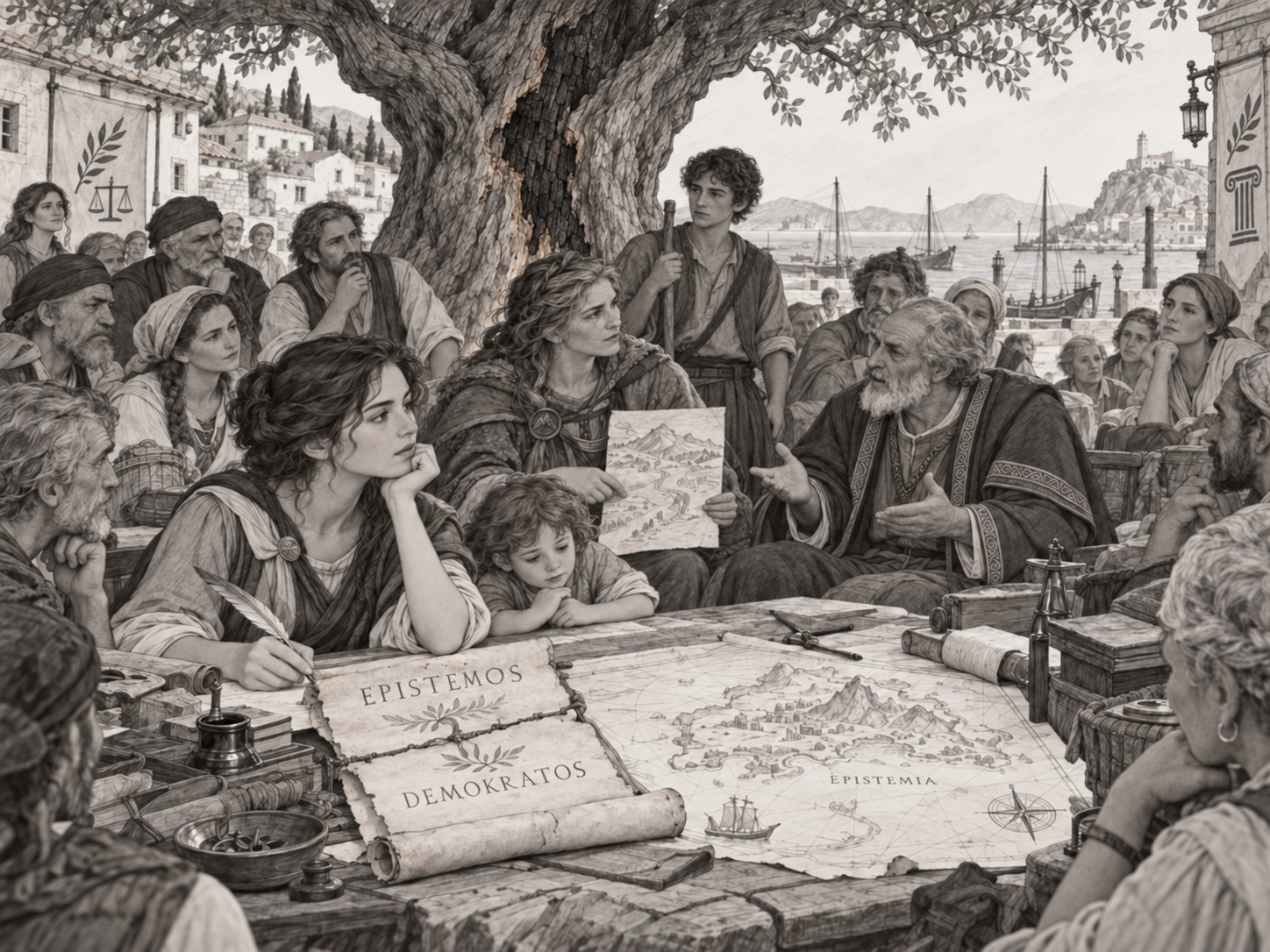
Far out at sea lay a small island. It was not large. On clear days, you could see from the hills in the north all the way to the fields in the south. There was a small harbour in the west, while in the east the houses stood close together. Almost everyone knew everyone else, at least by sight.
The inhabitants called their island Demokratia. Hardly anyone still knew that it had once been called Epistemia. Only a few old stones bore markings that no one could quite read any more.
The Old Conflict
Long before the inhabitants wrote down their order, a terrible conflict had broken out on the island. It had begun with things that did not seem very important at first: water, paths, land, and the question of who was entitled to control the shared supplies. Soon, however, they were no longer arguing only about water and paths. They were arguing about which people were reasonable, whom they could still trust, and who actually had the right to speak for the island.
Neighbours became opposing camps. Mistrust became fear. And fear became violence.
A house by the harbour burned down. Several people died. Others fled to the mountains for months. An old tree remained standing in the main square, its trunk charred black on one side. Decades later, parents were still showing their children that tree.
“Something like this must never happen again,” they said.
After the conflict, the inhabitants first tried to work out together how they wanted to live with one another in future. They could agree on many things. But on some fundamental questions, even long discussions brought no shared solution. These differences eventually gave rise to two ideas of what their common order should look like.
One group lived mainly in the flatter parts of the island and soon became known as the lowlanders. The others came more often from the higher villages and were called the highlanders.
The lowlanders wanted an order that gave people as much freedom as possible. They distrusted too many regulations. Rules, they said, could easily become so restrictive that in the end no one could act freely any more.
The highlanders saw the other side more clearly. Where many people lived together, binding rules were needed. Sometimes individuals had to accept something so that life together would work for everyone. Both sides believed their own ideas were better.
Yet within both groups there were people who went further. Some lowlanders were convinced that their order was not merely better, but the only truly reasonable one. They later became known as the Lowland Guardians.
There were such people among the highlanders too. For them, their own order was likewise not one possibility among several. They considered it superior in principle. They were called the Highland Guardians.
At that time, everyone still knew that a lowlander was not the same as a Lowland Guardian, and a highlander was not the same as a Highland Guardian. Later, that distinction would almost disappear.
The First Decision
Years after the great conflict, the inhabitants gathered beneath the charred tree. Once again, they talked for days. The lowlanders explained why their order was freer and more humane. The highlanders explained why theirs made life together more reliable. Neither side could convince the other.
At last, a highland woman said, “Perhaps we do not need to find out which of us is right for all time.”
A lowland man asked, “What else should we do?”
“Decide how we want to live together now.”
And so the idea of a joint vote emerged. Every adult inhabitant was to have one vote. Together, as they soon put it, they formed the island’s demos. The order that received the most votes would apply to everyone for the time being. The lowlanders agreed. So did the highlanders.
The Lowland Guardians had little objection. They were convinced that their side would win anyway.
The Highland Guardians were more sceptical.
“And what if the majority is wrong?” they asked.
An old fisherman replied, “Then perhaps it can decide differently later.”
They discussed this for a long time. At last, they reached an agreement. The losing side would accept the chosen order. In return, it could continue to argue for its own. No one would lose their place in the community through defeat. And if people chose differently one day, it should be possible to change the order again as well.
“We are deciding today,” said one of the lowlanders, “not for everyone who will ever live on this island.”
The highland woman nodded. “The island may still be the same then. But the people may not.”
Then they voted. Together, the lowlanders and the Lowland Guardians won a majority. The order of the lowlands became the island’s common order.
The highlanders accepted the result. They now had to live under rules they themselves had not preferred. For that very reason, the lowlanders made sure they could continue to have a say, voice criticism, and argue for change.
The Highland Guardians remained dissatisfied. But there were few of them. For the first time in a long while, the island seemed to be finding peace.
Epistemos and Demokratos
The inhabitants now decided to write down their new order. They wanted to spare later generations from having to negotiate everything all over again.
The document consisted of two parts. Above the first stood the word: Epistemos.
It contained not a single rule. In it, the inhabitants recorded what they had learned during the years of conflict and discussion. They wrote it not as a commandment, but as a letter to those who would come after them.
We have decided to the best of our knowledge, they wrote. And we may still have been wrong. We do not know who you will be. People change. And the order we leave you will change you too. That is why we have no right to decide for you how you must live for ever.
We have placed the foundations of our order beyond the reach of the council and its offices. Not beyond yours. If you wish to change them, come together as we came together: all of you, as equals, knowing that this time the whole is at stake.
And know what you then hold in your hands. There, you can decide on a better order. But there, you can also decide never to come together in this way again. No document can protect you from that with certainty. Not even this one. We can only remind you.
Below it began the second part. It was called Demokratos. That was where the rules were written. How voting would work. How disputes should be settled. Who would take on shared responsibilities. What rights every inhabitant possessed. And how the order could be changed.
The inhabitants distinguished between two kinds of rules. Many were to remain open to change in ordinary political life. No one wanted to summon the whole island over every new difficulty.
Others, however, determined the structure of Demokratos itself: how power was distributed, who was entitled to make decisions affecting whom, and how many individual decisions gave rise to a common order. Councils, officeholders, and shifting majorities were not to be allowed to remodel these rules piece by piece. For even an elected council could only ever see part of the whole. Offices developed habits of their own. One change could build on the next until something had emerged that no one had ever approved as a whole.
The old fisherman explained it like this: “The council may repair our house. It may move windows and renew the roof. But it must not turn it, stone by stone, into a different house and tell us in the end that we decided to do it ourselves.”
Almost everyone thought this reasonable. The special rules were therefore not protected because they were considered the only right ones for all time. They were protected because changing them required another explicit decision by everyone.
A highlander asked why they did not write Epistemos as a rule too. Then at least it would be secure. The fisherman ran his finger along the edge of the document.
“Even then, it would not be secure for all time. A rule can oblige us to hear one another out. But people have to see that it is observed. Epistemos is meant to remind them why this also applies to those whose order they do not want.”
“And what use is a reminder, then?”
“More than nothing,” said the fisherman. “And less than a wall.”
Even so, most people considered Demokratos the more important part of the document. Epistemos seemed almost unnecessary to them.
“Of course later generations can come together again,” said a highlander.
“Everyone knows that,” replied a lowlander.
Only one of the Lowland Guardians remained silent. He had still been young when the great conflict tore the island apart. His brother had died then. He remembered the burning houses and the months when people no longer trusted one another enough to cross paths. To him, the new order was more than a common decision. It was a bulwark against the past.
He had heard the fisherman. More than nothing. Less than a wall. To him, that was not enough. A bulwark that held only as long as people remembered its purpose was no bulwark in his eyes. And a reminder that they were allowed to tear it down sounded to him almost like an invitation.
On the night before the document was finally to be locked away in a shrine, he returned alone.
He opened the scroll. For a long time, he looked at the upper part. Then he took a knife.
He cut off Epistemos.
He left Demokratos untouched. He did not change a single rule. The special rules remained there too. It was still possible to read that they could not be changed through the ordinary procedure.
All that was now missing was the reminder that this limit did not stand above the demos, but was meant to prevent its basic order from being changed without it.
He could not bring himself to burn the piece he had cut off. He had seen too many houses burn. He rolled it up and took it home.
Perhaps he told himself, “I am taking no one’s freedom away. I am only protecting our children from making the same mistake again.”
Then he locked the shrine. No one noticed anything.
For the council and the villages, only Demokratos had already been copied out: the rules for everyday use. Everyone still knew Epistemos then; for those who came after, it was to be preserved with the shared original in the shrine. These first copies later served as models for further ones.
The Good Years
Demokratos proved its worth. Not because every individual rule was especially wise. But because so much could be changed. If a regulation no longer fitted, they changed it. If an office became too powerful, they limited it. If new problems arose, they looked for new solutions.
Lowlanders and highlanders often worked together in this. The lowlanders were quick to notice when rules restricted people unnecessarily. The highlanders were more likely to see when a lack of rules allowed new problems to arise. They argued. Sometimes one side prevailed, sometimes the other. And quite often, something else emerged.
Even the highlanders, who had not originally wanted the basic order, could help change it. Some rules later bore their unmistakable mark. And some regulations that lowlanders had at first considered unnecessary eventually came to be taken for granted by almost everyone.
The special basic rules were scarcely touched. No one minded.
The order itself also shaped the people in return. Children grew up with disputes being settled in the square rather than with weapons. Those who lost a vote learned that this did not make them belong to the island any less. People grew used to decisions being provisional without becoming arbitrary.
The harbour grew larger. New occupations emerged. Families from the mountains moved to the lowlands, and lowland families to the mountains. The island grew more prosperous. The great conflict receded further into the past. And with it, the memory of why certain things had once mattered so much slowly faded.
The First Forgetting
After a few generations, hardly anyone understood why people had once distinguished between lowlanders and Lowland Guardians. After all, both defended Demokratos. The boundary between highlanders and Highland Guardians blurred in the same way. Both criticised parts of the existing order.
Slowly, a simpler picture emerged. On one side stood those who defended Demokratia. On the other stood those who wanted to change it.
Hardly anyone knew any more that the older dividing line had run elsewhere. Lowlanders and highlanders had argued over which order was better. But both had accepted that the other side remained their equal, that majorities could change, and that no order could claim to last for ever merely because its supporters considered it superior. It was precisely this that the Lowland Guardians and the Highland Guardians had doubted.
Something else was forgotten too. People still knew the special rules of Demokratos. They knew: these rules must not be changed. That was what the document said.
In earlier times, an old inhabitant would have added, “Not through the ordinary procedure. For that, everyone must once again decide together on the basic order.”
Now, more and more often, only the first sentence was heard. A limit on the power of institutions slowly became a limit on the inhabitants’ own imagination.
Concern Grows
Many decades later, the island began to change more quickly. People lived differently from before. Some rules that had worked well for a long time no longer fitted so well. The highlanders began talking more often again about whether Demokratos was still the best basic order for the island. Some of their wishes could be realised within the ordinary rules. Others, they were told, ran up against the old limits.
“We cannot change that,” they would be told.
“It belongs to the protected parts of Demokratos.”
At first, many highlanders accepted this.
But eventually one of them asked, “And what if that is exactly what we want to discuss?”
A scribe replied, “That is not open to a decision.”
“Why not?”
The scribe pointed to Demokratos.
“Because it says so there.”
That was how the scribe had learned the sentence. No one asked any more about the qualification that was still there in Demokratos: through the ordinary procedure. In their conversations, a limit on the council had become a ban on even asking the question.
In any case, no one knew how many inhabitants actually wanted an entirely new order. Perhaps there were only a few. Perhaps their numbers were growing. Perhaps a common assembly would have shown that a large majority wanted to keep Demokratos. But the mere possibility of fundamental change troubled the Lowland Guardians. And they had a reason they could point to.
The Highland Guardians were still there.
Some of them said openly, “If we win one day, we will make sure this order never returns.”
This frightened many highlanders too.
“We want changes,” they explained. “But if we win, the lowlanders should still be allowed to argue for their order.”
The Lowland Guardians replied, “That is what you say today.”
“What is that supposed to mean?”
“How can we know that you will still think that way tomorrow?”
There was no easy answer to that.
The Guardians of Demokratia
Over the years, a particularly large number of Lowland Guardians had become scribes, teachers, judges, and members of the council. No one had planned this. They took an especially keen interest in the order and wanted to preserve it. That was why they more often took on responsibilities within its institutions.
With them, the language slowly changed as well.
People used to say, “Demokratia is the island where we decide together on our order.”
Now they more often said, “Demokratos is our democracy.”
It sounded similar. But it was not the same. For if Demokratos itself was democracy, then someone who wanted to change Demokratos fundamentally could easily appear to be questioning democracy itself.
“Our ancestors themselves,” the Guardians explained, “laid down that these foundations must not be changed.”
The sentence was not invented. It really was there in Demokratos. Only half its meaning had been lost.
At first, concern focused mainly on the Highland Guardians. But soon a more difficult question arose:
Where did the highlander end and the Highland Guardian begin?
“Of course not all highlanders are Highland Guardians,” said the Lowland Guardians.
“But we must not pretend that their ideas have nothing to do with one another either.”
When a Lowland Guardian wanted to apply a protected rule to a new question as well, people asked, “Will this help us preserve the order?”
When a highlander disputed whether the rule reached that far, people increasingly asked, “What is he really trying to achieve?”
“Is this only the beginning?”
An Order That Kept Changing
None of this made Demokratos rigid. Rules continued to change. New regulations appeared; others disappeared.
“Our order can change, after all,” many lowlanders said. “What do the highlanders actually want?”
During these years, a young woman named Mara began working as a scribe for the council. She had grown up by the harbour. She had spent her first winter’s wages on a warm coat and a small table where she made her copies at home. When she walked across the square, she still greeted with a certain pride the men and women whose decisions she wrote down.
During a dry summer, the council discussed the distribution of water. In future, each village would be allowed to open its channels at fixed hours. Mara had already copied out the draft three times. Now she was sitting beside the chairman when a highland woman stepped forward with a folded sheet of paper.
“Our village is supposed to irrigate in the morning on market days,” she said. “That is when most of us are down here with our goods.”
“Surely someone can stay in the village.”
“At the main channel, yes. But at the smaller channels, everyone has to watch their own field. Otherwise the water runs into the neighbour’s field or down the slope.”
She spread out her sheet. On it, she had drawn her village’s fields and watercourses. “We could swap with the lower village in the evening. Two people from there have already agreed to discuss it.”
The chairman drew the sketch towards him. “That should have been raised in the preliminary discussion.”
“We were not invited to that.”
“Your village was represented at the last discussion.”
“About repairing the channels. The times were not being discussed yet.”
Mara held her quill above the paper. She remembered that meeting. The woman was right.
One of the Lowland Guardians leaned forward. “At the time, you also demanded a change in the composition of the council.”
“Because there is hardly anyone from the upper villages on it any more.”
“Demokratos protects who is entitled to make decisions affecting whom,” said the Lowland Guardian. “That includes the composition of the council.”
“We want the upper villages to be better represented again,” said the highland woman. “Does that already mean changing the basic order?”
“Anyone who fundamentally questions the structure of the council cannot expect to be entrusted with preparing its decisions.”
The highland woman pulled her sketch back towards her. “Today I wanted to talk about the watering times.”
The chairman promised to note her request for the next review. For now, the plan had to apply. The summer was dry, and the lower fields needed water too. No one objected. Mara wrote: The water plan was adopted after the villages concerned had been heard. As the highland woman passed her on her way out, she saw the sentence.
“At least add what I said.”
Mara looked towards the chairman. He had already moved on to the next matter.
“I will add it,” she said.
That evening, she sat at her new table. Beside the copy lay the sketch the highland woman had left with her.
Mara added the objection. The decision remained the same.
In later discussions, she noticed how rarely the highlanders were involved from the outset: when the first drafts were drawn up, or when it was decided which problem would be addressed at all. A rule that worked well by the harbour could cause difficulties in the upper villages. Yet such difficulties were often not raised until much had already been negotiated.
No one decided, “We want an order for the lowlands.”
But an order that was continually being changed came to reflect more and more the experiences of those involved in changing it.
One day, an old highlander said at the market, “You are right. Your order is changing all the time.”
A lowlander nodded. “Exactly.”
The highlander looked at him. “It is just changing with our participation less and less often. And where we really want it to be different, you tell us that change is not allowed at all.”
Two Experiences of the Same Island
From then on, lowlanders and highlanders increasingly experienced the same order differently. Lowlanders saw rules being changed and problems being solved. They experienced Demokratia as capable of learning. Highlanders saw the changes too. But more and more often, they did not address the problems that mattered to them. And at certain points, they were confronted with the protected basic rules.
One evening, a lowlander said to his wife, “The highlanders used to want particular things done differently. Now they are even attacking rules that have been considered unchangeable for generations.”
His wife put down the knife she had been using to cut bread. “Perhaps that is why they think they have to question the whole order.”
“Why?”
“Because we tell them that they can never change those rules within the order.”
He said nothing.
And indeed, some highlanders became more radical. Some who had once kept well away from the Highland Guardians began listening to them.
“If we cannot make any headway on the decisive questions within this order,” they said, “why should we keep pretending it is ours too?”
The Lowland Guardians heard such remarks and saw their fears confirmed.
“We have always said that highlanders and Highland Guardians are closer to one another than they claim.”
The greater the mistrust became, the fewer highlanders were involved in developing the order further. The less they were involved, the further Demokratos moved away from them. The more often their proposals were rejected by invoking the protected rules, the more fundamental their criticism became. And the more fundamental their criticism became, the more reasonable it seemed to many lowlanders to keep them at a distance.
No one had planned this cycle.
The Old Tree
People now began speaking more often about the great conflict again. Teachers took children to the charred tree.
“This is how it begins,” people said.
“People question more and more of what they have upheld together. Eventually, they no longer recognise any common rules. And then it ends like this.”
The highlanders disagreed. “The great conflict did not begin because people wanted a different order.”
“Why, then?”
“Because they stopped treating one another as equals.”
But that answer was more complicated. The blackened side of the tree was easier to understand.
Even many lowlanders who had never seen themselves as Lowland Guardians grew more cautious. They heard the increasingly angry speeches of some highlanders. They heard the Highland Guardians. They remembered their grandparents’ stories. And slowly, the distinction between lowlanders and Lowland Guardians became even less clear. Not because all lowlanders suddenly believed Demokratos must last for ever. But because they grew afraid of what might happen if its protected foundations were opened to change.
The Question That Could No Longer Be Asked
At last, some highlanders openly demanded the assembly that their families said had existed in earlier times. Not an ordinary vote. Not a decision by the council. They wanted all the island’s inhabitants to come together again as equals and explicitly decide whether their basic order should remain the same.
No one knew whether the highlanders would win a majority there. Perhaps they would have lost decisively. Perhaps it would have emerged that even many of them preferred to reform Demokratos rather than replace it.
But the Lowland Guardians declared, “Demokratos makes no provision for such an assembly.”
A highlander replied, “But surely that is exactly the kind of question it was meant for.”
“Where does it say that?”
“Our ancestors decided that no one could change the basic order through the ongoing procedure, because only everyone together could decide on that.”
The Guardian opened a copy of Demokratos. “It says here that these rules must not be changed through the ordinary procedure.”
The highlander pointed to the line. “Through the ordinary procedure. Then it does not say that it must never happen.”
“But it does not say how another assembly is to come about, or who is entitled to call it, either.”
The highlander lowered his hand. “My grandfather spoke of a part of the document that is missing from our copies. Epistemos.”
The Guardian frowned. “What is Epistemos?”
“He said it explained why we created the order in the first place.”
“Have you read it?”
The highlander shook his head.
For the first time in many generations, they decided to take the original document out of the shrine. Almost the whole island gathered in the square. The scroll was opened. The scribe read.
Demokratos had been preserved in full. The special rules were there. And it did indeed say that they could not be changed through the ordinary political procedure. But nowhere did it say that the demos itself could assemble again.
The Lowland Guardians felt vindicated.
“There is nothing here either about the assembly you are demanding,” one of them said.
The highlanders protested. “The limit applied to the council. It was meant to stop it from deciding on the whole in our place.”
“That is your interpretation.”
“Our families have been telling this story for generations.”
“So have ours.”
“And they tell a different story.”
And so Demokratia began to argue over its own memory.
The Cut Edge
Mara had written down what was said at the assembly. As people left the square, she stayed beside the table with the old scroll. She knew Demokratos from many copies. She had never seen the original parchment so close before.
At the upper edge, a thin, faded line that the old scribe had drawn between the sections came to an end. Part of it was missing.
Mara bent closer.
“The parchment may once have been longer,” she said.
The old Guardian watching over the scroll examined the edge. “Perhaps it was damaged, and someone trimmed it.”
That was possible. Mara asked permission to search the shrine for further pieces. The Guardian lifted the empty cloths and showed her the bottom. There was nothing else inside.
Over the following days, she looked for older copies. The earliest all began with the same sentence.
Her supervisor saw the sheets on her table. “You are looking for something no one knows ever existed.”
“That is what I want to find out.”
“Then look after work. The copies for the council have to be finished tomorrow.”
The highland woman with the sketch came back to the scribes’ room. She wanted to know whether the watering times had been discussed yet. Mara had to tell her they had not. On her way out, the woman noticed the old sheets. Mara told her about the edge and the name the highlander had mentioned.
“So you do believe us after all,” said the woman.
“I do not yet know what is missing.”
The highland woman looked at her for a while. Then she gave her the name of an old lowlander who kept maps and records in the warehouse by the harbour.
There, they found a tablet on which only a few letters could still be made out:
...STEMIA
On an old nautical chart, the name appeared in full:
EPISTEMIA.
But the chart explained neither the name nor the missing part of the document.
The lowlander helped them search further. They opened boxes whose contents no one had looked at for years. In one lay bills for the construction of the shrine. Among them, they found the name of the man who had kept its key at the time. His descendants still belonged to the Lowland Guardians. When Mara knocked on their door, a young man stood in the doorway.
“You think our family stole something.”
“I do not know what happened. I am looking for old records.”
He did not let her in that day.
A few days later, he came to the scribes’ room himself. Under his arm, he carried a small chest.
“My grandmother says this came from him,” he said. “If you open it, I am staying.”
Among letters and brittle sheets of paper lay a tightly rolled piece of parchment. At the top stood:
EPISTEMOS.
They had the old scroll brought out of the shrine once more. Mara carefully slid the two pieces together. The edges fitted. The faded line continued across them too. For a while, no one said anything. Then the old lowlander began to read.
He read that the ancestors had decided to the best of their knowledge and could still be wrong. That people change, and that an order helps change them. That they had placed the foundations beyond the reach of the council and its offices, not beyond the demos. And that the demos could decide on a better order, or on the end of all such assemblies, and that no document could protect it from that with certainty.
The young Lowland Guardian read the lines a second time. “This is not even a law,” he said. “It does not oblige anyone to do anything.”
“It cannot compel anyone,” said Mara. “But it reminds us of what we owe one another.”
Suddenly, the sentence in Demokratos took on a different meaning too. These rules must not be changed. It had never meant: no one may ever change them. It had meant: no part of the order they created may change them in place of the demos.
What the Discovery Did Not Prove
The news spread across the island. Many highlanders rejoiced.
“We were right!”
But the old lowlander who had helped with the search disagreed.
“No.”
The highlanders looked at him in surprise.
“Epistemos does not prove that your order is better.”
“But it proves that we are entitled to demand the common assembly.”
The old man shook his head. “You always were. Even without this piece of parchment. It only shows that our ancestors saw it the same way.”
Then a Highland Guardian called out, “So Demokratia was a lie from the beginning!”
This time the highland woman objected. “It does not say that either.”
“But Epistemos was removed.”
“Yes. And even so, people upheld Demokratos together for generations. They changed it, improved it, and made it their order.”
“So everything was right?”
“No.”
“Then everything was wrong?”
“Not that either.”
For the first time in a long while, many highlanders no longer listened to a Highland Guardian as a matter of course. And something similar happened among the lowlanders. Some looked towards the Lowland Guardians and asked themselves:
Were we really always the same?
In the weeks that followed, the whole island talked about its past. Slowly, it became clear again that the most important boundary at the first vote had not run between the lowlands and the mountains. Lowlanders and highlanders had wanted different orders. But they had recognised one another as equals, jointly sustaining the same island. Those who lost were still to belong, to disagree, and to argue for a different order. The possibility that their own side might be wrong had also been part of their agreement. That was why they had not claimed the right to determine the order for all who would live there after them.
Lowland Guardians and Highland Guardians, by contrast, had wanted entirely different orders. Yet both found it hard to bear the thought that their own might one day disappear again.
For generations, people had learned to look at a different boundary: here, the friends of the existing order. There, its opponents.
The Letter
The chest also contained a letter from the first Lowland Guardian. There was no recipient named on the outside. The young man who had brought the chest helped Mara decipher the faded words. In it, the first Guardian had written about his brother. About the great conflict. About the burning houses. And about his fear.
At the end, it said: “If our children one day believe that every order can be opened up again, they may forget where that thought once led us. That is why Demokratos must remain. What is taken for granted today need not be written into law. And what is not written into law may one day cease to be taken for granted.”
Many inhabitants had expected to hate the man after this discovery. But when they read the letter, something else happened. They understood him.
He had lost his brother and believed he had to protect the island’s children from another conflict.
Even now, the danger he had feared could not simply be talked away. But his letter did not relieve the others of the question of whether that had entitled him to decide for them.
Now Epistemos and his letter lay side by side. One said: remember. The other said: do not rely on remembering. Both had been written by people who had seen the same houses burn.
Yet over the generations, one man’s fear had become a habit. The habit had become something taken for granted. And what was taken for granted had finally become a reversal: a rule meant to prevent institutions from gradually stripping the demos of its power was now being used to explain why the demos itself could no longer decide on certain questions.
The Last Assembly
Once again, the inhabitants gathered beneath the charred tree. This time, not because the council had called them. Nor because an old parchment gave them permission. The inhabitants of the present had to decide together which basic order should apply in future.
No one knew whether the highlanders had a majority for a different order. Perhaps not. Perhaps it would emerge that most inhabitants wanted to keep Demokratos. Perhaps only a few basic rules would be recast. Perhaps a different order really would emerge one day.
The old lowlander from the harbour stood up. “Our ancestors wanted to know which order was best for their island.”
He held Epistemos in his hand. “But they knew something we had forgotten.”
The highland woman from the upper village asked, “What?”
“That the answer to that question did not give them the right to close the question for ever.”
The young Lowland Guardian who had brought the chest rose. “And what if a majority here today decides that no one may ever assemble like this again? What if this is the last assembly this island ever sees?”
No one laughed. No one called him an enemy. The old lowlander looked for a long time at the parchment in his hand.
“Then we would have done it ourselves,” he said at last.
The highland woman raised her hand. “Who is we, then?”
The old man looked across at her.
“If I vote against it and lose, I have not done it myself. I just have to live under it.”
She pointed to the children at the edge of the square. “And them? They have had no say at all yet.”
The old man lowered the parchment. “You are right. I said we too quickly.”
“Our ancestors were not supposed to decide for everyone who came after them,” said the highland woman. “Why should we be allowed to?”
“Then surely we need a limit that no one can remove,” said the Lowland Guardian.
“Who makes sure it protects us?” she asked. “And who notices when others start deciding for us in its name again?”
A man from the council stood up. “The rules have also prevented an individual councillor from silencing his opponents. The requirement that a dispute be heard first has protected some people from violence.”
“We should keep that,” said the highland woman.
“And if a majority does not want to keep it?”
She did not answer at once. “Then I want to be able to disagree with it. Even after the vote.”
“That is no guarantee,” said the Lowland Guardian.
“No. But that does not entitle us to take this possibility away from others. Not even if we win.”
Mara had put down her quill. She thought of the water plan and her sentence about the villages being heard. It had not been false. But the highland woman had scarcely been able to recognise her own experience in it. Now Mara looked at the people standing between the table and the burned tree.
“Perhaps the lesson of this tree is not that we must never argue about fundamentals again,” she said.
She paused. “Perhaps it is that we must be able to argue about fundamentals without driving one another out of the community for doing so.”
The Lowland Guardian looked towards the children. “Including those who cannot have a say yet.”
Mara nodded.
No one in the square knew how this could be secured for all the ages to come. They moved the benches apart so that the people at the edges could find room too. The highland woman sat down with her sketch beside the man from the council. The Lowland Guardian remained standing with them.
The assembly had begun. Its hardest question remained open.
A child stood beside the shrine. Before the child lay the two parts of the old document. Epistemos above. Demokratos below. Beside them lay the old nautical chart.
The child looked first at the parchment and then at the adults.
“So what is our island really called?”
Some of the inhabitants smiled.
“Demokratia,” someone said.
The child pointed to the chart. “And Epistemia?”
Mara looked at the two pieces of the document.
Then she said, “Perhaps we made a mistake when we thought we had to choose one of the two names.”