
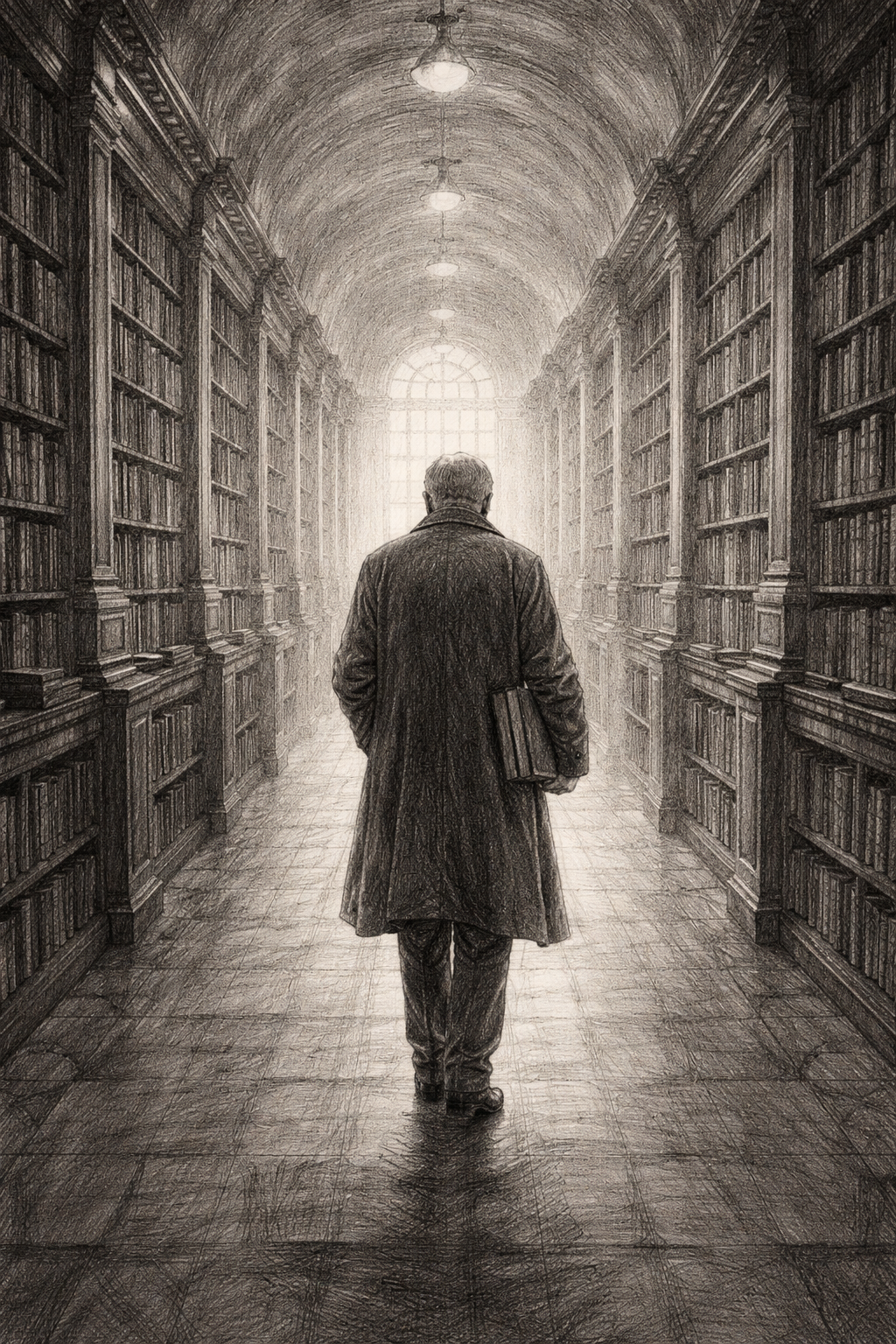
I keep a library that never stands still.
It grows even when no one reads. It grows because every age believes it must speak before it has finished thinking.
I walk slowly between the shelves. Not out of reverence, but out of caution.
“You walk more slowly all the time,” says the Zeitgeist.
He walks beside me without carrying any books. He knows their titles all the same.
In the beginning, I say, words were heavy. You can still feel it in the oldest texts. In the Torah, for instance. Little is explained there; much is weighed. You do not say everything you know, and you assert nothing whose weight you cannot bear.
“They were cautious because they knew little,” says the Zeitgeist.
“You confuse reverence with ignorance.”
Perhaps, I say. But they knew that a sentence binds. That words create order, but also guilt.
We walk on. To the Greeks. Questions everywhere. Concepts emerge, are discarded, recast. Thinking is visible. Error is allowed.
“And yet they thought their questions eternal,” says the Zeitgeist.
“That too was overconfidence.”
I do not disagree. I know he is right.
Later, the library becomes orderly. Too orderly. Systems emerge that seek to explain everything. Language becomes precise, but rigid.
“Order at last,” says the Zeitgeist, pleased.
“Without order, all that remains is idle talk.”
Order is not a problem, I say. Forgetting that it is provisional is.
Then comes the modern age. Numbers speak; experiments correct authorities. Sentences begin with “under these conditions”. I remember this aisle fondly.
“This is where my time begins,” says the Zeitgeist.
“Success. Effectiveness. Reach.”
And this, I say, is precisely where we should have slowed down.
He laughs. “Slowness is a luxury. People had to act. Build systems. Fight diseases. Organise states. Your caution would have held them back.”
Perhaps, I say. But speed has cost us something.
The shelves fill faster than concepts can be tended.
I take out three books, one after another. In the first, there is a sentence surrounded by conditions: in these circumstances, within this framework, as far as we know. In the second, the same sentence appears; the conditions have slipped into a footnote. In the third, it stands alone.
It sounds firmer now than in the first book. It bears less weight.
“That is the price of scaling up,” says the Zeitgeist.
“You cannot expect precision to hold on a global scale.”
I stop. “Then say so,” I say.
“Say that we are imprecise because we must be. Not because we can be.”
He falls silent for a moment.
At the far end, it grows loud. The newest books speak with certainty. They explain without hesitation. They defend without examining. Some spines no longer bear a name.
“The world is complex,” says the Zeitgeist.
“Without clear sentences, it falls apart.”
“Without clear limits too,” I reply.
We look at one another. For the first time.
“I need sentences that have an effect,” he says.
“And I need sentences that can bear weight,” I say.
He nods. “Then we are opponents.”
“No,” I say. “Then we depend on one another.”
The library lives by this tension. It dies wherever only one voice speaks. Where effect replaces truth, or caution prevents action.
I do not ask for perfect books.
I ask for authors who know when they must accelerate
and when they must pause.
The Zeitgeist turns away. “I will not wait.”
“I do not expect you to,” I say.
“I expect you to know what you leave behind.”
He walks on. The library grows.
I remain behind, between shelves full of sentences
that sought to bear weight
and others that merely drift.
I stay to remind us
that words have weight.
Even when no one has time for it.