
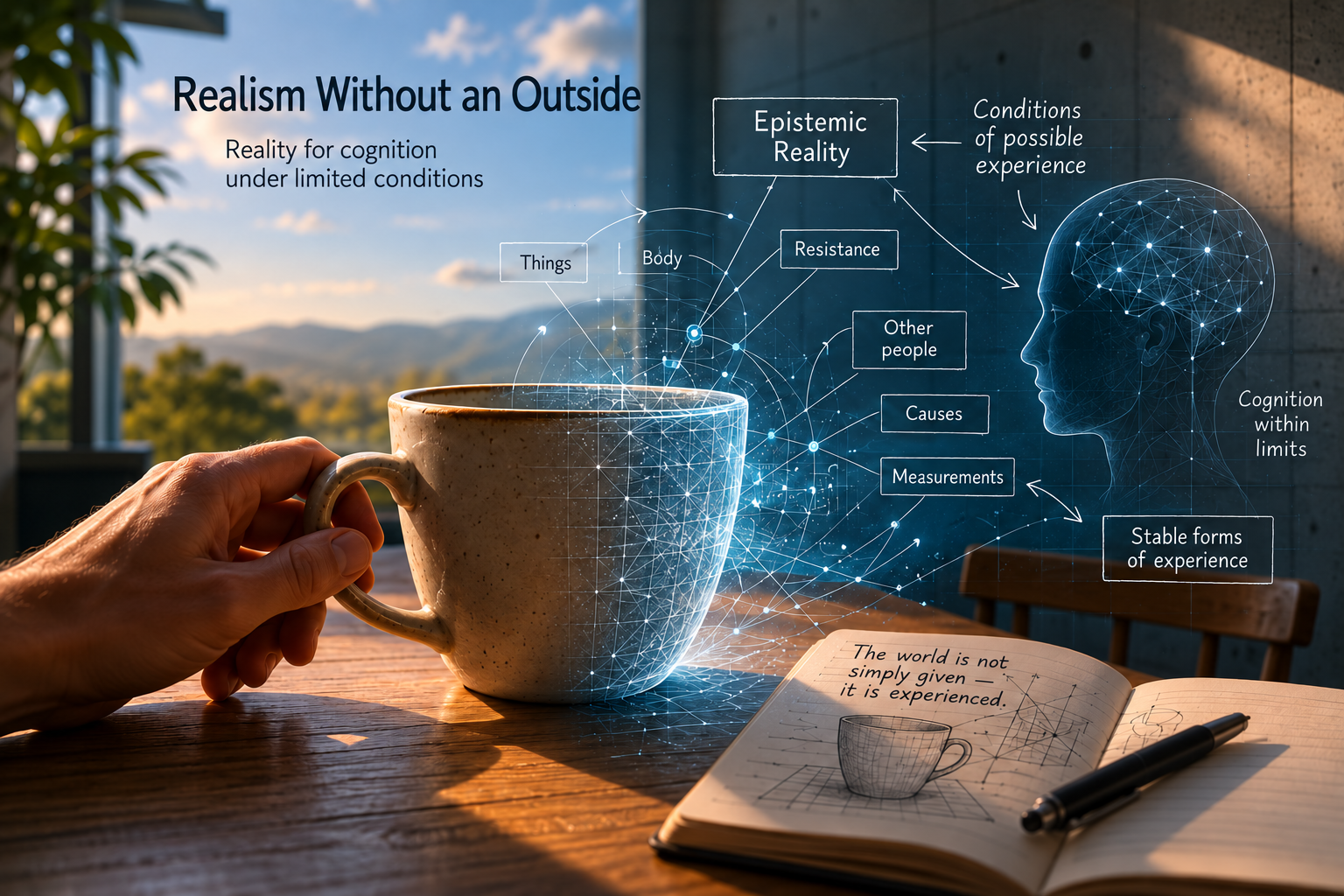
The problem does not begin when reality becomes doubtful. It begins when we take it too much for granted.
We are sitting at a table. A cup stands in front of us. We see it, reach for it, lift it, drink from it. Nothing about this seems puzzling. The cup is there. The table supports it. Our hand meets resistance. If we let go of the cup, it falls. If someone else enters the room, they too can see it, pick it up, use it, or knock it over. This is just what reality seems to be: something is there, stands before us, persists for a while, offers resistance, and does not simply depend on what we wish.
This everyday understanding of reality sustains our dealings with the world. We rely on it when we act, speak, plan, or learn. Everyday life depends on things already appearing as things, spaces as spaces, other people as other people, causes as causes, bodies as bodies.
Yet a closer look shows that this familiarity is not as simple as it seems. The cup is not merely a patch of color in our visual field. It appears as an object. It has a shape, a position, a function, an expected reverse side, a weight, a possible use. We do not just see something beige or white. We see a cup on a table. We know that we can pick it up. We expect it not to disappear suddenly. We anticipate that others can perceive it too.
Even the simplest everyday experience is therefore organized. It involves recognition, expectation, bodily reference, space, stability, possible action, and possible resistance. The cup does not confront us as raw material from which we subsequently make an object. It already appears as something determinate that we can rely on and use to find our way.
A wall makes the same point even more plainly. As long as I merely look at it, it appears as part of a room. Its reality becomes especially apparent when I walk into it. Resistance makes itself felt. Yet this resistance, too, does not confront me as a naked fact. It appears in a context: I have a body, I move, I expect my movement to continue, and that continuation is stopped. The wall is experienced as a limit to a possible action.
Or, more simply still, consider pain. It is not merely an opinion. It imposes itself, alters attention, action, and our relation to ourselves. Yet it is not a ready-made thing out there in the world either. It is reality in the mode of experience. It binds, disrupts, guides, and compels a response.
Embodiment as a point of connection
This structure becomes especially clear in the body. The body seems to confirm the boundary between inside and outside directly. Inwardly, we feel pain, effort, hunger, balance, movement. Outwardly, we encounter tables, walls, floors, temperatures, other bodies. The body seems to lie precisely where inner experience and the external world meet.
That is why it is so persuasive for our everyday understanding of reality. Through the body, the world is not merely seen; it is touched, endured, moved, and encountered as a limit. The world appears as that in relation to which movement succeeds or fails, as what supports, stops, injures, warms, cools, or resists. The body makes outer form practically plausible.
Yet this plausibility does not prove that we grasp the world as it is independently of us. The body is not the place where we step outside the conditions of our cognition. It is itself felt, seen, investigated, and described. It is both an object of investigation and a point of reference for our own sensations. It connects experience, movement, resistance, and orientation so closely that the distinction between inside and outside seems especially self-evident here.
The body is therefore a point of connection, but no metaphysical bridge to a world in itself. It explains why the external world seems so compelling to us. It does not already answer what this experience tells us about a world beyond all conditions of cognition.
What we are doing all the time
I walk past an open door. From the side, it looks narrower than from the front; its edge shifts against the frame, and the light falls differently on the wood. Yet it would not occur to me that the door had changed. I know that I have moved. If I had stayed still and the gap between door and frame had changed, I would judge differently. Then the door would have moved, perhaps because of a draft.
We make this distinction constantly and almost never explicitly. We attribute changes to the object, to our own access to it, or to the way it is presented to us. Is the door moving, or am I? Has the image on the screen changed because something happened in the room, because the camera shifted, or because someone subsequently moved the crop? Is there really a second room over there, or am I looking into a mirror?
Someone who recognizes a mirror organizes the very same views quite differently from someone who assumes a passageway. Someone who understands that they themselves are moving expects something different from someone who thinks the world is moving. Attribution is therefore no mere addition to perception. It determines what we expect next and how we act.
This achievement usually becomes visible only when it falters. An image does not fit what we expected. The door was supposed to open, but it sticks. A familiar path ends differently from what we anticipated. At such moments, what we may call friction arises: a mismatch between what our order led us to expect and what occurs. Friction does not yet tell us where the problem lies. It merely shows that some assignment fails to hold. Then the search begins: is it the lock, an obstruction, or our expectation? The place where we notice the disturbance is not already its cause.
Sometimes even the most basic assignment becomes uncertain. Someone sees an open door, imagines it being closed, and later no longer knows whether they saw the closing or merely imagined it. What happened to the door is then not the only open question. It is also unclear whether the remembered closing may be carried forward as an event that was seen or as an imagined occurrence.
How do we distinguish these at all? A single feature is not enough. In my mind, I can color an imagined door red or blue, open it, and close it. The door I see stays as it is, however much I wish it otherwise. This suggests taking availability for alteration as a criterion. Yet imagined scenes can also impose themselves, against our will and repeatedly. And I can change the actual door by painting it. Only the interaction of several features supports the distinction: how far something can be varied, whether it recurs under changing conditions, whether it limits expectations and requires correction, whether others can refer to it. Such profiles consolidate into two orders: an inner form, in which we treat sensations, memories, and imaginings as our own, and an outer form, which organizes recurrent, resistant, and jointly accessible relationships.
The external world is therefore not simply something we believe in. It is an order that we continually maintain, test, and correct. In everyday life, much of this happens without our specifically noticing it. The achievements involved often become apparent only when a familiar continuation fails to occur.
The dream
A familiar case shows how far this order extends. In a dream, I stand in front of a door. I walk around it, and from the side it looks different. It sticks. Someone comes along and opens it. Everything is organized like a world: views change with my position, obstacles resist, others intervene.
And yet this door does not belong to the world in which I wake up. If I tried to look for it in the morning, the assignment could not be continued. Nobody else knows the door, no trace leads to it, and nothing I now do connects with it. Friction arises here, and the assignment is corrected: it was a dream.
This correction need not deny what was experienced. Classifying it as a dream leaves intact that something was experienced; precisely how it unfolded remains open to correction in memory. The dreamed door is carried forward as a content of experience, not as a door in the shared waking world.
The dream therefore shows two things. First, outer form alone does not already assign its objects to the shared waking world. An experience can be outwardly organized without that assignment holding. Second, we test such an assignment through its continuation: across sleeping and waking, in exchange with others, through repeated examination. This, too, is no guarantee. But it makes differences and possible corrections visible.
Kant and the boundary
This is where Kant becomes important.
Kant shifted the problem in a decisive direction. We do not simply cognize the world as it would be independently of us. What appears to us as a world appears under conditions. For Kant, space, time, and the basic concepts of the understanding are not subsequent additions to a ready-made reality. They are conditions under which anything can appear to us as an object, event, or relationship at all.
Kant does not thereby destroy the reality of experience. He wants to preserve it. For him, the external world is no illusion. It is the world of appearances, which has order, lawfulness, and binding force for us. Yet Kant limits naive realism: we do not cognize things as they are in themselves, but as they appear under the conditions of possible experience.
The distinction we made at the door is also found in Kant. Someone looking at a house can begin at the top or the bottom; the sequence of their perceptions says nothing about a sequence among the parts of the house. Someone watching a ship drift downstream cannot freely choose the sequence; it is bound to the event. Kant asks what entitles us, in one case, to assume a mere succession of our perceptions and, in the other, an objective event. The question of attribution is therefore not new. This essay develops it through everyday cases: by considering presentation as a further aspect alongside object and access, and attribution as an achievement that is itself revisable.
Something else is already present in Kant. He uses the concept of the noumenon in its negative sense as a limiting concept: something is meant insofar as it is not an object of our sensible intuition. This opens up no positively known domain on the other side. Kant himself warns against turning a boundary of our cognition into knowledge of a landscape beyond it.
This warning can be generalized. It does not apply only to Kant’s limiting concept. It applies wherever a comprehensive statement about the world is derived from the conditions, forms, limits, or successes of our cognition. And it applies in both directions.
Two overextensions
Realism and solipsism usually appear as two worldviews between which we must choose. Either there is a world outside consciousness, or all certainty remains enclosed within our own experience.
A closer look shows that both begin with something right. The realist sees that the world is not arbitrary. The door does not open because I wish it to. Others encounter the same obstacles. Measurements contradict my expectations. The solipsist sees that everything I encounter—including this resistance, other people, and every measurement—is encountered within my own cognition. I cannot step alongside my experience and check whether the world really is like that.
Both observations are correct. The difficulty begins when they are made to yield more than they support. An overextension occurs when the success of our world-description is taken to show that we have grasped the world as it is independently of all conditions of cognition. The same happens when being bound to our own cognition is taken to show that nothing exists beyond it. In both cases, a limited finding is extended into a comprehensive statement without showing what supports the additional step.
This yields a simple rule, which we may call the basic rule: the conditions and successes of our cognition support only as much as an explicit justification warrants. This does not mean leaving everything open. If a suitable procedure would reliably indicate an elephant in the room and indicates none, this supports its absence. The silence of an unsuitable procedure does not support the same inference. And the limit of a procedure determines neither what lies beyond its reach nor that nothing lies there.
The question ‘What is really out there?’ is therefore not wrong, but incomplete. It must first say what it means. Does it ask whether the door stays closed even when nobody looks? That can be tested, and the answer is fairly clear. Does it ask whether there was a time before human beings could perceive it? That, too, can be inferred from traces. But if it asks how the world is constituted when we disregard every condition of any possible cognition, it is not yet clear what would distinguish a correct answer from an incorrect one. The spatial image of an ‘other side’ does not help. It merely gives the question the appearance of content.
Outer form as an achievement of ordering
This does not amount to a rejection of realism. Outer form sustains our familiar relation to the world. Things, bodies, other people, nature, causes, and measurements are not freely invented attributions. They are forms in which experience is organized so that it can be recognized, relied on, shared, and tested. This order enables us to continue relationships, form expectations, and jointly examine determinations. Whether every conceivable kind of cognition needs such an outer form is not thereby established.
To treat something as an object—as the same door, the same tree, the same person despite certain changes—is an achievement in its own right. We may call it ontologization. It is neither metaphysics nor a mistake. Without it, we could return to nothing, compare nothing, and correct nothing.
It becomes problematic when its presuppositions disappear from view. The ordered world then no longer appears as an order, but as what is simply given: complete, immediate, and without alternative. A classification is confused with the thing itself, a measurement with the whole property, a successful world-description with the world in itself. We may call this failure absolutization.
Naive realism relies on outer form but forgets its status. A realism without an outside makes the same move without absolutizing it. It speaks realistically and knows that it is doing so.
What, then, does ‘real’ mean? Not simply whatever exists independently of us. That answer names what we are looking for, but not how we recognize it. For us, reality becomes apparent in an order that holds: one that enables expectations that survive testing, makes resistance intelligible, allows interventions to succeed, and reveals errors. Stability alone is not enough. An error can be very stable, a measurement error can recur reliably, and the dream was internally organized. What matters is whether an order holds under challenge—under tests that could have shown its failure. Such tenability is never secured once and for all. Yet it is the best reason we have, and it is sufficient for realistic speech.
Reconstructing ourselves from the world
A second movement grows out of outer form. Once we have organized a world of bodies, organisms, and causal processes, we find ourselves within it. We appear as bodies, as living beings, as brains. Our cognition becomes a process in the world that can be investigated.
This reconstruction from the world-order is among the most powerful achievements of a realistic understanding of the world. It explains why we grow tired, why we are deceived, why an injury causes pain. Scientific findings can correct what we thought we knew about ourselves: how reliable our memory is, how much our perception fills in, how little we sometimes know about the reasons for our actions.
And yet it involves a remarkable turn. An everyday sentence makes this visible: ‘It all happens only in my head.’ The sentence is meant to say that we cannot get outside our experience. But to say it, we need a head: a body in space, an organ at a location, a causal order. It presupposes more world-description than its seemingly immediate character suggests. As a statement about conditions of experience, it can make sense. It becomes problematic when it also seeks to dismiss the world-order it uses as mere appearance without justifying that shift.
This reflexive relationship also concerns explanations in terms of the brain. When we locate cognition in the brain, we use the spatial, object-related, and causal order whose achievements we actually want to investigate. This does not make the brain-based explanation false. The fact that the brain, too, must be cognized weakens no justified dependence of experience on it. It does show, however, that the explanation remains an achievement of cognition. It is no standpoint outside from which cognition could finally be seen through completely.
Reconstruction from the world-order becomes absolutized when it forgets this: when the world-order we have developed presents itself as an immediately given and exhaustive foundation, and cognition appears only as one object among others. A particular form of this error occurs when the success of an explanation that already presupposes certain assumptions is subsequently credited as independent confirmation of precisely those assumptions.
A simple example shows how different description and experience are. I see green. Scientific explanations can investigate light, retinal responses, and the brain processes involved, and connect them with differences in color vision. Yet none of these descriptions is itself seeing green. Nor is my own description: when I say ‘green,’ I distinguish and communicate something about my experience without thereby transmitting my visual impression itself. That a description is not the experience does not by itself show a limit to its explanation. What must be examined is whether it captures the experienced differences it claims to explain.
Or, more simply still: I have a thought. If a measurement procedure does not detect it, it does not follow that I do not have it, unless it has been shown that the procedure could reliably have detected it. And where procedures seek to infer thoughts from measurements, they are also tested against the reports of those thinking them.
On the question of how something is being experienced now, one’s own access has a distinctive evidential weight. Its description is not infallible. How I name my experience, how I remember it, and what I attribute it to can be mistaken. Suppose someone tastes a difference between two glasses even though both contain the same wine. The sameness of the wine does not refute that experienced difference. Whether temperature, glass, expectation, sequence, or other conditions contribute requires an investigation of its own. Self-description and science can correct each other; the weight of their findings depends on the question. An investigation that seeks to explain experience must consider the relevant experiential findings while remaining able to examine their description.
This does not answer what experience ultimately is or how it relates to the brain. That a description is not itself the experience does not imply that experience must be something nonbodily. Nor does scientific success by itself establish an identity between an experience and a brain process. Such claims require reasons of their own.
Our self-understanding arises from several interacting approaches: our own experience, practical engagement with the world, feedback from others, and scientific investigation. The world-order thereby explains our cognition, and an explanation of our experience must confront the differences we experience. In this way, what we understand by remembering or comparing can change. Friction arises, for example, where an explanation excludes an experienced difference, or cannot make it intelligible, despite claiming to explain it. A more tenable overall picture may emerge from this friction, or it may reveal where an explanation reaches its limit. This also explains a familiar unease: the brain-based explanation seems both convincing and incomplete, because different legitimate approaches to ourselves meet here, none of which is simply a mistake. The overall picture we develop remains an achievement of cognition too. It gives none of these approaches a standpoint outside.
Science without a claim to the world in itself
Science is not weakened by this. It need not prove that it grasps the world in itself. It must show that its models, measurements, and procedures are tenable, corrigible, and effective within their scope.
The realistic sense of scientific statements is not thereby abolished. When science says that a virus exists, that a planet follows a certain orbit, or that the Earth formed billions of years ago, the statement need not be translated into a mere claim about a model. Science rightly speaks realistically here. What is limited is the metaphysical surplus: the idea that such statements have secured access to a world beyond all conditions of cognition.
Science extends what we can determine. It makes the invisible visible, the unclear calculable, the individual comparable, and the conjectured testable. Its particular strength lies in taking friction seriously: instead of explaining deviations away, it asks whether they arise from the object, the instrument, or the theory. An overextension occurs when a particular instance of tenability becomes a claim to ultimate reality and reconstruction from the world-order becomes a final explanation of origins.
Our own end
The tension between the experienced world and the ordered world becomes clearest in time.
We know that there was a time before us and that there will be a time after us. We infer it from traces, testimony, rock strata, and the light of distant stars. In this world-time, our life is a limited interval. We know its beginning from stories and documents. We anticipate its end by observing others.
From the perspective of experience, things look different. We may experience dying. Our own nonexistence, however, is not a state we experience; there is then nobody to experience it. We are indeed finite, yet this can only be inferred from the standpoint of our own experience. We know it from the world-order in which we have located ourselves.
This, too, is no error on either side. It does not follow that time depends on experience. Nor does it follow that we have determined time independently of all conditions of cognition. It shows how experience and world-order interlock without being absorbed into one another. Perhaps this is the most precise description of what it means to be a finite cognizing being.
What remains of realism?
Realism is not abandoned. It is understood. It is not a conviction we must first justify before we are allowed to act. It is an order we continually sustain: we treat things as the same across changing views, attribute changes, correct ourselves when something does not fit, and share this order with others.
The point is:
Reality does not disappear.
But it is not confused with what is supposed to lie beyond all determinability.
Cognition can be scientifically explained.
But that explanation remains an achievement of cognition.
A realism without an outside holds on to world, resistance, science, and orientation. It takes Kant’s warning seriously and pursues the question of justification in scientific explanation and in our understanding of ourselves: which claims does a successful order support? It distinguishes ontologization, which enables reference to be taken up again, from its absolutization, which conceals its presuppositions and limits.
What sustains our realistic relation to the world is not an outside accessible without presuppositions, but outer form: the order in which we understand and inhabit the world as a nexus that can be revisited, resists us, and can be examined, and which we can repeatedly make an object of inquiry in its own right.
This essay offers an introduction to this movement of thought. Its systematic development, including its differentiation from Kant, Dilthey, Carnap, and Fine, can be found in the paper of the same title, ‘Realism Without an Outside.’ The wider relationship between validity, friction, and revision is developed in ‘Modellführung unter endlichen Bedingungen’ (‘Model Governance under Finite Conditions’).