Revision under Finite Conditions
A
Theory of Model Transformation in Epistemics
Abstract
The paper thus shows that scientific rationality under finite conditions consists not only in stabilization, critique, and exploration, but equally in the controlled capacity to transform existing model orders. It begins from the observation that scientific rationality cannot be adequately described if one considers only stabilization, falsification, search, or complete model replacement. Between the provisional retention of a model and its complete replacement lies a field of regulated transformations, which the present contribution conceptualizes and systematizes as revision. Revision denotes the rule-governed transformation of a model or model nexus under conditions of rising friction, declining validity, increasing costs, or intensifying domain conflicts.
The paper clarifies the structural position of revision within Epistemics and distinguishes it from adjacent operations such as falsification, search, and mere stabilization. On that basis, it develops a typology of local, structural, domain-related, and global revision. It also identifies typical triggers of revision, formulates criteria of rational revision, and analyzes central pathologies, including omitted, delayed, cosmetic, and disproportional revision, as well as ontologization that blocks revision.
The central thesis is that revision constitutes the mediating transformative operation between friction, falsification, and search. Friction signals strain, falsification marks loss of validity, search opens the space of possible alternatives, and revision organizes the actual transformation of the model. The paper thus shows that scientific rationality under finite conditions consists not only in stabilization, critique, and exploration, but equally in the controlled capacity to transition existing model orders.
Keywords
Epistemics, revision, model revision, scientific models, friction, falsification, search, model management, finite conditions, domains, epistemic costs, ontologization
Stefan
Rapp
Independent Researcher
Last revised: 10
March
2026
https://orcid.org/0009-0004-0847-9164
https://doi.org/10.5281/zenodo.18935929
Epistemics
Project: https://www.epistemics.de
©
2026 Stefan Rapp — Licensed under CC BY-NC-ND 4.0
Table of Contents
1. The Problem and Aim of the Paper 4
2. The Structural Position of Revision within Epistemics 7
5.3 Domain-Related Revision 16
5.5 The Relation among the Four Forms of Revision 17
6. Criteria of Rational Revision 18
7. Revision, Friction, Falsification, and Search 20
9. Example: Revision as Domain-Related and Structural Reorganization 26
10. Revision as a Basic Operation of Model Management 27
Appendix A: Didactic Illustrations for Teaching and Initial Orientation 29
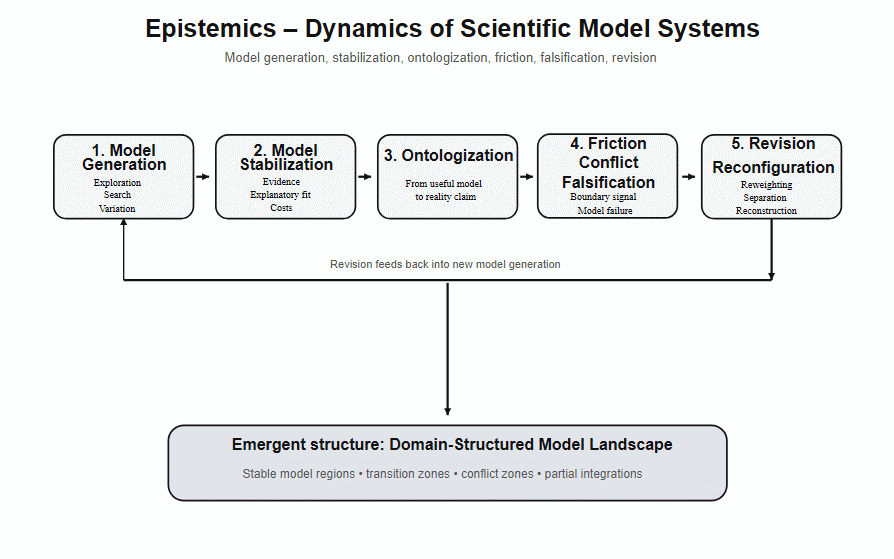
The diagram outlines the broader epistemic context within which revision is to be understood as a distinct operation of model transformation. In the context of this paper, it serves as an orientation aid for situating revision within the dynamics of scientific model systems.
Science does not operate under ideal conditions, but under finite ones. Models are generated, tested, stabilized, strained, adjusted, and, where necessary, replaced, without unlimited cognitive, methodological, empirical, or institutional resources ever being available at any point. A theory of scientific rationality must therefore explain not only how models are formed or rejected, but also how they are transformed under strain.
A systematic gap in many accounts of philosophy of science becomes visible at precisely this point. Either the stabilization of existing models is placed in the foreground, or attention centers on their falsification, replacement, or the search for alternatives. What remains less clearly determined is how the transition between these states is to be understood epistemically. Yet in many cases scientific practice consists neither in mere fidelity to a model nor in a complete break with it, but in regulated forms of revision. Models are rebuilt, delimited, restructured, supplemented, or partially abandoned, without this necessarily amounting to an immediate and complete paradigm shift.
The present approach thus enters a field already shaped by different accounts of scientific change, while its operative center has been articulated only in part. Popper makes the loss of validity of models visible through falsification, but does not specify in detail the graded processes of reconstruction between local failure and complete rejection (Popper 2002). Kuhn shows that scientific orders can be profoundly restructured in periods of crisis, yet his focus falls primarily on macrohistorical shifts rather than on controlled reorganizations within persisting model nexuses (Kuhn 2012).
Lakatos describes the modification of research programmes, but does not formulate these changes as a general epistemic basic operation of proportionate model transformation (Lakatos 1978). Laudan emphasizes the reorganization of scientific practice within a problem-solving horizon, but does not elaborate revision as a distinct mediating operation between strain, loss of validity, search processes, and reconstruction (Laudan 1977). Wimsatt, finally, brings into view the situation of finite epistemic agents who operate only piecemeal, robustly, and under limited resources, yet he does not develop from this a distinct theory of revision as the controlled transformative capacity of models (Wimsatt 2007).
This paper takes up these debates, but does so precisely at this open point. It treats revision not as a marginal case of progress, falsification, paradigm change, or problem-solving, but as a distinct epistemic operation through which models are transformed in a controlled way under strain.
Within the framework of Epistemics, this finding is especially important. The basic idea that scientific model guidance involves not only stabilization and rejection, but also regulated adjustment, is already built into the research programme. The foundational paper defines science as the management of models under finite conditions and thereby makes clear that models under strain are neither simply continued unchanged nor fully abandoned. The previous partial papers likewise presuppose this mobility. What has so far been lacking, however, is not a first mention of revision, but its distinct systematic elaboration. What remains underdetermined is its exact position within the operational architecture of Epistemics, its typical triggers, its different scopes, its criteria of rationality, and its pathologies. It is precisely this gap that the present paper addresses.
This paper closes that gap not by introducing revision for the first time, but by working it out systematically in its own right. It develops revision as a specific epistemic basic operation of model management. What is meant is the rule-governed transformation of a model or model nexus under conditions of rising friction, declining validity, increasing costs, or intensifying domain conflicts. The contribution of the paper thus consists in not merely presupposing revision implicitly, but in specifying its operational logic explicitly.
The central thesis of the paper is that revision is the mediating operation of transformation between friction, falsification, and search. Friction signals strain, falsification marks loss of validity, and search opens the space of possible alternatives. Revision organizes the transition to a modified model order. Without an explicit theory of revision, Epistemics therefore remains not merely in need of supplementation, but transformatively incomplete at its core.
The conceptual framework of the present text follows the foundational paper of Epistemics. The basic concepts introduced there, in particular model, validity, domain, stabilization, costs, and friction, are presupposed here. The present paper builds on that canon of concepts and specifies, within this framework, the concept of revision in particular.
Conceptual Framework of This Paper
For the purposes of the present paper, the following revision-specific determinations are especially guiding. Revision denotes the rule-governed transformation of a model or model nexus under epistemic pressure. Local revision concerns limited elements of a model without substantially altering its basic architecture. Structural revision intervenes in central relations, transitions, or organizational principles of the model. Domain-related revision concerns the redetermination of a model’s range of validity. Global revision occurs where the existing model order can no longer be sustained in its basic architecture and must be comprehensively reorganized or replaced.
Guiding all of this is the principle of revision proportionality. The scope of the chosen transformation must fit the structure of the problem. At this stage, the framework serves only as a preliminary conceptual orientation. The systematic elaboration of the individual forms of revision, their triggers, criteria of rationality, and pathologies follows in the subsequent chapters.
The theory of revision developed in this text is not confined to science in the narrow sense. It is worked out here with reference to scientific models because scientific practice represents the particularly explicit, methodologically controlled, and institutionally condensed case of epistemic model guidance. More generally, however, revision concerns the capacity of an epistemic system to respond to strain, loss of validity, problems of scope, and internal tensions through controlled reorganization. In this sense, science appears not as the origin of revision, but as a particularly elaborated special case of a more general epistemic basic operation.
The aim of the paper proceeds in four steps. First, it determines the structural position of revision within Epistemics. Second, it conceptually distinguishes revision from neighboring operations. Third, it develops a typology of different forms of revision. Fourth, it formulates criteria of rational revision under finite conditions and distinguishes them from typical pathologies.
The paper therefore does not pursue a historical reconstruction of concrete scientific developments, nor a general theory of progress. Its aim is narrower and more systematic. It seeks to make revision visible as a distinct operation of model management and thereby to articulate explicitly the transformative dimension of scientific rationality. The guiding question is accordingly: under what conditions, in what forms, and according to what criteria are scientific models rationally revised, if science is understood as the management of models under finite conditions?
Within Epistemics, revision cannot be treated as a merely subordinate special case. Rather, it belongs to the inner functional logic of scientific model management itself. As soon as science is understood not as a linear approximation to a fully available reality, but as the handling of models under finite conditions, it becomes clear that stabilization and rejection alone are insufficient to describe scientific practice adequately. Between the provisional retention of a model and its complete replacement lies a broad field of regulated transformations. It is precisely this field that revision designates.
In the foundational paper of Epistemics, science is defined as the management of models under finite conditions. Models there appear not as mere representations of an independently and fully available world, but as functional structures by means of which dynamic complexity is reduced, orientation becomes possible, and strain is managed. This very point of departure already makes clear that scientific rationality cannot be exhausted by a simple alternative between preservation and rejection. Wherever models are managed under finite conditions, situations necessarily arise in which existing orders can neither be maintained unchanged nor fully abandoned. It is precisely at this point that a distinct operation of transformation becomes necessary. Revision is therefore not merely a retrospective special case, but an internal consequence of the basic approach itself: if model guidance comes under pressure and is nevertheless not to end in mere rupture, there must be a rule-governed form of reconstruction.
This basic perspective also stands in clear proximity to Wimsatt’s reflections on cognition under conditions of limited cognitive and methodological reach (Wimsatt 2007). Wherever finite epistemic agents cannot rely on complete, unified, and immediately available access to the world, robust, piecemeal, and revisable model orders gain special importance. The present paper builds on that insight, but radicalizes the point in operational terms. It asks not only why cognition under finite conditions depends on partial and resilient orders, but how their reconstruction under pressure is itself to be understood as a distinct epistemic operation.
Its structural significance becomes even clearer when one considers the existing partial papers of Epistemics together. The paper on ontologization shows how models can conceal their constructed character and thereby become shielded against reconstruction. The paper on friction determines friction as a boundary signal of finite viability. The paper on falsification specifies different forms of loss of validity. The paper on search describes the opening and structuring of the space of possibilities. All of these works already contain preconditions for a theory of revision. What is still lacking, however, is their explicit systematic integration into a distinct operational form. Revision designates precisely this point: not mere strain, not mere loss of validity, not mere search for alternatives, but the regulated transformation through which such situations are actually addressed through reconstruction. In this way, revision acquires the status of a distinct hinge operation within Epistemics.
The friction paper makes clear that rising strain alone does not yet organize an epistemic response. Friction signals that maintaining a model, its transitions, or its claim to validity generates an increasing burden, but it does not decide how one is to respond. It is precisely here that revision becomes necessary. Revision is the operation that responds to friction by examining whether local adjustments suffice, whether structural reconstruction becomes necessary, whether the domain must be redrawn, or whether a global model change is required.
The falsification paper further sharpens this situation. There a distinction is drawn between contextual and global falsification. A model may fail in certain contexts without having to be abandoned altogether, or it may collapse in its global viability. This distinction is central for revision. For falsification is not identical with revision, but constitutes one of its possible triggers. A contextual loss of validity can lead to local or domain-related revision. A global loss of validity can force global revision or model replacement. Without the concept of revision, however, it remains unclear how the transition from the diagnosis of a validity problem to actual epistemic reorganization is to be understood.
It is precisely here that one can also see both a proximity to and a difference from Laudan’s problem-solving view of scientific change (Laudan 1977). Laudan makes it plausible that scientific progress can be understood neither adequately as a mere history of falsifications nor as a pure sequence of revolutions, but is essentially tied to the processing of problems. The present paper builds on this insight, but shifts the emphasis. Its primary concern is not progress as such, but the distinct epistemic operation through which controlled model transformation responds to strain, loss of validity, rising costs, or domain conflicts.
A similar difference applies with respect to Lakatos. Lakatos describes the modification of research programmes and thereby shows that scientific orders can be continued not only through abrupt breaks, but also through graded change (Lakatos 1978). The concept of revision developed here, however, is more general. It concerns not only the dynamics of entire research programmes, but the proportionate transformation of models and model nexuses at different levels of scope. Revision thus appears not merely as a special case of programmatic shift, but as a distinct operation of transformation within model management.
The search paper complements this architecture with the exploratory pole. Search opens and structures the space of possible alternatives. It is necessary when existing models reach their limits or when new configurational possibilities must be explored. Yet search, too, is not itself revision. Search generates variation, possibilities of comparison, and new candidates. Revision decides how these possibilities are translated into a concrete form of reconstruction. One may therefore say: search produces the space of possibilities, revision organizes the transformation in light of that space.
From this position it follows that, within Epistemics, revision forms the operative link between several core mechanisms. It connects stabilization with reconstruction, friction with response, falsification with reorganization, and search with concrete model transformation. Without revision, the epistemic architecture would remain incomplete. On the one hand there would be diagnostic concepts such as friction and falsification, on the other hand structural concepts such as model, domain, and search. What would be missing is precisely the operational form in which diagnostic pressure and exploratory opening become a regulated transformation of the model.
Revision therefore has a hinge function within Epistemics. It is precisely in this respect that it differs from accounts of scientific change aimed primarily at crisis shifts or research-programmatic displacements on a larger scale (Kuhn 2012; Lakatos 1978). It is neither the mere consequence of a defect nor a merely technical correction. It is the form in which a system of scientific model guidance realizes its own adaptability under finite conditions. Precisely because resources are limited, not every friction can be answered by total reconstruction, nor can every stability be conserved indefinitely. Revision is the middle operation between rigid preservation and complete rupture, but by no means a weak one. It makes it possible to preserve viability without enforcing blindness to strain, and to effect change without prematurely destabilizing the entire model order.
Its structural position can therefore be determined precisely: within Epistemics, revision is the central operation of transformation in model management. It enters where stabilization comes under pressure, falsification becomes effective, friction rises, or the search space opens new and more viable possibilities. Its function is to organize rationally, under finite conditions, the transition from a given model order to a modified model order.
If revision is to be understood as a distinct operation within Epistemics, it must first be clearly distinguished from neighboring concepts. In everyday language, “revision” often denotes, quite generally, a reworking, correction, or reassessment. For the context developed here, a more precise concept is required. Revision does not mean just any change to a model, but a rule-governed transformation of its structure, its scope, or its internal organization under conditions of epistemic pressure.
Provisionally, revision may therefore be defined as the controlled transformation of a model or model nexus in response to friction, problems of validity, rising costs, or domain conflicts, with the aim of preserving, restoring, or redetermining its viability. This specification is narrower than ordinary usage would suggest. Revision means neither any arbitrary correction nor any mere reparameterization, insofar as the latter remains only technical fine-tuning without epistemically relevant reconstructive work.
Rather, one should speak of revision only where the epistemically relevant structure, scope, or internal mode of organization of a model is being transformed in a controlled manner. Not every adjustment already counts as revision. Revision occurs only when the reconstruction goes beyond mere technical adaptation and concerns the way in which a model carries its validity, its domain, or its internal order.
The concept of revision used here should also not be equated with the narrower framework of formal theories of belief revision, as developed especially in the logical tradition since Alchourrón, Gärdenfors, and Makinson (Alchourrón, Gärdenfors, and Makinson 1985; Gärdenfors 1988). Those approaches concern above all the rational modification of sets of beliefs under conditions of consistency. By contrast, the present paper operates at a different level of analysis. Its focus is not on belief sets, but on scientific models, their domains, their viability, their costs, and their controlled reorganization under epistemic pressure. The shared term “revision” should therefore not obscure the difference in theoretical level.
First, revision is a transformation, not a mere reaction. This is important because models can respond to strain in very different ways. They can be defended, ignored, symbolically adjusted, or actually reconstructed. One should speak of revision only where a change in the epistemically relevant structure of the model takes place. Not every defense of a model already counts as revision, and not every linguistic reformulation constitutes genuine reconstruction.
Second, revision is controlled. By this is meant that it is not understood as accidental drift or mere capitulation to external pressure, but as a methodologically graspable reorganization. Revisions may differ in strength, speed, and depth, yet they remain within the framework of rational model guidance. A model is not simply deformed, but reworked along definite problems, tensions, and target conditions.
Third, revision is oriented toward viability. It is not an operation for its own sake, nor an expression of general flexibility for its own sake. A model is revised in order to secure its validity, reduce its strain, determine its domain more appropriately, or achieve a better structure under given conditions. Revision is therefore always functionally directed. It is oriented toward the question of how a model can be continued under finite conditions without generating unnecessary epistemic costs.
Fourth, revision presupposes epistemic pressure. This pressure may arise from different sources: increasing friction, contextual or global falsification, structural overextension, internal incoherences, or the emergence of better alternatives. Revision is thus not arbitrary creative variation, but a response to strains that the existing model order can no longer bear intact.
From this, it becomes clearer why revision is identical neither with falsification, nor with search, nor with stabilization. Falsification marks a loss of validity, but does not yet determine how one should respond. Search expands the space of possible alternatives without yet enacting a specific transformation. Stabilization aims at the preservation and resilience of a model order, whereas revision begins where that order must be reworked in a controlled way under pressure. It is precisely here that the concept developed in this paper lays claim to its distinctiveness: revision denotes the distinct epistemic operation between the diagnosis of strain, exploratory opening, and actual reconstruction.
One may therefore say: search is exploratory, stabilization preservative, revision transformative. Revision does not merely open possibilities, nor does it merely secure what already exists. Rather, it organizes the graded reorganization of a model under epistemic pressure. For precisely this reason, it must be understood neither as mere search nor as mere stabilization.
Finally, revision is not simply identical with model change. A complete change in model architecture is only one possible limiting case of revision. Many scientifically central transformations remain below that threshold. Models are restricted, recalibrated, internally reconstructed, supplemented with auxiliary assumptions, redetermined in their domain, or partially replaced. If revision were recognized only where an overall model is abandoned, one would lose precisely the domain in which scientific practice operates most frequently.
This yields a narrower concept: revision is the graded reorganization of an existing model or model nexus, without any prior assumption as to whether this reorganization is local, structural, domain-related, or global. This openness is crucial. Revision designates, first of all, the operational form, not yet its scope.
From a systematic perspective, revision can therefore be described as a middle form of epistemic change. It stands between mere continuation and complete rupture. But this middle position must not be confused with epistemic weakness. Revision is not “middle” because it would be theoretically less significant, but because it marks the operative zone in which scientific systems realize their adaptability. Under finite conditions, this zone is central. A system that can only conserve or collapse is epistemically rigid. A system that translates every strain immediately into complete reconstruction is epistemically unstable. Revision is the form of rational flexibility between these extremes.
For Epistemics, a concise working definition can therefore be derived: revision is the rule-governed transformation of a model under finite conditions, triggered by epistemic pressure and oriented toward the restoration, improvement, or reordering of its viability. This determination makes clear why revision must be treated as a distinct basic operation. It is not merely an addendum to stabilization, search, or falsification, but the specific form through which scientific model-guidance organizes its transformative capacity.
On this conceptual basis, the next step is to examine what typically triggers revision. For if revision is not arbitrary change, but pressure-dependent reorganization, then one must determine precisely which kinds of epistemic strain rationally set it in motion.
If revision is understood as the rule-governed transformation of a model, then the immediate question arises as to what triggers it. Not every deviation, not every difficulty, and not every new observation already justifies revision. Scientific model-guidance would become unstable if every local irritation were immediately translated into reconstruction. Conversely, it would become dogmatic if even persistent strains no longer triggered any transformative response. It is therefore necessary to determine more precisely the typical triggers of revision.
The most general trigger is rising epistemic pressure. What is meant here is a situation of strain in which continuing an existing model order in its current form becomes increasingly untenable, costly, weak in validity, or inappropriate to its domain, thereby generating a need for revision. Revision becomes rational when the existing forms of stabilization no longer suffice to secure validity, coherence, or domain-appropriateness in a viable way. This general pressure can occur in several more specific forms.
A first central trigger is friction. Within Epistemics, this has already been introduced as a distinct diagnostic concept: friction designates a boundary signal of finite viability. For the present paper, the decisive point is therefore not to redetermine its basic character, but to specify its function as a trigger of revision. Friction indicates that continuing a model, a model linkage, or a claim to validity generates increasing strain, without thereby yet determining what scope the appropriate response must have. It is precisely here that its significance for the logic of revision lies. Friction does not necessarily signal immediate falsity, but it does signal increasing pressure to reconstruct. Wherever friction rises and the existing stabilization can no longer absorb the situation in a viable manner, a rational occasion for revision arises.
A second trigger is loss of validity. As the falsification paper shows, this can occur contextually or globally. A model may fail in certain areas without collapsing altogether, or it may lose its general viability. In both cases, revision pressure arises. The difference lies in scope and intensity. Contextual loss of validity often suggests local or domain-related revision. Global loss of validity may require structural or global revision. The decisive point is this: falsification is not itself revision, but it belongs among its strongest triggers.
A third trigger consists in rising epistemic costs. A model may remain usable and yet become in need of revision if its maintenance becomes disproportionately expensive. What is meant here are not only monetary or institutional costs, but also cognitive, methodological, and theoretical burdens. If a model requires ever more auxiliary assumptions, special corrections, exceptions, or protective mechanisms, this may indicate that its current form is no longer economically viable. Revision is then triggered not primarily by direct collapse, but by a shift in the relation between effort and viability.
A fourth trigger lies in domain conflicts. Models are not valid without limit, but are tied to specific ranges, conditions, and forms of application. Revision pressure arises when these domain boundaries become blurred, when a model is overextended, or when different domain requirements can no longer be adequately held together within the same model structure. In such cases, the entire model does not necessarily need to be abandoned immediately. Often it suffices to redetermine its scope, specify its conditions of validity more precisely, or separate different model forms more cleanly. It is precisely here that the distinction between revision and complete model rupture becomes clear.
A fifth trigger is internal incoherence. Under strain, models may become revision-worthy not only because of external findings, but also because of tensions within themselves. If central concepts, transitions, assumptions, or functional connections no longer work together consistently, pressure arises to reorder the model’s internal organization. Internal incoherence is therefore especially relevant because it shows that revision does not occur only as a reaction to empirical resistance. The internal form of a model can itself generate the need for revision.
A sixth trigger arises from the emergence of more robust alternatives. A model may become ripe for revision even though it has not yet clearly collapsed. If new configurations appear that promise better stability at lower friction, lower cost, or greater domain-appropriateness, revision pressure can arise for that reason alone. Scientific rationality consists not only in registering obvious failure, but also in recognizing more viable orders and preparing the transition to them. Revision therefore does not begin only at the point of defect, but may already be motivated by the visibility of better possibilities of reorganization.
A seventh trigger lies in the lack of contextual appropriateness of the model resolution being used. Not every strain arises because a model is false in the strict sense or internally deficient. Revision pressure can also arise when, in a given context, a model form is being used whose complexity, precision, or scope has become inappropriate. In such cases, it may be rational to simplify a model, shift its application to a coarser level of analysis, or adapt its operative form to the demands of the situation. The most fine-grained model available is not always the epistemically most reasonable one.
These considerations imply an important point: revision must begin neither too late nor too early. If it occurs too late, frictions, costs, and maladjustments solidify to such an extent that only radical and often highly lossy reconstructions remain possible. If it occurs too early, the system loses stability because every irritation is translated into excessive transformation. Rational model guidance therefore requires a threshold logic. Not every strain calls for immediate revision, but persistent or increasingly condensed strain must not merely be managed either.
This shows that triggers of revision typically do not occur in isolation, but in constellations. Friction, rising costs, loss of validity, and domain conflicts often reinforce one another. It is precisely this clustering that makes revision epistemically urgent. A model is rarely revised because only a single signal appears. More often, the need for revision arises where several forms of strain converge, and the existing stabilization thereby loses its viability.
For Epistemics, one may therefore state: revision is triggered by situations of strain in which continuing a model in its current form becomes epistemically increasingly untenable, without this yet determining what scope the required transformation must have. This question leads to the next step. If revision is triggered by different forms of pressure, one must now specify the forms it can take.
Revision is not a uniform operation with an invariant scope. When models are transformed under finite conditions, that transformation can take very different forms. Some revisions concern only individual elements, others intervene in internal structure, others shift a model’s domain, and still others lead to comprehensive reconstruction. A theory of revision must therefore distinguish the different forms of this operation systematically.
What follows proposes a fourfold typology: local revision, structural revision, domain-related revision, and global revision. These types should not be understood as rigid classes, but as different scopes of controlled transformation. What matters less than assigning a case to a closed compartment is determining how deeply a model must actually be changed under a given pressure. The typology is therefore designed as a typology of scope. Its purpose is to show that revision does not occur as a uniform process between preservation and rupture, but in graded form. Under finite conditions, this gradation is epistemically central, because strains must neither be systematically underestimated nor unnecessarily totalized.
Local revision concerns limited elements of a model without calling its basic architecture into question. It applies where individual assumptions, parameters, transitions, measurement assignments, or side conditions must be adjusted, while the supporting structure of the model remains essentially intact. Such revisions are especially common in scientific practice. They respond to concrete strains without reorganizing the entire model.
The epistemic significance of local revision lies in its economy. Where a model remains viable overall, complete reconstruction would be unnecessarily costly and destabilizing. Local revision makes it possible to address limited disturbances without surrendering proven structural resources. Under finite conditions, this is of considerable importance. A rational scientific system must not translate every irritation into total reconstruction.
At the same time, local revision has a clear limit. It is appropriate only if the strain actually remains local. If structural problems are addressed through local corrections, there is an easy temptation to create the appearance of adaptability while the real friction persists. Local revision can then devolve into chains of repair that may stabilize the model in the short term, but in the long run increase its costs and undermine its revisability.
Structural revision intervenes more deeply. It transforms not merely individual elements, but central relations, transitions, or organizational principles within a model. The model remains as an identifiable order, but its internal architecture is reconstructed in essential respects. One may say: the model as such does not disappear, but the way its supporting components are ordered in relation to one another does.
This form of revision typically becomes necessary when friction is no longer concentrated at isolated points, but arises from the internal organization of the model itself. Individual corrections then no longer suffice, because it is precisely the connection among the elements that has become revision-worthy. Structural revision is therefore the appropriate response to strains that are not merely punctual, but architectural.
Its advantage is that it permits deep transformation without yet requiring complete abandonment of the model. It preserves continuity where that is reasonable, yet allows substantial reorganization. Under finite conditions, this is often the epistemically most reasonable form of reconstruction: more radical than local correction, but more economical and controlled than global rupture.
Conversely, the danger of structural revision lies in its being underestimated or avoided. Models are often repaired locally for too long even though the real problem lies in their internal structure. In such cases, friction continues to rise because the chosen scope of revision is systematically too small.
Domain-related revision concerns not primarily the internal structure of a model, but its range of validity. It applies where the model itself may not necessarily fail in its construction, but its scope has become unclear, overextended, or inappropriate. In such cases, the rational response does not necessarily consist in reconstructing the model, but in redetermining the boundaries of its application.
This form is especially important for Epistemics because it explicitly brings into view the connection between model validity and domain boundedness. Models often fail not absolutely, but relative to a wrongly specified or overly extended domain. Revision then means formulating the claim to validity more narrowly, more precisely, or more differentially. In this way, a model may be stabilized within a limited area even though it loses its earlier claim to universality.
Domain-related revision is often more epistemically
productive than blanket rejection. It allows viable elements of a
model to be retained without perpetuating its overextension. This is
especially crucial in complex scientific situations. Many conflicts
arise not because a model is worthless as such, but because its
proper domain has been wrongly determined.
Its typical pathology consists in the opposite movement:
either a model continues to be universalized despite clear domain
boundaries, or its domain is opportunistically narrowed more and more
until almost any strain can be fended off. In the first case,
overextension arises; in the second, immunization. Rational
domain-related revision must therefore achieve genuine boundary
clarification, not merely strategic self-preservation.
Global revision is the most far-reaching form. It occurs where the existing model architecture can no longer be sustained in a viable manner and must be replaced or fundamentally reorganized through a new basic order. Unlike structural revision, the issue here is not merely a transformed internal organization of a model, but a redetermination of the entire framework of model-guidance.
This form typically becomes relevant where friction, loss of validity, and rising costs can no longer be addressed locally or structurally. The model is then problematic not merely in individual parts or in its range, but in its overall architecture. Global revision is therefore the limiting case in which revision approaches or passes over into model change.
For the theory of revision, it is crucial that even this case can still be described as revision as long as the transition is methodically understood as a regulated transformation. Global reconstruction is not simply identical with discontinuous rupture. Even deep reorganization can be understood epistemically as a process of revision insofar as it responds to identifiable strains and rationally organizes the transition into a new form of order.
Its danger lies in premature totalization. Not every serious friction requires global revision. Where it is assumed too early, the system loses continuity and generates unnecessary reconstruction costs. Global reconstruction is therefore necessary when lesser forms of revision no longer suffice, but problematic when it occurs merely as a dramatic overreaction to limited difficulties.
These four types are not to be understood as rigid compartments. In scientific practice, they often shade into one another. Local revision may prove insufficient and develop into structural revision. Structural revision may be combined with domain-related redelimitation. Several forms may occur simultaneously. Nevertheless, the distinction is indispensable because it makes visible the scope of the reaction that is appropriate in each case.
The real theoretical gain of this typology lies in making possible a logic of proportional revision. Models need not simply be preserved or rejected. Between these poles there are graded possibilities of transformation. Under finite conditions, this gradation is epistemically central because it prevents strains from being either trivialized or overdramatized.
For Epistemics, this yields a guiding principle: what is rationally decisive is not willingness to revise as such, but the appropriate scope of revision. A revision that is too small conserves friction. A revision that is too large destroys stability unnecessarily and increases the costs of reconstruction. Good model-guidance therefore requires not merely a willingness to change, but a proportionate fit between the structure of the problem and the form of revision.
With this typology, the framework is in place for the next step, namely clarifying the criteria according to which revision can count as rational. For the question is not only which forms of revision are possible, but by what standard one can decide whether a concrete revision is epistemically successful.
If revision is a distinct operation of model management, it is not enough merely to determine its triggers and forms. One must also clarify the logic according to which concrete revision decisions can be assessed. The question, therefore, is not only whether a model is changed, but whether the chosen form of change fits the structure of the problem and brings forth a more viable order. Criteria of rational revision are therefore not merely a retrospective list of desirable properties. Rather, they provide the standard by which one can examine whether a revision is epistemically successful, insufficient, or misguided. A theory of revision therefore requires not only a typology of possible reconstructions, but also a decision logic for evaluating them.
At its core, revision must be judged from three interwoven standpoints: the structure of the problem, the scope of the chosen transformation, and the viability of the new order thereby produced. A revision is rational if it brings these three levels into an appropriate relation. It is insufficient if the scope of revision falls short of the structure of the problem, and misguided if it destroys more stability or generates more costs than the strain being addressed justifies. The following criteria make this general test rule more precise.
This perspective corresponds to a non-idealized view of scientific rationality under finite conditions, in which robust viability, proportionate adjustment, and limited revision costs matter more than the fiction of complete and cost-free optimization (Wimsatt 2007; Rescher 1978).
The first and most fundamental criterion is the reduction of friction. Revision is rational if it does not merely react to strains, but reduces them in an epistemically viable way. The point is not the complete elimination of every tension. Science operates in principle under finite conditions, so friction-free model guidance is neither realistic nor necessary. What matters, rather, is whether the revision reorganizes a problematic state of strain such that the model can once again be sustained with less internal resistance, a lower defensive burden, or greater coherence.
A second criterion is the securing or improvement of validity. Revision must not count as successful merely because it makes a model easier to handle. It must also achieve something epistemically. This means that the revised model captures its domain more appropriately, processes contextual strains better, or determines its claim to validity more clearly and more viably than before. A revision that lowers friction but empties the epistemic content of the model would be only apparently successful. Revision is rational, therefore, only if it not only reduces the burden, but at the same time preserves, specifies, or enhances model validity.
A third criterion is cost-appropriateness. Under finite conditions, not every improvement at any price is rational. A revision may appear attractive in content and yet be epistemically unreasonable if it generates disproportionate cognitive, methodological, institutional, or theoretical costs. Conversely, a more limited revision may be rationally preferable if it enables a sufficient gain in viability at markedly lower expense. Rationality here means not the maximization of a single target variable, but a proportionate balance between the cost of revision and the stabilization thereby achieved.
A fourth criterion is domain-appropriateness. Revision is successful only if it neither extends the scope of a model inappropriately nor artificially narrows it so far that almost any strain can be avoided. After revision, a model must be positioned in a way that corresponds to its actual viability. Domain-related overextension leads to continued friction. Domain-related underdetermination or opportunistic narrowing can lead to immunization against criticism. Rational revision therefore requires an appropriate recalibration of the range of validity.
A fifth criterion is the preservation of structure to an appropriate degree. Revision should not destroy more than is necessary for addressing the problem. This point is especially important because scientific models contain not only weaknesses but also stability achievements already attained. Rational revision preserves viable structures insofar as they are not themselves part of the problem. It therefore operates neither blindly conservatively nor unnecessarily destructively. The aim is not maximal change, but problem-adequate reorganization.
A sixth criterion is second-order revisability. A good revision not only solves a current problem, but preserves the capacity of the model system to respond to future strains as well. It is precisely here that the difference between rational transformation and dogmatic hardening becomes visible. Revisions that stabilize a model in the short term but at the same time shield it against later adjustment are epistemically risky. A successful revision therefore not only creates local relief, but preserves or improves openness to further controlled transformation.
A seventh criterion is openness to search processes and model comparison. Revision must not be understood in isolation. It stands within a larger nexus of variation, comparison, and reorganization. A revision must therefore also be judged by whether it productively preserves relations to alternative models, neighboring domains, or further search processes. A revision that merely patches things internally while sealing itself off from all possibilities of comparison may generate short-term calm, but weakens long-term epistemic flexibility.
From these criteria it follows that rational revision is neither purely conservative nor purely innovative. It preserves viable structures insofar as they are not themselves part of the problem, and permits real transformation where strains would otherwise merely be managed rather than resolved. Rationality therefore lies neither on the side of preservation nor on the side of reconstruction as such, but in the appropriate coordination of problem structure, scope of revision, and achieved viability. For Epistemics, this can be condensed into a brief guiding formula: a revision is rational if it regains or newly generates more viable order than it produces in additional strain, narrowing, or instability.
With these criteria, the point has now been reached at which the position of revision within the overall architecture can be determined more precisely once again. For if revision is to be evaluated according to certain standards of rationality, it must become clear exactly how it relates to friction, falsification, and search. It is precisely this mediating function that forms the subject of the next chapter.
The preceding argument now permits a more precise functional determination. Within Epistemics, revision does not stand alongside friction, falsification, and search as merely one additional concept, but occupies a distinct position within the interplay of these operations. Friction signals strain, falsification marks loss of validity, search opens and structures the space of possible alternatives, and revision organizes the actual transformation of a model under the pressure of such situations. Its systematic status therefore lies neither on the side of mere diagnosis nor on the side of mere exploration, but on the side of transformative enactment. This is precisely what makes clear why revision cannot be treated as a side effect of other operations.
It is also precisely here that one sees why obvious alternative frameworks do not suffice on their own. If scientific change is described primarily in terms of falsification, the reconstruction process itself remains conceived in overly binary terms (Popper 2002). If it is understood above all as a process of search, it remains unclear how concrete reorganization emerges from possibilities. If, in the style of Kuhn, it is read primarily as a macrohistorical dynamic of crisis and reordering, graded forms of controlled transformation below the threshold of paradigm rupture disappear from view (Kuhn 2012).
Lakatos certainly captures the modification of research-programmatic orders, but does not determine revision as a general basic operation of proportionate model transformation (Lakatos 1978). Laudan makes the reorganization of scientific practice intelligible within a problem-solving horizon, but does not elaborate revision as a distinct mediating operation between strain, loss of validity, search movement, and reconstruction (Laudan 1977). And if “revision” is understood in the narrower AGM sense of formal belief change, the level of scientific models, domains, orders of viability, and revision costs remains underdetermined (Alchourrón, Gärdenfors, and Makinson 1985). The present concept of revision addresses precisely this gap.
This becomes clearest first of all in relation to friction. Within Epistemics, friction designates a boundary signal of finite viability. It indicates that the maintenance of a model, its transitions, or its claim to validity generates increasing strain. Yet friction is initially only a signal, not a solution. It makes visible that something has come under pressure, but it does not yet specify in what form one should respond. It is precisely here that revision begins. Revision is the epistemic response to friction insofar as the latter is not merely endured or repressed, but translated into a controlled transformation. One may therefore say: friction is the signal of strain, revision the transformative response.
This relation matters because it shows that friction does not automatically mean model rupture. Rising friction can trigger local, structural, domain-related, or global revision. Only in light of the concrete form of revision does the actual scope of the strain become visible. Without the concept of revision, friction would therefore remain either a mere warning sign or would be prematurely misread as a sign of total failure. Revision mediates between these extremes by translating friction into proportionate transformation.
Its relation to falsification must also be specified precisely. Falsification marks a loss of validity. It indicates that a model no longer holds in a certain respect, within a certain domain, or under global conditions. In the classical logic of falsification, the emphasis accordingly lies on the diagnostic side of failure (Popper 2002). But here too the same point applies: falsification alone does not yet organize a new model order. It is a diagnosis of nonviability, not the operation of reconstruction. Only revision determines how one responds to falsification. A contextual loss of validity may lead to local correction, structural reconstruction, or domain-related restriction. A global loss of validity may culminate in more comprehensive reorganization or model change. Revision is thus the form in which falsification becomes practically effective.
This point is central for Epistemics. If falsification is thought without revision, an overly binary picture easily arises. Then it appears that the only alternative is either to retain or to reject a model. Scientific practice, however, is usually more complex. Models are often not abandoned immediately, but transformed in a controlled way. Revision therefore does not prevent falsification, but makes its epistemic enactment differentiable. It allows loss of validity to be processed proportionally, rather than treated merely as a yes-or-no decision.
In relation to search, the other side of this mediating function becomes especially clear. Search opens the space of possible alternatives, uncovers new model candidates, variants, and possibilities of comparison. But this alone does not yet decide how the existing model is actually to be handled under the given strains. Revision begins only where such a space of possibilities is translated into concrete reorganization. It is therefore not identical with exploratory opening, but with the controlled enactment of transformation in light of that opening. For precisely this reason, the distinction between search and revision remains important even when both are tightly coupled in practice: search generates possibilities, revision shapes from them a specific reconstructive decision.
The relation can therefore be ordered succinctly. Friction signals strain, falsification marks loss of validity, search opens alternative configurational spaces, revision organizes the actual transformation. Without friction, the pressure to reconstruct would often be missing; without falsification, the validity problem would remain underspecified; without search, the space of possible reordering would be absent. Without revision, however, these moments would remain epistemically disconnected. It is precisely for this reason that revision occupies a hinge position within Epistemics.
This hinge position can also be described in temporal-logical terms. Friction and falsification frequently appear as diagnostic precursors. Search then expands the space of possibilities in response or in parallel. Revision is the operation in which diagnosis and exploration yield a reorganized model state. This does not mean that in practice there is always a linear sequence. These processes often run together in intertwined fashion. Friction can trigger search, search can make new situations of falsification visible, revision can itself generate new frictions. What matters, therefore, is not rigid sequence, but functional differentiation: signal of strain, diagnosis of validity, opening of possibility, and enactment of transformation are distinguishable, yet tightly coupled moments.
Precisely from this coupling it follows that revision must be understood as neither merely defensive nor merely offensive. It is not just the repair of a damaged model, but also an active reordering in light of new possibilities. Revision responds to pressure, but it is not exhausted by damage control. It can equally be an expression of epistemic flexibility when search processes render more robust orders visible before a model has fully collapsed. In this sense, revision is the operative form in which a scientific system realizes its adaptability under strain.
For Epistemics, the resulting connection can be stated precisely: friction, falsification, and search form the diagnostic-exploratory environment of revision, while revision itself is the transformative core operation through which that environment is translated into a new model order. This once again shows why the problem of revision cannot be treated as a mere appendix. It concerns the point at which the different core mechanisms of the programme converge in a concrete practice of model reconstruction.
If revision is the central mediating operation, it also becomes clear why its pathologies are epistemically so consequential. Wherever revision fails to occur, occurs too late, remains merely cosmetic, or translates every strain immediately into total reconstruction, the entire architecture of model management falls out of balance. The next step must therefore examine which typical pathologies of revision are to be distinguished.
If revision is a central operation of scientific model-guidance, then its pathologies are not merely marginal problems. They directly concern the ability of a model system to remain viable, flexible, and revisable under finite conditions. Pathologies of revision arise where epistemic pressure is met either not at all, disproportionately, or only in ways that are seemingly transformative. They therefore mark disturbances in the relation between strain, scope of response, and achieved viability.
A first and fundamental pathology is omitted revision. It occurs where persistent friction, repeated validity problems, rising costs, or clear domain conflicts arise without leading to any genuine transformation of the model. The model is then maintained in its previous form despite increasing strain. This stance may have different motives: theoretical inertia, institutional path dependence, identification with an established framework, or the ontologizing tendency to treat the model no longer as a revisable construction but as a fixed description of reality. In all such cases, a form of epistemic rigidity emerges. Short-term stability is often only seemingly preserved, while long-term viability declines.
A second pathology is delayed revision. Here, the need for revision is not entirely ignored, but postponed for too long. The model reacts transformatively only once friction and costs have already risen sharply or the loss of validity has condensed to such a degree that only far-reaching reconstructions remain possible. The result is often that revision then becomes more costly, more lossy, and more unstable than it would have been had it occurred earlier. Delayed revision is therefore not merely a temporal imprecision, but an epistemic harm. It worsens the very conditions under which transformation takes place.
A third pathology is cosmetic revision. It occurs where a model is outwardly modified while the structure actually carrying the problem remains untouched. Typical cases involve auxiliary assumptions, reformulations, special-case rules, or conceptual shifts that create the appearance of adaptation without addressing the real source of friction. Cosmetic revision is epistemically especially problematic because it creates the appearance of rational responsiveness and can thereby conceal the need for genuine revision. What it stabilizes is not the model in a viable way, but often only its façade.
A fourth pathology is revision export. It occurs where revision pressure is recognized, but the structure carrying the problem is systematically displaced onto a different level than the one at which the actual reconstructive work would be required. In such cases, data, instruments, boundary conditions, or circumstances of execution are treated as the primary locus of the problem, even though the decisive source of strain lies within the model itself. Revision export is epistemically delicate because it must not be confused with legitimate criticism of data or measurement procedures. It becomes problematic only where such displacements serve to avoid reconstructing the model order itself. The pathology lies not in examining external factors, but in systematically outsourcing a need for revision that actually lies within.
A fifth pathology consists in disproportional revision. Here, the scope of transformation does not fit the structure of the problem. This can happen in two directions. Either one responds to deep structural or domain-related problems only with local correction. In that case, the source of strain remains intact even though revision activity becomes visible. Or the reverse: limited disturbances are met with excessively large-scale reconstruction. Stable and functioning structures are then unnecessarily destroyed, epistemic costs rise, and the system loses continuity. Disproportional revision is therefore the expression of a lack of revision proportionality.
A sixth pathology is revision-blocking ontologization. It is a particularly consequential variant of omitted or delayed revision, but merits separate emphasis. Where models are ontologized, they no longer appear as revisable orders, but as immediate captures of what is the case. Strains are then read not as occasions for methodological examination, but as attacks on an allegedly fixed reality. This shift not only makes individual revisions more difficult, but damages the revisability of the model system as a whole. The blockage then lies not at the level of individual data or arguments, but in the epistemic self-interpretation of the model.
A seventh pathology is permanent revision without sufficient stabilization. This is the mirror image of rigidity. Here, almost every irritation, every new possibility, or every local difficulty is translated into continuous reconstruction. The system remains flexible, but loses the ability to consolidate viable orders for any length of time. Revision then ceases to be a rational form of adaptation and becomes a mode of constant self-dissolution. Under finite conditions, this too is unreasonable, because cognition requires not only openness, but also temporary stabilization.
An eighth pathology is the revision cascade. It occurs where one revision does not lead to viable relief, but itself triggers a chain of further needs for revision. This happens above all in tightly coupled model nexuses, where interventions at one point generate new incoherences, frictions, or domain problems elsewhere. The pathology therefore lies not in the mere plurality of revisions, but in their uncontrolled concatenation. A model system then loses the ability to confine reconstructions locally and falls into a sequence of reciprocal revisions. Especially in complex and tightly networked orders, this can mean that the dynamics of revision themselves become a source of epistemic instability.
A ninth pathology is strategic domain narrowing. It occurs where a model responds to strain not through genuine transformation, but by narrowing its range of validity more and more so that problematic cases are excluded. Domain-related revision is, as such, rational and often necessary. But it becomes misguided where boundary determination no longer follows actual viability, but serves merely to fend off criticism. In that case, what emerges is not a more precise model order, but an immunized residual validity purchased at the price of epistemic depletion.
A tenth pathology is model change without revision. Even a complete transition to a new model architecture is not automatically rational. Where one model is prematurely replaced by another without methodically addressing the transition problems, questions of scope, and structural losses involved, precisely the controlled logic of transformation that constitutes revision is missing. A mere leap into a new order may sometimes be unavoidable, but remains epistemically deficient if it is not shaped as a comprehensible reorganization. Revision is therefore important even where it reaches the boundary of global upheaval.
These pathologies show that revision must not simply be understood as the positive counterpart of rigidity. Reconstruction, too, can be misguided, insufficient, or destructive. Precisely for this reason, a theory of revision requires not only a typology of legitimate forms, but also a diagnostic account of their distortions. Only then does it become clear that scientific rationality consists not merely in a willingness to change, but in the ability to steer change appropriately in scope, timing, and direction.
The present typology does not claim completeness. It names central pathologies of revision, but does not exclude further forms. Depending on the degree of coupling, scope structure, domain logic, and conditions of identity of models, additional problematic cases may arise. These include, for example, concealed shifts of identity, selective domain revision, symbolic claims of revision without operative transformation, or other forms of silent reordering under an asserted continuity. The list developed here should therefore be read not as a closed catalogue, but as a systematic selection of especially important pathologies.
For Epistemics, this yields a clear overall picture. Pathologies of revision are disturbances in the relation between strain and transformation. Either the model remains too rigid despite pressure, or it changes in a way that fails to generate a viable new order. In both cases, the function of model management under finite conditions is damaged. Good revision is therefore neither minimal nor maximal, but appropriate. It matches the scope of the problem without destroying more stability or preserving more friction than necessary.
One may imagine an initially very successful model with a high claim to integration. It explains many phenomena within a common order and is therefore increasingly applied to areas for which its original presuppositions hold only to a limited extent. At first, the difficulties that arise remain limited. Individual parameters are readjusted, auxiliary assumptions introduced, and measurement assignments refined. As long as the strain remains punctual, local revision is rational.
Over time, however, it may become clear that the problems do not concern only isolated points. Certain domains of phenomena can be integrated only at increasing expense, transitions become untidy, and the need for special assumptions grows. The problem then no longer lies merely in individual parameters, but in the model’s very claim to validity. At this point, domain-related revision becomes rational. The model is not rejected, but redetermined in its scope. Its claim is brought back to those areas in which its presuppositions are in fact fulfilled.
This very redelimitation can then make visible that the internal structure of the model is still tailored to its earlier, overextended claim. Concepts are too coarse, couplings too strongly homogenizing, transitions insufficiently differentiated. Domain-related revision alone is then no longer enough; structural revision becomes necessary in addition. The example shows that scientific rationality consists neither in rigid fidelity to a model nor in premature total rupture, but in the proportionate steering of the transition from local correction, through domain clarification, to deeper reconstruction.
The paper has shown that, within Epistemics, revision constitutes the central operation of transformation in model management. It mediates between signals of strain, loss of validity, search processes, and concrete model transformation. At its center stood a typology of local, structural, domain-related, and global revision, together with the thesis that rational revision must be measured by the appropriate coordination of problem structure, scope of revision, and achieved viability.
At the same time, it became clear that revision is identical neither with falsification, nor with search, nor with mere stabilization. Friction signals strain, falsification marks loss of validity, search opens the space of possible alternatives, and revision organizes the concrete transformation of the model. Without an explicit theory of revision, Epistemics would therefore remain diagnostically strong, but transformatively incomplete.
The overarching consequence is accordingly this: scientific rationality consists not only in stabilization, critique, and search, but equally in the controlled capacity for reconstruction. Revision is not a marginal phenomenon of scientific practice, but one of its central forms of enactment. Anyone who understands science as the management of models must therefore also understand revision as a basic operation of that practice.
Alchourrón, Carlos E., Peter Gärdenfors, and David Makinson. 1985. “On the Logic of Theory Change: Partial Meet Contraction and Revision Functions.” The Journal of Symbolic Logic 50 (2): 510–30.
Gärdenfors, Peter. 1988. Knowledge in Flux: Modeling the Dynamics of Epistemic States. Cambridge, MA: MIT Press.
Godfrey-Smith, Peter. 2003. Theory and Reality: An Introduction to the Philosophy of Science. Chicago: University of Chicago Press.
Kuhn, Thomas S. 2012. The Structure of Scientific Revolutions. 4th ed. Chicago: University of Chicago Press.
Lakatos, Imre. 1978. The Methodology of Scientific Research Programmes. Edited by John Worrall and Gregory Currie. Cambridge: Cambridge University Press.
Laudan, Larry. 1977. Progress and Its Problems: Towards a Theory of Scientific Growth. Berkeley: University of California Press.
Morrison, Margaret, and Mary S. Morgan, eds. 1999. Models as Mediators: Perspectives on Natural and Social Science. Cambridge: Cambridge University Press.
Nickles, Thomas, ed. 1980. Scientific Discovery, Logic, and Rationality. Dordrecht: Reidel.
Popper, Karl R. 2002. The Logic of Scientific Discovery. London: Routledge.
Rapp, Stefan. 2026. Epistemics: Model Management Under Finite Conditions. Zenodo. https://doi.org/10.5281/zenodo.18441326.
Rapp, Stefan. 2026. Beyond Physics and Metaphysics: Epistemics and the Differentiation of Reality into Subjective, Intersubjective, and Functional-Empirical Physics. Zenodo. https://doi.org/10.5281/zenodo.18317965.
Rapp, Stefan. 2026. Ontologization as an Epistemic Basic Operation: Functional Stabilization, Intersubjectivity, and Malfunction. Zenodo. https://doi.org/10.5281/zenodo.18346602.
Rapp, Stefan. 2026. Friction: Boundary Signal of Finite Load-Bearing Capacity in Subjective, Intersubjective, and Functional-Empirical Stability Spaces. Zenodo. https://doi.org/10.5281/zenodo.18434699.
Rapp, Stefan. 2025. Contextual and Global Falsification of Scientific Models: An Integrated Theory of Epistemic Validity. Zenodo. https://doi.org/10.5281/zenodo.17714966.
Rapp, Stefan. 2026. Efficient Search under Finite Conditions: A Dual-Mode Architecture of Model Management. Zenodo. https://doi.org/10.5281/zenodo.18799473.
Rescher, Nicholas. 1978. Scientific Progress: A Philosophical Essay on the Economics of Research in Natural Science. Pittsburgh: University of Pittsburgh Press.
Wimsatt, William C. 2007. Re-Engineering Philosophy for Limited Beings: Piecewise Approximations to Reality. Cambridge, MA: Harvard University Press.
The present appendix serves exclusively to illustrate didactically central distinctions made in the main text. It is not intended to replace, extend, or independently justify the systematic conceptual determinations of the paper. The following examples are deliberately simplified, everyday in character, and oriented toward teaching. Their purpose is to make the basic logic of the theory of revision developed in the main text more accessible, especially for first reading, teaching, and conceptual orientation.
Only the main text is authoritative for the conceptual determination of revision, forms of revision, criteria of rationality, and pathologies. The examples in the appendix should therefore not be read as definitional cases or exhaustive classifications of real scientific processes, but as simplified illustrations intended to support understanding of the systematic architecture.
A.1 Local Revision: Tomorrow’s Weather Forecast
Someone uses a weather app that forecasts 22 degrees and no rain for the next day. Over the course of the evening, new data indicate that the temperature will probably be only 19 degrees and that isolated showers are likely in the afternoon. The weather app must therefore adjust its forecast. Yet the underlying weather model is not thereby abandoned in principle. Only individual parameters and short-term estimates are corrected.
This illustrates local revision. The model remains intact as a whole, but individual elements are changed because new strains have become visible. No one would therefore say that meteorology as a whole has collapsed. Rather, a viable model is being readjusted at specific points.
A.2 Structural Revision: The Doctor with an Overly Simple Disease Model
A doctor initially interprets a patient’s symptoms through a simple explanatory model: fatigue, pallor, and concentration problems are classified as consequences of stress. Over time, however, it becomes clear that this schema is too coarse. Blood values, additional symptoms, and the progression of the case indicate that the issue is not simply “stress,” but that different causes must be distinguished, such as iron deficiency, thyroid problems, or sleep disorders. The previous model was not merely wrong at a single point; rather, it coupled different symptoms within an overly simple order.
At this point, a mere individual correction no longer suffices. It is not enough simply to add a small supplement. The diagnostic model itself must become more finely differentiated in its internal structure. That is precisely what structural revision is. The basic task remains the same, namely to interpret symptoms of illness in a meaningful way, but the internal architecture of the model is reconstructed.
A.3 Domain-Related Revision: A Learning Concept That Works Only for Beginners
A teacher develops a teaching concept that works very well for beginners. Students make rapid progress because the method relies strongly on repetition, clear patterns, and fixed exercise routines. Because of this success, the same method is later applied to more advanced students. There, however, problems arise. Learners become bored, important nuances are no longer captured, and progress stalls.
In this case, the concept need not be completely abandoned. It was in fact viable. The problem lies rather in the fact that its scope was wrongly determined. The reasonable response consists in redetermining the domain of the model: the concept is good for beginners, but not for advanced students. This is domain-related revision. The model is not primarily reconstructed internally, but rather delimited anew in its range of validity.
A.4 Global Revision: The Navigation System with the Wrong Base Map
A navigation system repeatedly calculates implausible routes. At first, one tries re-entering individual destinations, updating traffic data, and changing minor settings. Yet the errors persist. Eventually it becomes clear that the system’s base map is outdated or damaged. Roads are missing, one-way regulations are recorded incorrectly, and entire connections are no longer accurate.
Here, local corrections no longer help. Nor would a mere restriction of the area of use amount to a genuine solution. The basic order on which the system relies has become faulty. It therefore requires a fundamental rebuilding or a deep replacement of the map base. This illustrates global revision. Not just individual elements, but the supporting architecture of the model must be reorganized.
A.5 Cosmetic Revision: The Excuse Instead of the Reconstruction
Someone has long used a certain explanatory schema for being constantly late. Sometimes the traffic is to blame, sometimes the weather, sometimes a phone call, sometimes something unforeseen. Each individual explanation initially sounds plausible. Over time, however, it becomes visible that the real problem lies not in changing external circumstances, but in systematically faulty time planning. Instead of changing the model itself, for example by estimating travel routes, buffer times, and preparation more realistically, more and more new excuses are added.
This is cosmetic revision. Superficially, something changes, because the specific story is adjusted. Yet the structure actually carrying the problem remains untouched. For precisely that reason, cosmetic revision often appears deceptively plausible. It creates the impression of responsiveness without performing real reconstruction.
A.6 Strategic Domain Narrowing: “It Works, but Only in Special Cases”
Someone claims that their method for assessing people is highly reliable. At first, it is applied broadly. When misjudgments occur, however, the range of validity of the method is narrowed more and more. Suddenly it is said to work only in calm situations, then only with familiar persons, then only with persons of a certain age group, then only when they are not currently stressed. In the end, almost nothing remains of the original claim.
This is no longer a reasonable domain-related revision, but strategic domain narrowing. The range of validity is not specified because actual viability is being cleanly determined, but because criticism is to be warded off. The model preserves its residual validity at the price of its substantive depletion.
A.7 Omitted and Delayed Revision: The Household Budget
A family has noticed for months that its household budget no longer works. Certain expenditures are rising, reserves are shrinking, and less and less remains at the end of the month. Nevertheless, the previous expenditure model is initially retained. They hope things will improve on their own. Only once the burden has become very large do they react, and then under considerable pressure and with more painful cuts than would have been necessary earlier.
This example shows the difference between omitted and delayed revision. Omitted revision means that clear pressure of strain initially produces no transformation at all. Delayed revision means that the correction eventually does take place, but only once the costs of reconstruction have already risen sharply.
A.8 Time Pressure and Threshold Shift: Preparing for a Vacation
A family knows that it will fly on vacation in two weeks. At that point, the model of its situation is still clear: there is enough time, preparation is important but not yet urgent, and many tasks can sensibly be postponed. Under the given conditions, this model is initially viable. As departure approaches, however, the configuration of strain changes. Certain tasks become more urgent, suitcases must be packed, documents checked, transportation organized, and last purchases completed. The scarcer the remaining time becomes, the less the earlier model of a still relaxed preparation continues to hold.
The example illustrates how friction rises as conditions change, even though the original model was by no means unreasonable at first. The family must therefore revise its order of action step by step, moving from a loose temporal perspective to a prioritized one and finally to an acute logic of execution. On the day of departure, the earlier model form collapses completely. The model “there is still plenty of time” has now become not merely imprecise, but untenable. The case thus shows with particular clarity that revision often rests not on absolute falsity, but on temporally dependent viability, increasing revision pressure, and a threshold point at which a previously reasonable order can no longer be sustained.
A.9 The Basic Idea in Simple Form
The examples make visible that revision is more than mere correction and less than immediate total rupture. It denotes the regulated transformation of a model when its previous form comes under pressure. Sometimes a small readjustment suffices, sometimes the internal structure must be reordered, sometimes the problem lies primarily in a wrongly determined scope, and in some cases comprehensive reconstruction becomes necessary.
It also becomes clear that not every change already counts as good revision. Problems can also be concealed, postponed, or defended against genuine correction through artificial narrowing. Revision is therefore rational only if the scope of change fits the structure of the problem and yields a more viable order.